WhatsApp vs email cold outreach in 2026: an honest head-to-head
WhatsApp vs email cold outreach has no single winner in 2026. Email reaches more people and suits formal B2B, but it now runs under strict Gmail, Yahoo and Outlook sender rules, and its open tracking is unreliable. WhatsApp lands in a chat people actually read and works best where it is the default and the lead is warm, but a mistake there can cost you the whole number rather than a domain.
- Reach: email has more users overall, but WhatsApp is the top messaging app in most countries measured, so your market decides.
- Rules: Gmail, Yahoo and Outlook enforce authentication, unsubscribe and spam-rate rules. WhatsApp has no such standard, but its terms forbid bulk and auto-messaging.
- Data: recent cold email reply benchmarks run from 0.45% to 4.5% depending on how replies are counted. There is no neutral benchmark for cold WhatsApp.
- Risk: a burned email domain can be replaced. A banned WhatsApp number takes its chats with it, so warm-up and pacing matter more.
- Best setup: email first for enterprise and formal B2B, then WhatsApp for leads who engaged, or the reverse in WhatsApp-first markets.
WhatsApp vs email cold outreach at a glance
Email wins on reach, formality and account safety. WhatsApp wins on attention, speed and fit in markets that already run on it. Sources for each row are in the sections below.
| Factor | Cold email | Cold WhatsApp |
|---|---|---|
| Potential reach | About 4.48 billion email users (2024) | More than 3 billion monthly users |
| What you need | A work email address | A mobile number that is on WhatsApp |
| Where it lands | Inbox, promotions tab, spam folder or rejection | The chat list, next to friends and family |
| Sender rules | SPF, DKIM, DMARC, one-click unsubscribe and spam-rate limits at Gmail, Yahoo and Outlook | No authentication standard; WhatsApp's terms forbid bulk messaging and auto-messaging |
| Open or read signal | Pixel opens, inflated by Apple Mail Privacy Protection | Read receipts, if the recipient has them on |
| Reply-rate data | 0.45% to 4.5%, depending on method | No neutral benchmark for cold messages |
| Pace | Asynchronous, built for considered answers | Chat, built for quick back-and-forth |
| Cost per contact | Domains, mailboxes and software, rising with volume | Numbers, proxies and software; per-message fees only on the official API |
| Account risk | Domain reputation drops; mail goes to spam or is rejected | The number can be banned, along with its chats |
| Records and attachments | Threads, CC, forwarding, PDFs and contracts | Voice notes, images and documents, but a less formal record |
| Best for | Enterprise, formal B2B, large buying groups | WhatsApp-first markets, SMBs, warm or opted-in leads, fast follow-up |
Treat it as an outbound channel comparison for 2026, not a verdict: the winner depends on your buyers, their market and how warm the list is.
Which channel reaches more people in 2026?
Email reaches more people in total, but WhatsApp is the main messaging app in most countries, so reach depends on where your buyers are. The Radicati Group counted 4.48 billion email users in 2024 and forecast 4.97 billion by 2028.
WhatsApp has more than 3 billion monthly users, according to Mark Zuckerberg in April 2025. Similarweb's 2025 ranking, based on Android data, found it was the top messaging app in 70 of the 100 countries it examined. Markets differ: in the US, WhatsApp reported more than 100 million monthly users in 2024, so check where your own buyers actually talk.
Reach on paper isn't reach in practice. Most B2B data tools supply work emails, while many professionals never publish a mobile number. In a 2025 r/b2bmarketing thread, commenters asked how you would even find a prospect's WhatsApp (thread). Email's problem is attention instead: Microsoft found the average worker receives 117 emails a day, most skimmed in under 60 seconds.
What sender rules apply to cold email in 2026, and does WhatsApp have any?
Cold email runs under formal sender rules at the three biggest mailbox providers. WhatsApp has no equivalent standard, only terms, policies and enforcement against the number itself.
Google (Gmail)
From February 2024, Google required anyone sending more than 5,000 messages to Gmail addresses in one day to set up SPF, DKIM and DMARC, offer one-click unsubscribe and process unsubscribes within two days. The spam rate should stay below 0.10% and never reach 0.30%. Gmail began ramping up enforcement in November 2025, including rejections, and anyone who crosses the threshold once counts as a bulk sender permanently.
Yahoo
Yahoo's rules also started in February 2024: SPF, DKIM, a passing DMARC policy, one-click unsubscribe honoured within two days and a spam rate below 0.3%. Yahoo says it will not specify a volume threshold, so the 5,000 figure is Google's, not Yahoo's.
Microsoft Outlook
From 5 May 2025, Outlook.com requires SPF, DKIM and DMARC from domains sending more than 5,000 emails a day to its consumer addresses. Microsoft first planned to send failing mail to Junk, then switched to rejecting it with error 550 5.7.515.
WhatsApp has nothing like SPF or DMARC. Its Terms of Service list "bulk messaging, auto-messaging, auto-dialing" among impermissible communications, and its Business Messaging Policy says businesses may only contact people who have given opt-in permission. WhatsApp is also testing a monthly cap on messages to people who haven't replied, without saying what the limit will be.
In short, email punishes bad sending by hiding your mail, and WhatsApp punishes it by removing the sender. More on the email side in why cold email doesn't work like it used to.
Cold email vs WhatsApp tracking: opens, read receipts and replies
Email open rates are no longer a reliable signal, WhatsApp read receipts are real but optional, and replies are the only number worth comparing across the two channels.
Email opens stopped meaning much in 2021
Apple's Mail Privacy Protection, announced in June 2021, downloads remote content in the background whether or not the person engages, so tracking tools log opens that may never have happened. Apple accounted for 76.56% of the opens Litmus tracked in September 2026, in data that leans towards consumer email.
Tracking may cost replies too. Hunter saw 4.4% replies with open tracking against 7.4% without, and Snov.io saw 1.08% against 2.36%. Both are correlations, but reason enough to switch it off. More in the death of email open rates.
WhatsApp read receipts are real, but optional
Blue ticks appear when the recipient opens the chat, if they have read receipts on. Nothing pre-fetches the message, so a read is a read, but no read can simply mean receipts are off.
The famous "98% open rate" is untraceable: Meta's own WhatsApp Business blog footnotes it to a vendor listicle that gives no source. The best measured figure comes from the vendor Chatarmin: a 72.05% median and 79.6% volume-weighted open rate across 382 brands' opt-in campaigns in 2026, counted from read receipts. Those are opt-in messages, not cold ones. Our breakdown of the real WhatsApp open rate explains the method.
Cold email reply rates depend on how you count
Recent cold email reply benchmarks run from 0.45% to 4.5%, and most of the gap comes from the denominator, not performance. Every source below sells outbound software or services.
| Source | Reply rate | How it is counted |
|---|---|---|
| Belkins | 0.45% | Unique replies divided by all emails sent; 7.5 million emails, 2025 |
| Smartlead | 0.74% | Median sender, replies divided by contacts; first half of 2026 |
| Woodpecker | 1.5% | Median campaign; last 90 days of 2025 |
| Instantly | 3.43% | Platform-wide average; 2025 |
| Hunter | 4.5% (3% for sales) | Average sequence reply rate; 31 million emails, 2025 |
No traceable source shows an industry-wide fall from one year to the next measured the same way. Hunter's own average rose from 4.1% on 2024 data to 4.5% on 2025 data, though the samples differ. One useful pattern: Instantly found 58% of replies come from the first email in a sequence.
There is no neutral cold WhatsApp benchmark
Nobody publishes a methodology-backed reply rate for cold WhatsApp messages, so any honest WhatsApp cold outreach vs email comparison has to use your own numbers: split one list across both channels and count replies and meetings per 100 contacts.
What cold emailers report on Reddit
These individual reports from r/coldemail are anecdotes, not data, but they show what senders deal with.
- r/coldemail, 2025: after more than two years at about 2% responses, the poster fell to 0.8% despite new copy, lower volume and two new warmed domains. Opens held near 19%, so commenters suspected the spam folder. (thread)
- r/coldemail, 2025: an agency emailing local businesses went from 5-9% reply rates to 0.5-1% with almost no changes, while inbox tests still showed 98% placement. (thread)
- r/coldemail, 2024: a textbook setup, at most 20 emails per mailbox a day, dropped from 3% to under 0.5% replies in one week with the same copy. (thread)
- r/coldemail, 2024: emails that reached Gmail inboxes all landed in spam for Microsoft recipients. "Are we forever done with sending to Microsoft accounts?" the poster asked. (thread)
What does each channel cost per contact?
Neither channel has to cost anything per message, so the comparison that matters is cost per reply. Email costs domains, mailboxes and software, and grows with volume because each mailbox can only send a little. One agency owner in a 2024 r/agency thread described 20,000 to 30,000 emails and 2,000 calls per client a month, across 80 to 90 domains, to book 15 to 20 meetings (thread).
WhatsApp from ordinary accounts has no per-message fee, but each number needs a SIM, weeks of warm-up and ideally its own proxy. The official API is different: Meta charges per delivered message by category and recipient country, and businesses need opt-in and templates to start conversations, which rules it out for cold lists. We compare the two routes in Wassuply vs the WhatsApp API.
For each channel, divide your monthly cost (software, domains or numbers, mailboxes or proxies, data) by contacts reached, then by the replies you actually measured. As an illustration only: a $397 lifetime licence spread over 1,000 WhatsApp contacts a month is about 3 cents a contact in the first year, before SIMs and proxies.
Domain reputation vs number bans: which risk is worse?
A WhatsApp ban usually hurts more than a burned email domain. A domain can be replaced, while a banned number takes its chat history with it, and appeals are uncertain.
Email: you lose reputation, not the account
Bad sending lowers a domain's reputation until mail lands in spam or, at Outlook, is rejected. Gmail says it blocks nearly 15 billion unwanted emails every day. The fix is new domains, new mailboxes and weeks of warm-up, which is why cold senders keep outreach off their main domain. In a 2025 r/coldemail thread, a campaign with 98-100% warm-up health fell from 1.5-2% replies per step to 0.1%, and commenters argued every cold email programme eventually burns out its domains (thread).
WhatsApp: you can lose the number
WhatsApp enforces at the account level, and appeals don't always succeed. Individual Reddit reports:
- r/whatsapp, 2024: replies, then a ban. A business messaged its own lead-form leads on WhatsApp, through the API, minutes after each form was filled. The poster says most replied, but the number was banned for spam and the appeal rejected within seconds. (thread)
- r/whatsapp, 2024: banned at 50 a day. Cold-messaging through a bulk-sender extension, one poster wrote: "i used to send only to 50 numbers a day however it still got banned". (thread)
- r/whatsapp, 2024: a month to recover. A business number was banned a second time; the first unban had taken a month of sending evidence. (thread)
Warm-up and pacing lower the risk without removing it. Give a new number at least 15 days, ideally 30, before its first campaign (see a new WhatsApp number's first 30 days), and follow our guide to avoiding WhatsApp bans.
What about the law?
Privacy and marketing law applies to both channels. In the EU and UK, GDPR covers the personal data in your list either way, and electronic marketing rules vary by country and by whether the recipient is a company or an individual. WhatsApp's policy adds an opt-in expectation on top. This is not legal advice; our guide to cold WhatsApp messages and GDPR covers the basics.
WhatsApp or email for outreach: when does each one win?
Email wins for enterprise and formal B2B, where threads, attachments and many stakeholders matter. WhatsApp wins where it is the default channel, with smaller businesses, with warm or opted-in leads and for fast follow-up.
Email wins when
- You sell to enterprises or formal B2B teams. Gartner puts buying groups at five to 16 people, and Forrester counts 13 internal stakeholders plus nine external influencers in a typical decision. An email can be forwarded to all of them.
- You need a documented thread for pricing, scope and procurement questions.
- You are sending attachments such as proposals, contracts or security questionnaires.
- The prospect treats WhatsApp as personal. In the r/b2bmarketing thread above, the top reply said they would be annoyed and block any attempt.
WhatsApp wins when
- Your market runs on WhatsApp and business talk happens there by default.
- You sell to small businesses and owner-operators who handle enquiries from their phone.
- The lead is warm or opted in: form fills, event contacts, past customers.
- Speed matters. A classic HBR study of inbound web leads found firms that tried to make contact within an hour were nearly seven times as likely to qualify the lead as firms that waited even an hour longer. The data is from the late 2000s, but a chat app suits that kind of follow-up.
On both channels, relevance decides the outcome: Gartner found that 73% of B2B buyers actively avoid suppliers who send irrelevant outreach. A quick test for your list:
- No mobile numbers, or numbers not on WhatsApp? Use email.
- A buying committee in a large company? Lead with email.
- WhatsApp is the normal business channel in their country? Lead with WhatsApp.
- The lead raised a hand? A WhatsApp follow-up is fair.
- Can't afford to lose the sending account? Warm and pace the number, or stay on email.
How to use both: an email and WhatsApp sequence
Most teams get the best of both by opening with email and following up on WhatsApp with people who engaged, or the reverse where WhatsApp comes first. No published study covers email-plus-WhatsApp sequences, but Gong's data shows a second channel helps: prospects who were also cold called replied to email at 3.44% against 1.81%, even when the call didn't connect. An illustrative email-first sequence:
- 1Day 1: a plain-text emailShort, specific, one question, open tracking off. Most replies come from the first email.
- 2Day 4: one email follow-upA new reason to reply, not "just bumping this".
- 3Day 5: sort by engagementReplies, clicks, site visits or forwards count as engagement. Opens don't.
- 4Day 6: WhatsApp for engaged leads onlyOnly where you hold their number and the law allows it. Mention the email and ask a yes or no question.
- 5Stop on replyMove to a call, then send the proposal by email so the wider team has a documented thread.
In a WhatsApp-first market, flip it: open on WhatsApp with warm or opted-in leads, then move the proposal and the wider buying group to email. One r/coldemail poster in 2025 claimed that adding LinkedIn and a call or WhatsApp step to email doubled or tripled their replies, but a commenter noted an undisclosed link to the tool they named, so treat it as a claim (thread). More sequences are in our multichannel outreach guide.
Where Wassuply fits in a two-channel setup
Wassuply handles the WhatsApp side of the sequence, not the email side. It is a Windows 10/11 desktop app that runs ordinary WhatsApp and WhatsApp Business numbers through WhatsApp Web sessions, each with its own isolated session, browser fingerprint and optional proxy. There is no Business API, Meta verification or template approval, and no per-message fee.
New numbers warm up by chatting with each other using lines from built-in chat packs, on random 30-120 second gaps inside the hours you set. Health & Risk gives each number a safe daily limit of 30 to 250 messages depending on its age, plus a live 0-100 risk score; turn on Smart Send and it slows sending at 60 and pauses at 80.
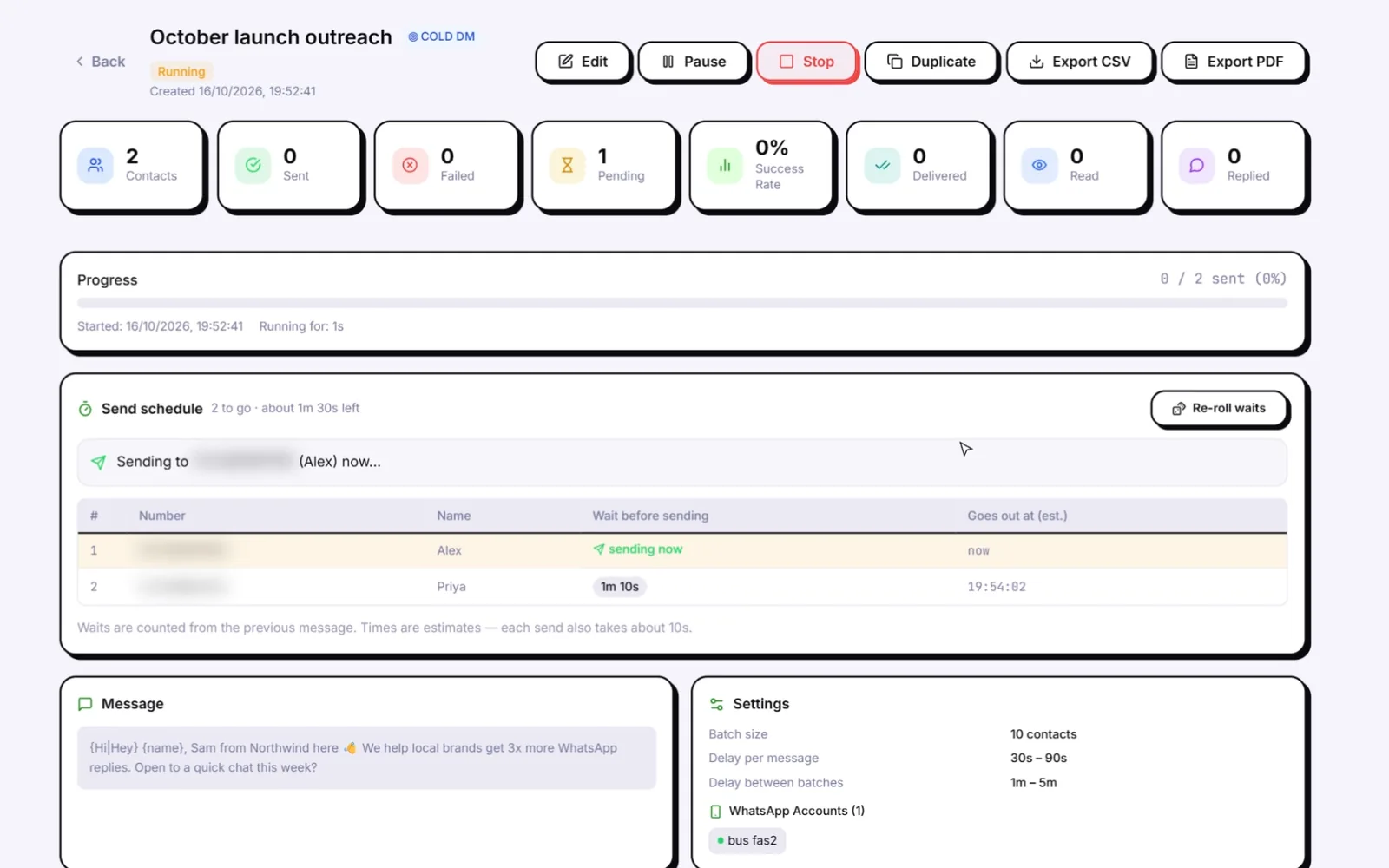
For the follow-up step, import engaged leads as a CSV, add merge fields and spintax, and send with random 30-90 second gaps in batches of 10. Follow-ups stop the moment someone replies, and replies land on a Pipeline CRM board.
It won't fix email deliverability or make a cold list warm, and no tool removes ban risk. The app is free to download; warming and sending need a licence, currently $397 one-time for lifetime access.
Run the WhatsApp half of your outreach properly
Warm new numbers, see a safe daily limit for each one and send follow-ups at a human pace from one Windows app.
Free account. Windows 10 and 11. Warming and sending need an active licence.
Frequently asked questions
Is WhatsApp better than email for cold outreach?
Neither is better everywhere. WhatsApp tends to suit markets where it is the default business channel, small businesses and warm or opted-in leads. Email suits enterprise buyers, formal B2B and anything that needs a documented thread or attachments. WhatsApp also carries a higher account risk, because numbers can be banned. The fairest test is to split one list across both channels and compare replies and meetings per 100 contacts.
What is a good cold email reply rate in 2026?
It depends on how replies are counted. 2025 benchmarks range from 0.45% at Belkins, which divides unique replies by every email sent, to 3.43% at Instantly and 4.5% at Hunter, whose sales sequences averaged 3%. Compare your results with a benchmark that uses the same method, and track positive replies and meetings rather than opens, which Apple Mail Privacy Protection inflates.
What is the open rate of WhatsApp messages?
There is no reliable figure for cold WhatsApp messages, and the widely quoted 98% has no traceable measurement behind it. The best measured benchmark, from the vendor Chatarmin, found a 72.05% median open rate across 382 brands' opt-in campaigns in 2026, counted from read receipts. Expect cold messages to strangers to do worse, and note that people with read receipts off never show as read.
Can you get banned for cold messaging on WhatsApp?
Yes. WhatsApp's Terms of Service list bulk messaging and auto-messaging as impermissible, and numbers that message strangers at volume get banned. Reddit posters describe bans at 50 messages a day and appeals that fail. Warming a new number for at least 15 days, ideally 30, sending small daily volumes at irregular gaps and messaging people who expect contact all lower the risk, but nothing removes it.
Is cold outreach on WhatsApp legal?
It depends on where your recipients are and how you got their numbers. In the EU and UK, GDPR applies to the phone numbers in your list, and electronic marketing rules differ by country and by whether the recipient is a business or an individual. WhatsApp's own Business Messaging Policy also expects opt-in. Take advice for your market. Our guide to cold WhatsApp messages and GDPR covers the basics.
Should I use email and WhatsApp together for outreach?
Often, yes. A common pattern is to open with email, then follow up on WhatsApp only with leads who engaged, for example by replying, clicking or visiting your site, and whose numbers you hold. In WhatsApp-first markets, reverse it: start the conversation on WhatsApp, then move proposals and the wider buying group to email. Stop every sequence as soon as someone replies.