Best cold outreach channel 2026: email, LinkedIn, WhatsApp, SMS and five more, scored
The best cold outreach channel? 2026 has no single winner. Email has the widest reach and suits formal B2B, LinkedIn is best for named decision makers, WhatsApp usually wins conversations in markets where it is the default app, and SMS suits opted-in customers. Cold calls fit high-value accounts, while Instagram, Telegram, Messenger and RCS each fit narrower jobs.
- No single winner: the right channel depends on the buyer, the app their market already uses and whether they know you yet.
- Email: the widest reach and the best fit for formal B2B, but it now runs under strict Gmail, Yahoo and Outlook sender rules.
- LinkedIn and calls: LinkedIn reaches named decision makers within tight limits; calls suit high-value accounts and work best next to email.
- WhatsApp: usually wins conversations where it is the default app, but numbers must be warmed first and can be banned.
- The rest: SMS, RCS and Messenger suit opted-in contacts more than cold lists; Instagram and Telegram suit audiences that already live there.
Best cold outreach channel 2026: the short verdict
No channel wins every job. Match the channel to the buyer, their market and how warm they are, then test it: public reply figures are rarely sourced, so your own replies and meetings per 100 contacts are the real benchmark.
| If you need... | Choose | Why |
|---|---|---|
| Formal B2B, enterprise buying groups, proposals | The widest reach and a thread the whole buying group can see | |
| Named decision makers by job title | Profiles show role and company; invitation limits keep volume low | |
| A meeting with a few high-value accounts | Cold calls, next to email | A live conversation when someone answers; calls lift email replies in Gong's data |
| Conversations in markets where WhatsApp is the default app | Lands in the chat list people check all day; numbers need warming | |
| Many conversations from several numbers, without the API | WhatsApp (with a warmer such as Wassuply) | Ordinary accounts with no per-message fee, each number warmed and paced |
| Reminders and offers to customers who opted in | SMS, or RCS where supported | Reaches almost any phone; consent rules make cold lists a poor fit |
| Buyers who already live on Instagram, Telegram or Messenger | That app's DMs | Go where they chat, but expect request folders and account limits |
Cold outreach channels compared: the 2026 scorecard
Figures below come from different publishers using different methods, so read each row on its own. Where nobody publishes reliable data, the cell says so. Prices, limits and rules are as of October 2026.
| Channel | Reach | Response or read data | Cost | Main rules or limits | Ban or block risk | Best for |
|---|---|---|---|---|---|---|
| 4.48 billion users (Radicati, 2024) | Replies 0.45% to 4.5%, by counting method (Belkins, Hunter, 2025 data) | Low per send; domains and mailboxes add up | Authentication, one-click unsubscribe and a spam-rate ceiling for bulk senders | Medium: spam folder or rejection; domains are replaceable | Formal B2B, enterprise, contacts with no mobile number | |
| "+1.3B" members (accounts, not active users) | 26% acceptance, 7.2% replies (Belkins, 2025, vendor data) | Sales Navigator Core from US$119.99 a month | No published invite cap (vendors say about 100 a week); automation banned | Medium: week-long restrictions; suspension for automation | Named B2B decision makers | |
| 3 billion+ monthly users; top app in 70 of 100 countries (Similarweb, Android) | No neutral cold benchmark; opt-in campaigns read at a 72% median (Chatarmin, 2026) | No per-message fee on ordinary accounts; the API charges per delivered message | Terms forbid bulk and auto-messaging; unanswered-message cap in testing | High: the number itself can be banned | WhatsApp-first markets, small businesses, warm leads, fast follow-up | |
| SMS | Almost any phone; 2.2 trillion US texts in 2024 (CTIA) | No read signal; the "98%" open rate is untraceable; opt-in clicks 12.39% (Omnisend, 2025) | US $0.0083 a segment plus carrier fees; UK $0.056 (Twilio) | US 10DLC registration, consent and Do-Not-Call rules; UK and EU consent for individuals | Medium to high: carrier filtering and blocking | Opted-in customers, reminders, offers |
| Cold calls | Any number, but 80% of US adults say they don't answer unknown callers (Pew, 2020) | Average rep connects with 5.4% of prospects (Gong); about 370 dials per meeting (Belkins) | High: rep time on every dial | US Do-Not-Call and calling hours; UK TPS and CTPS screening | Medium: business numbers can pick up spam labels | High-value accounts, paired with email |
| Instagram DMs | 3 billion monthly users (September 2025) | No published data; non-followers land in Requests | Free, but manual | No published daily DM cap; the API only answers chats the user starts | Medium: spam rules target high-frequency activity | Consumer brands, creators, visual products |
| Telegram | 1 billion monthly users (2025); first in Russia, Kazakhstan, Uzbekistan and others (Similarweb, Android) | No published data | Free, though some users charge Stars to non-contacts | No published limit for new accounts; bots can't start chats | Medium: reports limit you to people who saved your number | Markets and communities where Telegram leads |
| Messenger | 1.3 billion monthly users, a 2017 figure; 58% of UK online adults (Ofcom, 2025) | No published data | Marketing Messages are paid per delivered message | Business-started chats go to subscribers only, one marketing message a day | Low to medium: misusing message tags can restrict sending | Re-engaging people who messaged your Page |
| RCS | 1 billion+ Google Messages users with RCS on (2023); on iPhone since iOS 18 | Read receipts for senders; no independent benchmark | US rich text $0.0083 a segment plus carrier fees (Twilio) | Verified brand agent; carrier support varies by country | Little data; agent approval and carriers gate access | Branded messages to opted-in customers |
Email, LinkedIn and cold calls: how the B2B standards score
The default B2B channels, each with a ceiling: sender rules, invitation limits or unanswered calls.
Cold email
Cold email still has the widest reach and the best fit for formal B2B, but it runs under strict sender rules. Reply benchmarks for 2025 run from 0.45% at Belkins, which divides unique replies by every email sent, to 4.5% at Hunter (3% for sales sequences). Since February 2024, Gmail has required senders of more than 5,000 messages a day to authenticate, offer one-click unsubscribe and keep spam complaints below 0.10% and never reaching 0.30%; Yahoo and Outlook have similar rules.
Email's strength is the thread: Gartner puts B2B buying groups at five to 16 people, and an email can be forwarded to all of them. Its hidden cost is volume. One agency owner in a 2024 r/agency thread described 20,000 to 30,000 emails and 2,000 calls per client a month across 80 to 90 domains, adding "This typically yields 15 to 20 new business meetings." (thread; one account, not a benchmark). Deep dives: WhatsApp vs email cold outreach and why cold email doesn't work like it used to.
LinkedIn is the best channel for reaching named B2B decision makers, but volume is capped and automation is banned. It lists "+1.3B" members, which are accounts, not active users. Its User Agreement bans bots and unauthorised automated methods, and invitation restrictions typically last one week.
LinkedIn doesn't publish a weekly invitation number; automation vendors report roughly 100 a week. Free members can add a personal note to five requests a month. Belkins measured 26% acceptance and a 7.2% reply rate on 2025 data, mostly from an automation vendor's platform. In a 2024 r/agency thread, one commenter said "like 75% of sales are from LinkedIn for us" (thread). More in LinkedIn vs WhatsApp for outreach.
Cold calling
Cold calling gets a live conversation when someone answers, and most people don't: in Pew's 2020 survey, 80% of US adults said they don't generally answer unknown numbers. Gong, analysing more than 300 million calls, found the average rep connects with 5.4% of prospects, and the agency Belkins counted roughly 370 dials per booked meeting in 2025.
Calls still earn a place next to email: in Gong's data, prospects who were also called replied to email at 3.44% against 1.81%, even when the call didn't connect. US telemarketing calls to consumers must respect the Do-Not-Call Registry and the 8am to 9pm window, though the FTC says most business-to-business calls are exempt from its Do-Not-Call rules. UK B2B callers must screen against both the TPS and CTPS. More in cold calling vs WhatsApp.
WhatsApp, SMS and RCS: how the phone-number channels score
All three reach a mobile number but differ on cost, consent and the price of a mistake.
WhatsApp usually wins conversations in markets where it is the default app, and it costs the most to get wrong. It has more than 3 billion monthly users (Meta, 2025) and is the top messaging app in 70 of the 100 countries in Similarweb's Android data. Ofcom found it reached 90% of UK online adults in May 2025, while Pew puts US use at 32% of adults.
Nobody publishes a neutral cold WhatsApp benchmark. The widely quoted 98% open rate is untraceable; the best measured figure, a 72% median open rate, covers 382 brands' opt-in campaigns. WhatsApp's Terms of Service forbid bulk messaging and auto-messaging, its Business Messaging Policy expects opt-in, and it is testing a monthly cap on messages to people who haven't replied. In 2019 it said it removed over two million accounts a month for bulk or automated behaviour.
Ordinary accounts carry no per-message fee; the official Business Platform has charged per delivered message since July 2025. One r/whatsapp poster in 2024 wrote "i used to send only to 50 numbers a day however it still got banned" (thread), and in a 2025 r/b2bmarketing thread the top reply said "Whatsapp is for people I want to talk to." (thread). Deep dives: WhatsApp Business vs personal WhatsApp, WhatsApp voice notes for sales and the real WhatsApp open rate.
SMS
SMS reaches almost any phone, but cold texting is tightly regulated and every message costs money. A2P 10DLC is the US registration system for business texts sent from ordinary 10-digit numbers; Twilio has blocked all unregistered 10DLC traffic to US numbers since 1 September 2023. Its list price is $0.0083 a segment in the US plus carrier fees, and $0.056 to UK mobiles.
Under the FCC's telemarketing rule, US Do-Not-Call protections cover marketing texts, and autodialled marketing needs prior express written consent. The ICO says you must not send marketing texts to individuals without specific consent, though texts to companies are outside that rule (sole traders count as individuals). The 98% SMS open rate has no measurement behind it, even though the trade body CTIA repeated it to Congress, where it also said carriers blocked more than 55 billion spam texts in 2024. SMS suits opted-in customers, rarely cold lists. More in SMS vs WhatsApp for outreach.
RCS
RCS is the richer successor to SMS: branded senders with a verified badge, images and read receipts in the phone's default messaging app. Apple added it to iPhone with iOS 18 in September 2024, where carriers support it. Google says more than a billion RCS messages are sent daily in the US, though T-Mobile says that covers only Google's own Jibe traffic.
Business RCS needs an approved brand agent and carrier support, which varies by country. Claims of "1.5 billion RCS users" are untraceable. Treat consent as you would for SMS. More in RCS vs WhatsApp.
Instagram DMs, Telegram and Messenger: how the social inboxes score
Huge audiences, but each keeps strangers at arm's length and none publishes cold-outreach data.
Instagram DMs
Instagram DMs suit consumer brands, creators and visual businesses whose buyers already spend time there. Instagram passed 3 billion monthly users in September 2025, and Pew found half of US adults use it. Messages from people who don't follow you land in the Requests folder.
Meta publishes no daily DM limit for the app; the "safe limits" quoted online are vendor guesses, and its spam policy targets very high-frequency activity. Meta's messaging API only opens a 24-hour window after the person acts first, so cold DMs are manual work. In a 2025 r/LeadGeneration thread, a 3D artist said a friend got a good response cold-DMing brands on Instagram while their own cold emails got none (thread). More in Instagram DM vs WhatsApp.
Telegram
Telegram is worth testing only where your buyers already use it. It passed 1 billion monthly users in 2025, and Similarweb's 2025 Android data puts it first in Belarus, Kazakhstan, Moldova, Russia and Uzbekistan, among others. In the UK it reached just 9% of online adults in May 2025 (Ofcom).
Its Terms of Service ban spam, and its spam FAQ says that when reports are upheld, an account can be limited to messaging people who saved its number, usually for a few days on a first offence. Telegram publishes no daily limit for new accounts, bots can't start conversations, and since March 2025 users can charge Stars for messages from non-contacts. More in Telegram vs WhatsApp Business.
Facebook Messenger
Messenger is for re-engaging people who already messaged your Page, not for cold contact. Meta's last official count, 1.3 billion monthly users, dates from September 2017. Ofcom found Messenger reached 58% of UK online adults in May 2025, with its audience down 7% in a year.
Meta retired Sponsored Messages in 2024. Their replacement, Marketing Messages, is paid per delivered message and reaches subscribers only: people who replied to a click-to-Messenger ad, were matched from your CRM list or accepted an opt-in. A Page can send each person one marketing message a day, in 20 markets. More in Messenger vs WhatsApp Business.
How to build a multichannel cold outreach sequence
Run two or three channels on the same list rather than betting on one. No neutral study shows the best mix, but Gong's call data shows a second channel helps. An illustrative B2B sequence that keeps the riskier channels for people who engaged:
- 1Pick a lead channel per segmentUse the verdict table: email for enterprise, LinkedIn for named roles, WhatsApp where it is the default.
- 2Collect the data and a lawful basisWork email, LinkedIn URL and mobile number. Record each contact's source, and screen numbers against Do-Not-Call or TPS lists before calling.
- 3Day 1: a light first touchA LinkedIn connection request with no pitch.
- 4Day 2: a short plain-text emailOne reason, one question, open tracking off. Hunter saw 4.4% replies with tracking against 7.4% without.
- 5Days 4 to 6: call or WhatsApp the engagedCall high-value accounts. Send a short WhatsApp text only to engaged leads, or in WhatsApp-first markets, from warmed numbers. Keep voice notes for after a reply.
- 6Stop on reply, then measureMove the conversation to one channel, compare replies and meetings per 100 contacts monthly, and cut what doesn't pay.
In WhatsApp-first markets, flip the order: open on WhatsApp with warm or opted-in leads, then move proposals to email. Our multichannel outreach guide has more sequences.
How to start WhatsApp outreach safely
If the scorecard points you to WhatsApp, start slowly. Volume on day one is the classic way to lose a new number.
- 1Create a free accountSign up free and download the Windows app. Connecting numbers, warming and sending need an active licence.
- 2Warm each new number for at least 15 days30 days is better. Your numbers chat with each other at random gaps inside the hours you set; see how the WhatsApp warmer works.
- 3Start small, with people who expect youStay inside each number's safe daily limit, vary every message and honour opt-outs. Check the rules for your market in our guide to cold WhatsApp and GDPR.
- 4Stop on reply and watch the risk scoreLet follow-ups end the moment someone answers, and turn on Smart Send so sending slows when a number's risk rises. More in our guide to avoiding WhatsApp bans.
Where Wassuply fits in a multichannel stack
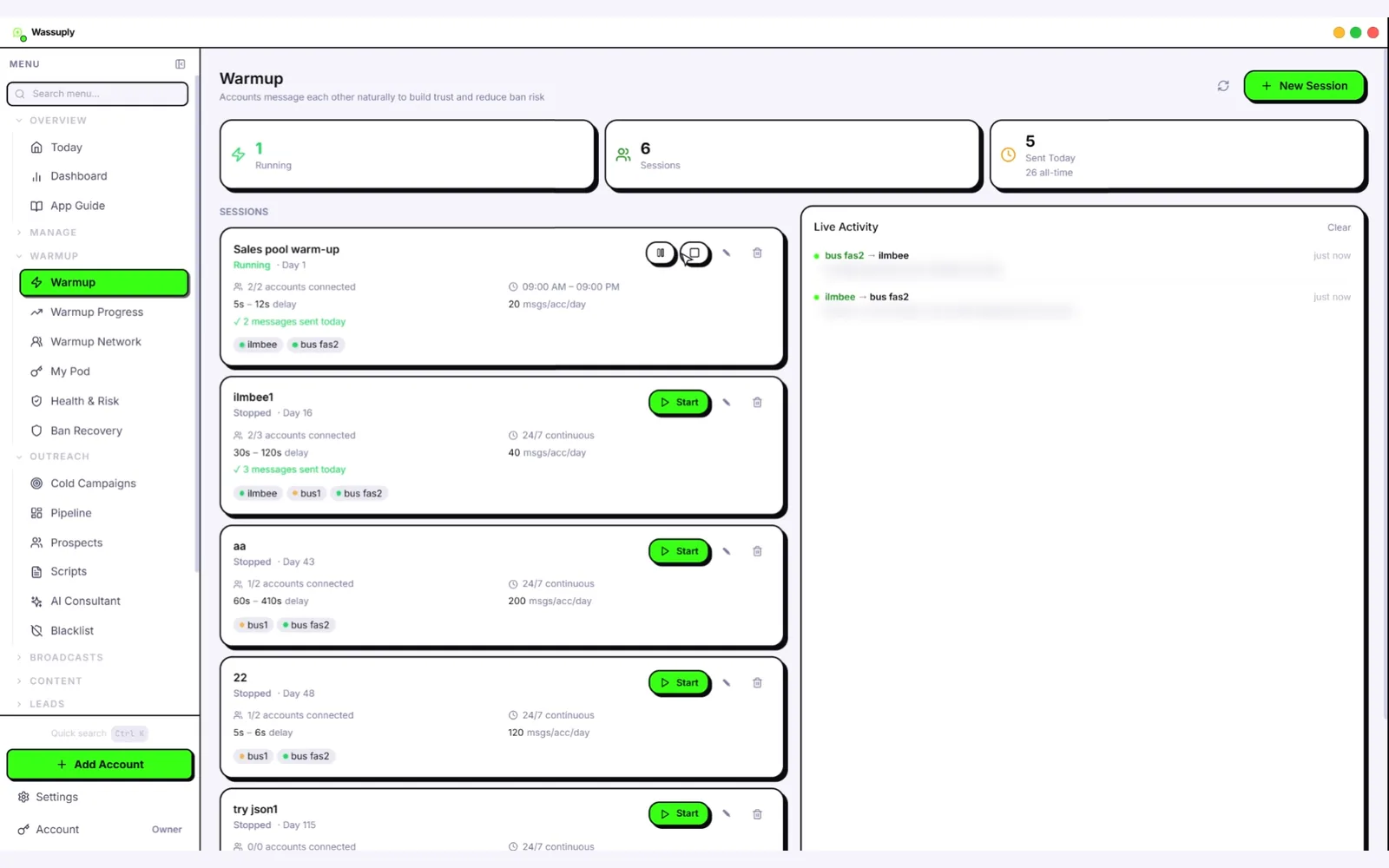
Wassuply covers the WhatsApp row of this scorecard and nothing else: it won't send email, connect on LinkedIn or place calls. Wassuply is a Windows desktop app for warming up WhatsApp numbers and running cold WhatsApp outreach from unlimited numbers, sold as a one-time $397 lifetime licence during early access.
It drives ordinary WhatsApp and WhatsApp Business accounts through WhatsApp Web sessions, so there is no Business API, template approval or per-message fee, and each number gets its own isolated session, browser fingerprint and optional proxy. What matters for a multichannel setup:
- Warm-up: numbers chat with each other from 10 built-in chat packs at random 30-120 second gaps inside your hours, or join Warm-up Pods with other users' numbers.
- Pacing: Health & Risk sets a safe daily limit of 30 to 250 messages per number by age and shows a live 0-100 risk score; with Smart Send on, sending slows at 60 and pauses at 80.
- The WhatsApp step: import engaged leads as a CSV, personalise with merge fields, spintax or AI first messages from your own Claude, ChatGPT or DeepSeek key; follow-ups stop the moment a contact replies.
No tool removes ban risk or makes a cold list warm. The download and account are free; warming and sending need a licence (see pricing).
Add WhatsApp to your outreach mix the careful way
Warm new numbers, see a safe daily limit for each one and run WhatsApp follow-ups next to your email and LinkedIn sequences from one Windows app.
Free account. Windows 10 and 11. Warming and sending need an active licence.
Frequently asked questions
What is the best cold outreach channel in 2026?
There is no single best channel. Email has the widest reach and suits formal B2B, LinkedIn suits named decision makers, and WhatsApp usually wins conversations in markets where it is the default app, provided the numbers are warmed. Cold calls fit high-value accounts. SMS, RCS and Messenger suit opted-in contacts more than cold lists. Test two channels on one list and compare replies and meetings per 100 contacts.
Which outreach channel has the highest response rate?
No study compares channels like for like, and each publisher counts differently. Cold email averages 0.45% to 4.5% depending on method (Belkins, Hunter), Belkins measured a 7.2% LinkedIn reply rate, and Gong says the average rep connects with 5.4% of prospects by phone. WhatsApp, Instagram, Telegram and RCS have no neutral cold benchmark, so measure your own.
Is cold email still worth it in 2026?
Yes, for many B2B teams, but it needs more care. Gmail, Yahoo and Outlook enforce authentication, one-click unsubscribe and spam-rate limits for bulk senders, and open rates are unreliable. 2025 reply benchmarks run from 0.45% to 4.5% depending on how replies are counted. Keep volume low per mailbox, switch off open tracking and pair email with a second channel such as calls or LinkedIn.
Can you do cold outreach on WhatsApp without getting banned?
Nothing removes the risk. WhatsApp's Terms of Service forbid bulk messaging and auto-messaging, and new numbers that message strangers get banned, sometimes at low volumes. You can lower the risk: warm each new number for at least 15 days (30 is better), stay under a safe daily limit, vary messages, send at irregular gaps and message people who are likely to expect contact. Our guide to avoiding WhatsApp bans covers the details.
Is SMS or WhatsApp better for cold outreach?
Neither suits strangers well, but they fail in different ways. SMS needs 10DLC registration in the US, costs per message and generally needs consent for marketing texts to individuals in the US, UK and EU, so it fits opted-in customers. WhatsApp has no per-message fee on ordinary accounts and suits markets where it is the default app, but numbers can be banned. Our SMS vs WhatsApp comparison covers costs and rules.
How many channels should a cold outreach sequence use?
No neutral study sets an ideal number. The clearest evidence that a second channel helps comes from Gong: prospects who were also cold called replied to email at 3.44% against 1.81%, even when the call didn't connect. A practical start is two channels: the one your buyers use most, plus one where you hold valid contact data. Stop every channel the moment someone replies.
Sources
- The Radicati Group: Email Statistics Report, 2024-2028, Executive Summary (October 2024, archived copy)
- Belkins: Cold email response rates study (June 2026)
- Hunter: The State of Cold Email, 2026 edition (2026)
- Google Workspace Admin Help: Email sender guidelines (checked October 2026)
- Gartner: 74% of B2B buyer teams demonstrate unhealthy conflict (May 2025)
- LinkedIn Newsroom: About LinkedIn (checked October 2026)
- LinkedIn: User Agreement (effective November 2025)
- LinkedIn Help: Types of restrictions for sending invitations (checked October 2026)
- LinkedIn Help: Invitation limit reached (checked October 2026)
- Hublead: LinkedIn Invitation Limit 2026 (2026)
- LinkedIn Sales Solutions: Compare plans and pricing (October 2026)
- Belkins: LinkedIn outreach study (June 2026)
- Pew Research Center: Most Americans don't answer cellphone calls from unknown numbers (December 2020)
- Gong Labs: The hidden power of cold calling, insights from 300M calls (July 2024)
- Belkins: Cold calling benchmarks (June 2026)
- Cornell LII: 47 CFR 64.1200, delivery restrictions (amended August 2025)
- FTC: Q&A for telemarketers and sellers about DNC provisions in the TSR (updated 2026)
- ICO: Business-to-business marketing (checked October 2026)
- TechCrunch: WhatsApp now has more than 3 billion users a month (May 2025)
- Similarweb: Most Popular Messaging Apps in 2025 (2025)
- Ofcom: Online Nation 2025 (December 2025)
- Pew Research Center: Americans' Social Media Use 2025 (November 2025)
- Chatarmin: WhatsApp Open Rate Benchmark 2026 (September 2026)
- WhatsApp: Terms of Service (checked October 2026)
- WhatsApp: Business Messaging Policy (September 2026)
- TechCrunch: WhatsApp will curb the number of messages people and businesses can send without a response (October 2025)
- WhatsApp: Stopping Abuse, How WhatsApp Fights Bulk Messaging and Automated Behavior (February 2019, mirrored copy)
- Meta for Developers: Pricing on the WhatsApp Business Platform (checked October 2026)
- Twilio Changelog: Full blocking of unregistered US A2P 10DLC traffic (September 2023)
- Twilio: SMS pricing, United States (October 2026)
- Twilio: SMS pricing, United Kingdom (October 2026)
- ICO: Electronic mail marketing, Guide to PECR (checked October 2026)
- CTIA: Testimony of Sarah Leggin to the House Energy and Commerce Committee (June 2025)
- CTIA: 2025 Annual Survey Highlights (September 2025)
- Omnisend: SMS marketing benchmarks (June 2026)
- Apple Newsroom: iOS 18 is available today (September 2024)
- Google: New features to celebrate Messages' 1 billion RCS users (November 2023)
- Google: A billion RCS messages are sent every day in the U.S. (May 2025)
- Android Authority: T-Mobile responds to Google's RCS figure (2025)
- Google for Developers: RCS for Business overview (checked October 2026)
- TechCrunch: Instagram now has 3 billion monthly active users (September 2025)
- Meta for Developers: Instagram Messaging overview (checked October 2026)
- Meta for Developers: Messenger Platform and IG Messaging API policy (checked October 2026)
- Meta Transparency Center: Spam policy (June 2024)
- Telegram: Press info (2025)
- Telegram: Terms of Service (checked October 2026)
- Telegram: Spam FAQ (checked October 2026)
- Telegram blog: Star Messages, Pinned Gifts, Verification Platform 2.0 (March 2025)
- VentureBeat: Facebook Messenger passes 1.3 billion monthly active users (September 2017)
- Meta for Developers: Marketing API v20.0 changelog (2024)
- Meta for Developers: Marketing Messages on Messenger FAQ (checked October 2026)
Sources checked October 2026. Vendor figures are labelled as such in the text.