How to get clients in 2027: a practical forecast for owners, agencies and freelancers
How to get clients in 2027 comes down to being chosen before the first conversation. Buyers now research, ask peers and ask AI tools before they contact anyone, while inbox filters tighten and social ad prices climb. This is a practical forecast for business owners, agencies and freelancers: what the data says, what to keep, fix or drop, and a 90-day plan you can start this week.
- Be known before they search: B2B buyers increasingly shortlist vendors on their own, often with AI tools, before speaking to anyone. Content, reviews and peer mentions decide who makes the list.
- Ask for referrals on purpose: referred clients tend to be better clients, but referrals arrive unevenly, so build a routine for asking.
- Reach out on a signal: outreach still works when something real triggers it. Generic volume email is the tactic most likely to fade in 2027.
- Use conversational channels with care: WhatsApp is where many buyers already talk, but it needs warmed numbers, slow pacing, a lawful basis and a message clearly about them.
- Reply fast: answer within minutes, in the channel the buyer chose. It is the cheapest advantage you can build.
How to get clients in 2027: what is changing?
Getting clients in 2027 will reward the businesses that buyers already know, trust and can reach quickly. The buyer does more of the work alone, with search, peers and AI tools, and contacts a seller later, with a shortlist already in mind. Cold volume and paid reach still exist, but each now costs more for less.
This post covers client acquisition in 2027 as a whole: content, referrals, outreach, ads and messaging. If you only care about outbound, read the companion piece, cold outbound in 2027: what's changing and what will work. This one is broader, and where there is no good number, we say so.
Seven forces shape what works in 2027 marketing and sales:
- Buyers want fewer conversations with sales reps.
- Buyers pick a favourite vendor before first contact.
- AI agents are starting to sit between buyers and sellers.
- Buying groups are large and varied.
- Email filtering is stricter, and many senders report falling replies.
- Paid social keeps getting pricier, while search lead costs have levelled off.
- Business messaging keeps growing.
Why do buyers choose a vendor before they contact you?
Buyers choose early because they can: research, peer advice and AI answers are all available before any sales call. Gartner's survey of 645 B2B buyers, published in May 2026, found that 67% prefer a rep-free experience and 45% had used GenAI during a recent purchase (Gartner, May 2026). The previous year's survey, a different sample, put the rep-free preference at 61% (Gartner, June 2025).
The shortlist forms early too. In 6sense's 2025 Buyer Experience Report, which covered more than 4,000 buyers, 94% of buying groups had already ranked their preferred vendor before first contact with sellers, and that early favourite won 77% of the time (6sense via Business Wire). A SurveyMonkey and Reddit survey of 1,202 US decision-makers found 83% research before speaking to sales, and 73% trust peer insights more than vendor websites or search engines (SurveyMonkey, March 2026). Reddit sponsored that study, so weigh it accordingly.
Reps still matter, just later. The same Gartner survey found 69% of B2B buyers prefer to validate AI-generated insights with sales reps (Gartner, May 2026). The seller's job moves from introducing to confirming, so first contact works best when the buyer already knows your name.
AI agents and crowded buying groups
Gartner predicts that by 2028, 90% of B2B buying will be intermediated by AI agents, pushing over $15 trillion of B2B spend through AI agent exchanges (Gartner, October 2025). It's a forecast, but the direction is clear: more of the research will be done by software that reads what is published about you.
Buying groups are big and varied. Gartner says they are more diverse than ever, ranging from five to 16 people across as many as four functions (Gartner, May 2025). Forrester's 2026 State of Business Buying counts 13 internal stakeholders and nine external influencers in a typical decision, and says GenAI search is now the buyer's starting point (Forrester, January 2026). The studies count differently, so don't compare the numbers directly, but both point the same way: you have to be credible to more people, most of whom you will never meet.
Is cold email still a good way to find clients in 2027?
Cold email can still find clients in 2027, but it is harder and less forgiving than it was. Since February 2024, Gmail and Yahoo have required bulk senders to authenticate their mail, offer one-click unsubscribe and keep spam complaints low. Google sets a target below 0.1% and a line of 0.3% never to cross, and from November 2025 began ramping up enforcement, including rejecting non-compliant mail (Google; Gmail sender guidelines; Gmail FAQ; Yahoo). Since 5 May 2025, Outlook.com has rejected mail from domains sending more than 5,000 emails a day that fail SPF, DKIM and DMARC checks (Microsoft).
How many replies cold email gets depends on who is counting. Published averages for 2025 range from 0.45% (Belkins, unique replies against all emails sent) through 3.43% (Instantly's platform average) to 4.5% (Hunter's average sequence reply rate), because each company measures differently (Belkins; Instantly; Hunter). All three sell outbound tools or services. Instantly also found 58% of replies come from the first email. No traceable source measures an industry-wide decline consistently across years, so we won't claim one.
What practitioners do report is individual campaigns collapsing. In a 2025 r/coldemail thread, one poster saw replies fall from about 2% to 0.8% even after new copy, lower volume and two freshly warmed domains (r/coldemail, 2025). One reply put it bluntly: "19% opens but 0.8% replies sounds like deliverability theater". That is one account, not proof. For the full picture, read why cold email doesn't work like it used to.
Relevance is the other filter. In Gartner's 2025 survey of 632 buyers, 73% said they actively avoid suppliers who send irrelevant outreach (Gartner, June 2025).
Are ads getting too expensive to get clients?
Paid social is getting more expensive, but not every ad channel is. Meta's own earnings releases show its average price per ad rose 9% across 2025 and 12% year over year in Q2 2026, the latest quarter reported at the time of writing (Meta, Q4 2025; Meta, Q2 2026). Triple Whale's data from over 40,000 brands puts the median Meta CPM at $15.06 for August 2025 to July 2026, up 13.24% (Triple Whale). WordStream's 2025 Facebook benchmarks put the average cost per lead for lead campaigns at $27.66, up 20.94% (WordStream).
Search tells a different story. LocaliQ's 2026 search benchmarks show the average cost per click still rising, to $5.42, but the average cost per lead at $66.69, and LocaliQ says cost per lead fell overall for the first time in five years (LocaliQ, 2026). The honest summary: clicks keep getting pricier, search lead costs have levelled off, and social reach costs more each year.
Ads still work as an amplifier, but they are an expensive way to be your only source of clients. Our guide on how to get clients without ads covers what to build underneath them.
Why are messaging apps becoming a client acquisition channel?
Messaging apps are becoming a client channel because that is where buyers already talk, and businesses are following them there. WhatsApp alone has more than 3 billion monthly users (TechCrunch, 2025), and Meta says about a billion people message a business each week across its messaging apps (Meta, 2023).
The money points the same way. Meta's CFO said revenue from click-to-WhatsApp ads grew 60% year over year in Q3 2025 (Q3 2025 call transcript), and paid messaging on WhatsApp passed a $2 billion annual run rate in Q4 2025 (Q4 2025 call transcript). Juniper Research forecasts global OTT business messaging revenue rising from $3.6 billion in 2025 to $9.8 billion in 2029 (Juniper Research).
Two cautions. Most of that growth is opt-in and ad-driven messaging, not cold outreach. And WhatsApp is testing a monthly cap on messages sent to people who haven't replied, without saying what the limit will be (TechCrunch, October 2025), while its responsible-use guidance asks people not to bulk message or auto-message. Messaging rewards relevance and punishes volume.
What will work to get clients in 2027?
The best way to get clients in 2027 is to combine five habits: be findable before the buyer searches, earn referrals on purpose, reach out only on a signal, use conversational channels like WhatsApp carefully, and reply fast.
1. Be known before the buyer searches
If buyers shortlist before contact, your content has to reach them during research. That means pages that answer the exact questions your buyers type, honest price ranges, specific proof of past work, and being mentioned where peers talk. Answer engines read your site too, so write plainly, answer first and keep facts current.
2. Referrals and your network
Referred clients tend to be better clients. A peer-reviewed study of about 10,000 bank customers found a referred customer's value was at least 16% higher than a comparable non-referred customer's (Schmitt, Skiera and Van den Bulte, 2011). That is consumer banking, so read it as direction rather than a B2B benchmark.
In Hinge's 2015 survey of 523 professional services firms, 81.5% received referrals from people they had never worked with, yet 51.9% of referred prospects ruled a provider out before talking to it (Hinge Marketing). The referral opens the door; your public reputation decides whether they walk through.
Agency owners on Reddit describe the same thing. In a 2025 r/agency thread, one poster said their last six leads were all referrals, four direct and two warm intros, which they got by meeting business owners and asking at the end (r/agency, 2025).
3. Signal-based outreach
Outreach in 2027 should start from a reason: a new hire, a funding round, a new location, a job post, a review they left. A signal gives you something relevant to say, which answers Gartner's finding that buyers avoid irrelevant outreach. Our guide to signal-based selling lists the signals worth tracking, and GTM engineers and WhatsApp shows how to turn a signal list into messages.
4. Conversational channels like WhatsApp, done carefully
In countries where WhatsApp is the default messenger, a short, relevant message can start a conversation that email never would. Similarweb's Android data has WhatsApp as the top messaging app in 70 of the 100 countries it examined (Similarweb). Cold WhatsApp only works with warmed numbers, slow pacing, a list you have a lawful basis to contact and a message that is obviously about the recipient.
In a 2025 r/b2bmarketing thread asking whether WhatsApp could replace email newsletters, the top reply said they would be annoyed and block any attempt: "Whatsapp is for people I want to talk to" (r/b2bmarketing, 2025). Check whether bulk WhatsApp is legal where you sell before you start.
5. Speed to reply
When a buyer does reach out, speed is the cheapest edge you can build. The best-known evidence is old: a 2011 Harvard Business Review study of 1.25 million inbound sales leads found firms that tried to contact a lead within an hour were nearly seven times as likely to qualify it as firms that waited even an hour longer (HBR, 2011). That data dates from the late 2000s and covers inbound web leads, not cold outreach, so read it as direction. The practical rule: answer in the channel the buyer chose, within minutes during working hours.
Speed is not a licence to chase. In a 2024 r/whatsapp thread, a poster messaged Meta lead-form leads through the WhatsApp API minutes after they signed up; most replied, yet the number was banned for spam (r/whatsapp, 2024). A commenter's lesson: stop following up with leads who go quiet.
What stops working in 2027, and what should you keep, fix or drop?
Three habits stop paying in 2027: generic volume email, interruption ads as your only lead source, and unpersonalised automation.
- Generic volume email. Filters are stricter, replies are scarce and buyers avoid irrelevant suppliers. More of the same message makes each send worth less.
- Interruption ads alone. Ads still create demand, but an ad with no content, reviews or referrals behind it buys attention you can't keep.
- Unpersonalised automation. Gartner expects AI agents to outnumber sellers 10 to 1 by 2028, with fewer than 40% of sellers saying the agents improved their productivity (Gartner, July 2026). When everyone can automate, generic automated messages stop being an edge.
Here is how a typical 2026 plan changes for 2027.
| 2026 tactic | 2027 verdict | What to do instead |
|---|---|---|
| Referrals whenever they happen | Keep, and formalise | Ask at set moments: after a result, at project end, at renewal |
| Networking and peer communities | Keep | Show up where your buyers ask each other for advice |
| Blog posts written around keywords | Fix | Answer-first pages that buyers and AI answer engines can quote, with specific proof |
| Cold email at volume from many domains | Fix | Small, signal-triggered lists, with the first email doing most of the work |
| Paid ads as the main lead source | Fix | Retarget people who already know you; build content and referrals underneath |
| WhatsApp only for existing customers | Fix | Add warmed, paced, relevant outreach where WhatsApp is the default messenger and you have a lawful basis |
| Generic templates on email and LinkedIn | Drop | One relevant line about their situation, or don't send |
| Follow-ups that ignore replies | Drop | Sequences that stop the moment someone replies |
| Answering inbound leads the next day | Drop | Reply within minutes, in the channel the buyer used |
A 90-day plan for client acquisition in 2027
This plan turns the forecast into a schedule you can start now, so you enter 2027 with channels already warm. Several steps overlap.
- 1Days 1 to 14: pick one buyer, one offer, five signalsWrite down who you serve best and the events that make them need you now: a hire, an expansion, a launch, a bad review, a new regulation.
- 2Days 1 to 30: fix what buyers see firstRewrite your top pages answer-first, add price ranges and specific proof, and ask three happy clients for a review or a result you can quote.
- 3Days 1 to 30: warm your channelsCheck email authentication on every sending domain. If you will use WhatsApp, start warming new numbers now: at least 15 days before a first campaign, 30 recommended.
- 4Days 15 to 45: run a referral sprintList every past client and warm contact. Ask each a specific question, such as who they know who is opening a second location this year.
- 5Days 30 to 60: start signal-based outreachSmall batches, each triggered by a signal, each with one relevant first line. Keep daily volume low on every channel.
- 6Days 30 to 90: set a reply standardRoute every reply, from every channel, to one place, and answer within minutes during working hours.
- 7Days 60 to 90: review and cutKeep the channels that produce conversations with the right buyers and drop the rest. Turn the questions prospects ask into new answer-first pages.
Where does Wassuply fit in a 2027 client acquisition plan?
Wassuply covers the WhatsApp part of this plan. It is a Windows 10 and 11 desktop app that warms up WhatsApp numbers and runs paced cold outreach from many of them, using normal WhatsApp and WhatsApp Business accounts through WhatsApp Web sessions, with no Business API or template approval.
For step 3, your numbers chat with each other using lines from built-in chat packs, at random gaps inside the hours you set. Health & Risk gives each number a safe daily limit (30 to 250 a day, by number age) and a live 0 to 100 ban-risk score. Smart Send Protection is opt-in: turn it on and sending slows at 60 and pauses at 80.
For steps 5 and 6, you import a CSV (phone, name, custom1, custom2), add AI-personalised first lines with your own Claude, ChatGPT or DeepSeek API key, and send with random gaps and a daily cap per number. Follow-ups stop when someone replies, and replies land on a Pipeline board.
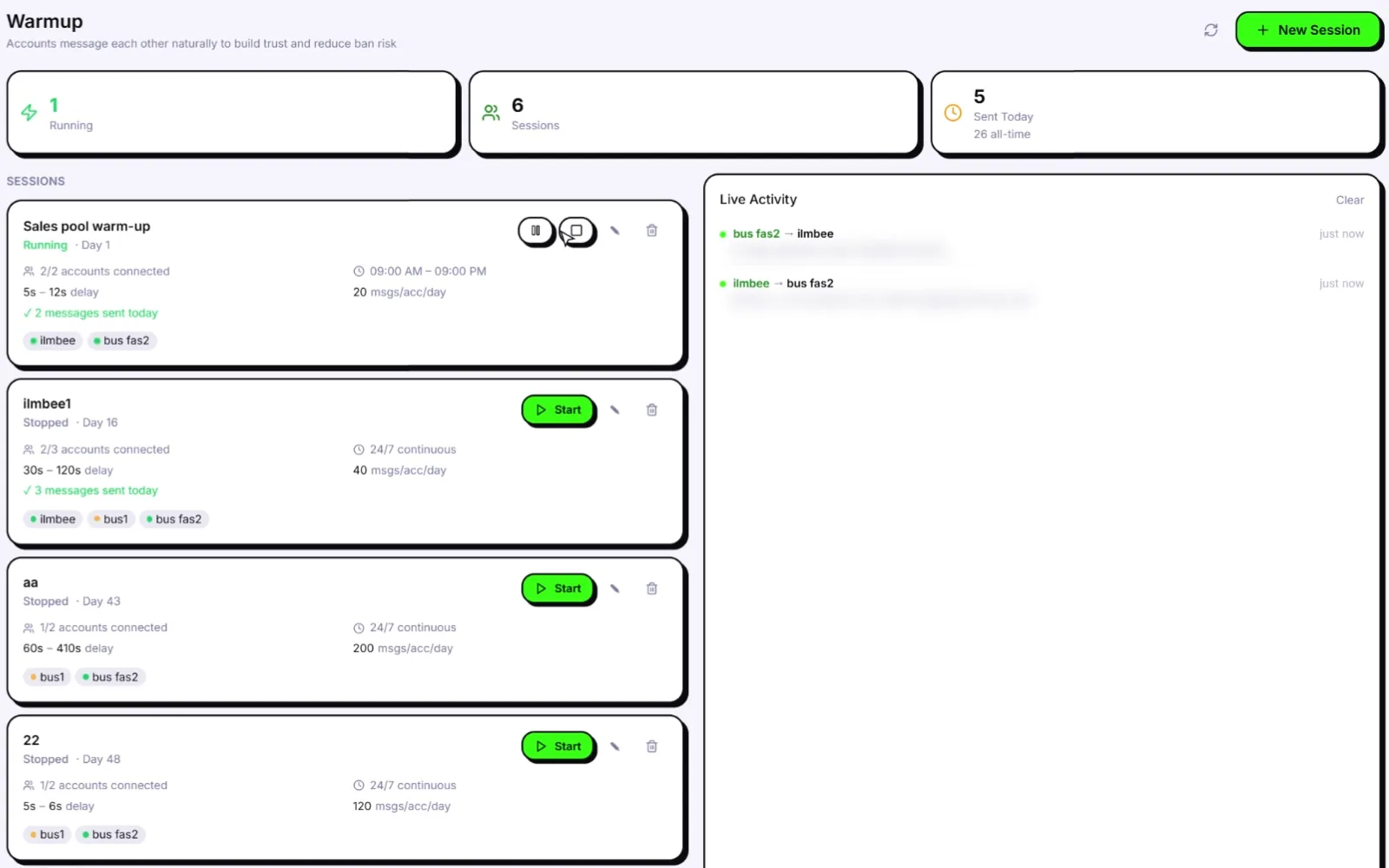
It won't make cold outreach risk-free or fix a weak offer. The download is free; warming and sending need a licence, currently $397 one-time on early-bird lifetime pricing. New to this? Read how a WhatsApp warmer works first.
Get WhatsApp ready for your 2027 client plan
Start warming your numbers now so they are ready when your signal-based outreach begins.
Free account. Windows 10 and 11. Warming and sending need an active licence.
Frequently asked questions
What is the best way to get clients in 2027?
The best way to get clients in 2027 is a mix rather than one channel: be findable when buyers research, ask for referrals on purpose, reach out only when there is a clear signal, use conversational channels like WhatsApp with care, and reply within minutes. Buyers increasingly shortlist vendors before contacting anyone, so being known early matters more than sending more messages.
Will cold email still work in 2027?
Yes for some teams, but expect stricter filtering and modest replies. Gmail, Yahoo and Outlook require authentication and low spam rates from bulk senders, and published 2025 reply-rate averages run from 0.45% (Belkins) to 4.5% (Hunter), depending on how replies are counted. In 2027 cold email works best as small, signal-triggered sends with a relevant first line, alongside other channels, not as a volume game.
How do I find clients in 2027 without paid ads?
Start with people who already know you: past clients, partners and your wider network, and ask each for a specific introduction. Then publish answer-first content that shows up while buyers research, and run small signal-based outreach by email or WhatsApp. Paid social prices keep rising, so ads work better as an amplifier on top of these than as your only source of leads.
Are referrals still the best source of clients?
Referrals are still one of the strongest sources because trust arrives with the introduction. A study of bank customers found referred customers were worth at least 16% more. The catch is consistency: referrals arrive unevenly, so pair them with a channel you control, such as content or outreach, and ask for them at set moments.
Is WhatsApp good for getting clients?
WhatsApp can work well for getting clients in countries where it is the default messenger, because people read and answer it like a personal chat. That is also the risk: irrelevant messages get blocked or reported, and WhatsApp bans numbers that behave like spam. Use warmed numbers, slow pacing, a lawful basis to contact each person and a message that is clearly about them.
How will AI change client acquisition in 2027?
AI will do more of the buyer's research. Gartner reports that 45% of B2B buyers used generative AI during a recent purchase. For sellers, clear and factual public content matters more, because AI tools read it. Generic AI-written outreach matters less, because everyone can produce it, so specific relevance becomes the thing that gets replies.