GTM engineers and WhatsApp: the missing channel in the GTM engineer stack
A GTM engineer builds the automated systems that find, enrich and contact buyers, usually with Clay, a CRM and a sequencing tool. The job data and public write-ups on GTM engineering centre on email and LinkedIn. This post explains the role and the stack, then makes an honest case for WhatsApp as the conversational channel most stacks leave out, with a step-by-step playbook and guardrails.
- What a GTM engineer is: someone who builds automated revenue systems with data enrichment, AI and workflow tools. Clay says it coined the title in 2023.
- The typical stack: Clay for enrichment and orchestration, a CRM such as HubSpot or Salesforce, a sequencer such as Outreach or Apollo, and automation in Zapier or n8n.
- The gap: the job-posting analysis and Clay's own guide to the role don't mention WhatsApp at all. There is no data showing GTM engineers adopting it yet.
- The case for it: cold email replies are hard to win and Gmail, Yahoo and Outlook rules are stricter, while WhatsApp is the default messenger in much of the world.
- How it fits: export a signal list from Clay as a CSV, personalise the first line, send from warmed numbers at a slow pace and route replies into your pipeline.
What is a GTM engineer?
A GTM engineer is a technical operator who builds the automated systems a company uses to find, qualify and contact buyers. Clay says it coined the role in 2023, and describes it as building revenue systems with AI, data enrichment and workflow automation (Clay, April 2026). In practice, a GTM engineer turns a go-to-market idea, such as reaching every company that just opened a second office, into a working pipeline of data, logic and messages.
Bloomberry's analysis of about 1,000 GTM engineering job postings found the most common responsibilities were building and automating GTM workflows, integrating GTM tools and owning the CRM (Bloomberry). Compared with RevOps roles, GTM engineering postings put more weight on outbound and prospecting. SQL and Python each appeared in 38% of them.
How many GTM engineer jobs are there?
It depends who is counting, and each source counts something different:
- Clay says about 100 GTM engineer listings go live each month (Clay), and that 400+ were posted in spring 2025 at a $160K median salary (Clay). These are Clay's own figures, and Clay sells the role's best-known tool.
- Bloomberry found new jobs up 205% year over year for January to September 2025, but that count combines GTM engineer and RevOps postings. Its $127,500 median salary uses only postings with public pay ranges (Bloomberry).
- Kyle Poyar, using Sumble's job-post data, found just 45 GTM engineer posts in one month and 128 over three months in mid-2025 (Growth Unhinged).
The fair reading: GTM engineering is a real job title, growing from a small base. Be wary of anyone who says GTM engineer jobs tripled without saying what was counted.
What does a GTM engineer stack look like?
A typical GTM engineer stack has five layers: data and enrichment, signals, sequencing, CRM, and the automation that connects them. In Bloomberry's posting data, the GTM engineer tools named most often were HubSpot (52%), Outreach (49%), Salesforce (45%), Zapier (39%), Apollo (29%), n8n (28%), Gong (23%) and Looker (17%). Clay was the most popular tool overall, though Bloomberry gives no percentage for it (Bloomberry).
Clay's own guide describes Clay as the orchestration layer for sourcing, enrichment and AI messaging, and gives signal examples such as website visits, hiring patterns, trial activation milestones and support ticket spikes (Clay). The flow is roughly this: a signal fires, the record is enriched, a rule decides whether the account is worth contacting, and a sequencer sends. For the wider tool set around this, see our outbound sales stack for 2026.
Why is GTM engineering built around email and LinkedIn?
GTM engineering leans on email and LinkedIn because most of the outbound tools it connects were built around those channels, and the role grew up inside software companies. Clay's own examples of companies hiring GTM engineers include Cursor, Lovable and Webflow (Clay).
The sources reflect that bias. Neither Bloomberry's posting analysis nor Clay's guide to GTM engineering mentions WhatsApp or SMS, and in Bloomberry's data, cold calling appears in only about 1.4% of postings (Bloomberry).
Is email getting harder for GTM engineers?
Yes, mainly because mailbox providers raised the bar. Since February 2024, Gmail and Yahoo have required bulk senders to authenticate their mail, offer one-click unsubscribe and keep spam complaints low. Google sets a target below 0.1% and a line of 0.3% never to cross, and from November 2025 began ramping up enforcement, including rejecting non-compliant mail (Google; Gmail sender guidelines; Gmail FAQ; Yahoo). Since 5 May 2025, Outlook.com has rejected mail from domains sending more than 5,000 emails a day that fail SPF, DKIM and DMARC checks (Microsoft).
Reply rates are harder to pin down. Published cold email averages for 2025 range from 0.45% (Belkins, unique replies against all emails sent) through 3.43% (Instantly's platform average) to 4.5% (Hunter's average sequence reply rate), because each company measures differently (Belkins; Instantly; Hunter). All three sell outbound tools or services. Instantly also found 58% of replies come from the first email. We found no traceable source showing an industry-wide decline measured the same way across years, so we won't claim one.
What practitioners do report is campaigns collapsing even with clean setups. In a 2024 r/coldemail thread, a poster with records set, no blacklists, gradual warm-up and at most 20 emails per mailbox a day saw their reply rate drop from 3% to under 0.5% in a single week, with the same copy (r/coldemail, 2024). In a 2025 thread, a months-old personalised campaign fell from 1.5-2% replies per step to 0.1% (r/coldemail, 2025). These are individual accounts, not data. There's more in why cold email doesn't work like it used to.
For a GTM engineer, the implication is practical. Adding more domains and inboxes buys less each year. Adding a channel where a relevant message still gets read may buy more. Our broader forecast on how to get clients in 2027 covers the other channels worth adding.
Why is WhatsApp the missing channel in the GTM engineer stack?
WhatsApp is the missing channel because it is where a large share of the world's buyers already talk, and the GTM engineering sources we reviewed don't mention it at all. WhatsApp has more than 3 billion monthly users (TechCrunch, 2025), and Similarweb's Android data has it as the top messaging app in 70 of the 100 countries it examined (Similarweb). Even in the US, WhatsApp passed 100 million monthly users in 2024 (TechCrunch, 2024).
Business conversations are already there. Meta says about a billion people message a business each week across its apps (Meta, 2023), and its CFO said US click-to-message ad revenue grew more than 50% year over year in Q4 2025 (Q4 2025 call transcript). Those are mostly buyers messaging businesses first, not cold outreach, but they show the habit exists.
Read rates are often oversold, so plan with real numbers. The "98% open rate" quoted everywhere has no primary measurement behind it. The largest measured benchmark we found, Chatarmin's study of 382 brands' mostly opt-in campaigns, put the median brand at about 72% and found no account reaching 98% as a campaign average (Chatarmin). We look at this in detail in what WhatsApp open rates really are.
The counterweights are real. WhatsApp's responsible-use guidance asks people not to bulk message or auto-message, and WhatsApp is testing a monthly cap on messages to people who haven't replied (TechCrunch, October 2025). Some B2B buyers also treat it as personal space: in a 2025 r/b2bmarketing thread on whether WhatsApp could replace email newsletters, the top reply said they would be annoyed and block any attempt (r/b2bmarketing, 2025). The opportunity is narrow: a few relevant conversations with the right people, not another blast channel. Whether it suits your market is covered in does WhatsApp outreach work.
Where does WhatsApp fit in a GTM engineer stack?
WhatsApp fits as an extra sending channel at the end of the workflow you already run: the same data, signals and logic, with a different last step for contacts where WhatsApp is the better route. Here is the GTM engineer stack, layer by layer.
| Stack layer | Typical GTM engineer tools | Where WhatsApp and Wassuply fit |
|---|---|---|
| Data and enrichment | Clay, Apollo | Clay stays the source of truth. Add a mobile number in international format for contacts you plan to message on WhatsApp. |
| Signals | Clay, website visit, hiring and trial data | The same signals decide who gets a WhatsApp message. No signal, no message. |
| Personalisation | Clay's AI messaging, your own prompts | Put a Clay-written line in custom1, or let Wassuply write AI-personalised first messages with your own Claude, ChatGPT or DeepSeek key. |
| Sequencing | Outreach, Apollo | Wassuply campaigns and follow-up sequences on WhatsApp, which stop the moment a contact replies. |
| Sending infrastructure | Domains, inboxes, email warm-up | Warmed WhatsApp numbers, each with its own isolated session, browser fingerprint and optional proxy. |
| CRM and pipeline | HubSpot, Salesforce | Replies land on Wassuply's Pipeline board; move qualified conversations into your CRM. |
| Automation | Zapier, n8n | The hand-off is a CSV import (phone, name, custom1, custom2). Plan that step; don't assume a native connector. |
How do you add WhatsApp to a GTM engineer workflow?
You add WhatsApp the way you would add any channel: pick a segment, build the list, warm the infrastructure, write the message, send slowly and route the replies. These steps describe a simple GTM engineer WhatsApp workflow, with Clay as the data layer and Wassuply as the WhatsApp layer.
- 1Pick the segment and check the basisChoose accounts in countries where WhatsApp is the default messenger, triggered by your strongest signal. Confirm you have a lawful basis to contact each person before anything else.
- 2Build and enrich the list in ClayEnrich to a mobile number in international format. Put the signal in one column (for example, that they opened a Lisbon office) and the problem it usually creates in another.
- 3Export a four-column CSVMap to phone, name, custom1 and custom2. Nobody needs to save the contacts on a phone. Run the list through Wassuply's number validation before sending.
- 4Warm the numbers firstGive each new number at least 15 days of warm-up before its first campaign, 30 recommended. Health & Risk shows a safe daily limit per number, from 30 to 250 a day depending on its age.
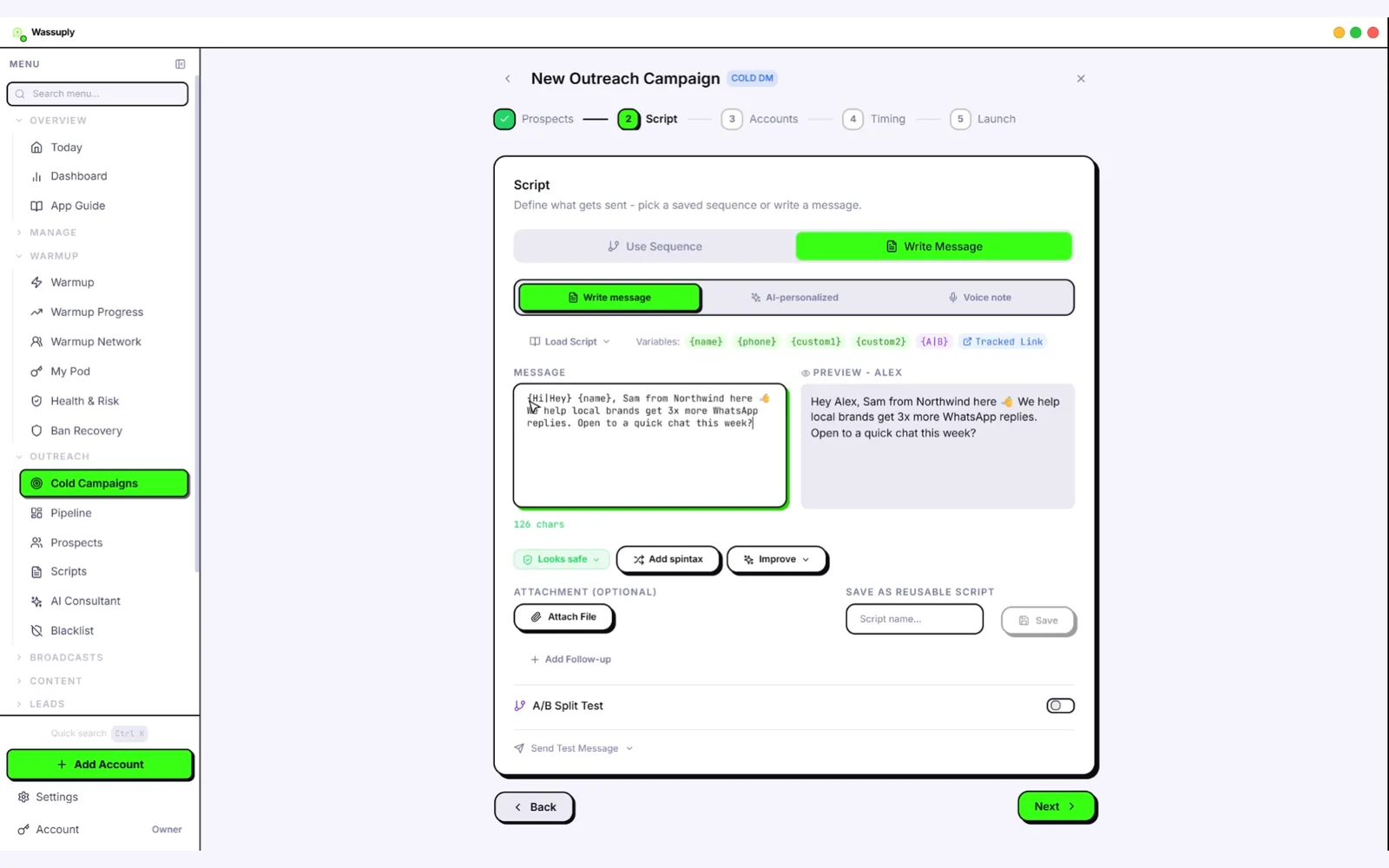
- 5Write a short first lineUse the merge fields {name}, {custom1} and {custom2}, spintax for variation, or AI-personalised first messages written per contact with your own API key. One reason, one question.
- 6Send slowlyRandom 30 to 90 second gaps, batches of 10, random 1 to 5 minute breaks, blackout hours and a daily cap per number. Keep the first campaigns small.
- 7Route replies and stop chasingReplies land on the Pipeline board, follow-ups stop the moment someone replies, and opt-outs get an automatic reply. Move qualified conversations into HubSpot or Salesforce.
Here is an illustrative first message built from those columns. It shows the shape, not a template with proven results:
Offering email is deliberate: it gives the person an easy, polite way to answer, and any reply stops the follow-ups. Our guide to AI personalisation on WhatsApp covers writing first lines that don't read as automated.
What guardrails does a GTM engineer need before adding WhatsApp?
A GTM engineer needs three kinds of guardrail before adding WhatsApp: consent and legal, relevance, and pacing. Relevance matters on every channel; in Gartner's 2025 survey, 73% of B2B buyers said they actively avoid suppliers who send irrelevant outreach (Gartner). On WhatsApp, the cost of getting it wrong includes the number itself.
- Legal: confirm a lawful basis for each contact in each country, and record where each number came from. See cold WhatsApp outreach and GDPR.
- Legal: no bought or scraped lists.
- Legal: honour opt-outs at once, and switch on the automatic opt-out reply.
- Relevance: message only on a signal, with one specific reason per message.
- Relevance: keep follow-ups to people who never answer to a minimum. WhatsApp is testing a cap on unanswered messages.
- Relevance: measure replies, conversations and meetings, not messages sent.
- Pacing: warm every new number for at least 15 days, ideally 30.
- Pacing: stay under each number's safe daily limit. Our page on WhatsApp sending limits explains how they work.
- Pacing: give each number its own isolated session and proxy, so numbers don't share an IP.
- Pacing: watch each number's risk score and pause it when the score climbs.
Pacing alone is not a shield. In a 2024 r/whatsapp thread, a poster trying to win clients from a large cold list said their number was banned even at 50 messages a day through a bulk-sender extension (r/whatsapp, 2024). List quality and relevance matter as much as speed.
Where does Wassuply fit for a GTM engineer?
Wassuply fits as the WhatsApp sending layer a GTM engineer's stack doesn't have. It doesn't replace Clay, your CRM or your sequencer, and we're not claiming GTM teams already run it. It is a Windows 10 and 11 desktop app that warms up WhatsApp numbers and runs paced outreach from many of them, through normal WhatsApp and WhatsApp Business accounts in WhatsApp Web sessions. No Business API, no Meta verification, no template approval.
The parts that map to a GTM workflow: CSV import with phone, name, custom1 and custom2; merge fields and spintax; AI-personalised first messages using your own Claude, ChatGPT or DeepSeek key; follow-up sequences that stop on reply; and a Pipeline board for replies. Each number gets its own session, fingerprint and optional proxy that you supply. Health & Risk gives each number a safe daily limit and a live 0 to 100 ban-risk score, and opt-in Smart Send Protection slows sending at 60 and pauses at 80.
The download is free; warming and sending need a licence, currently $397 one-time on early-bird lifetime terms, with unlimited numbers (see pricing). A sensible first move is to start the WhatsApp warmer on two or three numbers while you build the first Clay list, so the numbers are ready when the list is.
Add WhatsApp to your GTM stack
Warm a few numbers now, then send your first signal-based list as a small, paced campaign.
Free account. Windows 10 and 11. Warming and sending need an active licence.
Frequently asked questions
What does a GTM engineer do?
A GTM engineer builds the automated systems a company uses to find, qualify and contact buyers. In job postings analysed by Bloomberry, the top responsibilities were building and automating go-to-market workflows, integrating sales and marketing tools, and owning the CRM. Day to day, that means wiring together enrichment, buying signals, AI-written messaging and sequencing, then measuring which plays book meetings.
What tools does a GTM engineer use?
Clay is the most common GTM engineer tool, according to Bloomberry's analysis of job postings. The same analysis found HubSpot in 52% of postings, Outreach in 49%, Salesforce in 45%, Zapier in 39%, Apollo in 29% and n8n in 28%, with SQL and Python each in 38%. Messaging channels such as WhatsApp did not come up.
How much does a GTM engineer earn?
Estimates vary by source. Clay reported a $160K median salary across 400+ GTM engineer jobs posted in spring 2025, using its own count. Bloomberry found a $127,500 median from postings that listed public pay ranges. Treat both as rough guides, because they come from job adverts rather than actual pay.
What is the difference between a GTM engineer and RevOps?
The roles overlap heavily. Bloomberry found RevOps and GTM engineer postings share most responsibilities, such as automating workflows and owning the CRM. The difference is emphasis: RevOps postings lean towards forecast accuracy, while GTM engineer postings lean towards outbound and prospecting. Put simply, a GTM engineer builds the systems that create pipeline, and RevOps keeps the revenue numbers accurate.
Can GTM engineers use WhatsApp for outbound?
Yes, with care. There is no data showing GTM engineers widely using WhatsApp yet, so treat it as an opportunity rather than a trend. The practical route is to export a signal-based list from Clay as a CSV, send short, relevant first messages from warmed numbers at a slow pace, and stop follow-ups on reply. WhatsApp discourages bulk and automated messaging, so the ban risk is real.
Is cold WhatsApp outreach legal?
It depends on where your contacts are and how you got their numbers. In the EU and UK, data protection and electronic marketing rules apply, and you need a lawful basis for each contact; other countries have their own rules. WhatsApp's terms are a separate question from the law. Read our guide to cold WhatsApp outreach and GDPR and take local advice for your markets.