Why cold email doesn't work like it used to (and what still does)
Why cold email doesn't work as well as it did comes down to structure more than copy: Gmail, Yahoo and Outlook now enforce sender rules, the average worker receives 117 emails a day, and open tracking both misleads you and costs replies. Cold email isn't dead for everyone. It got harder, and the senders still winning send fewer, more relevant emails.
- Not dead, harder: 2025 benchmarks put cold email reply rates anywhere from 0.45% to 4.5%, depending on how replies are counted. No source shows a clean industry-wide decline.
- Stricter gatekeepers: Google and Yahoo have enforced sender rules since February 2024 and Outlook since May 2025, and Gmail stepped up enforcement from November 2025.
- Fuller inboxes: a forecast 376 billion emails a day worldwide in 2025, and 117 a day for the average Microsoft 365 worker.
- Opens mislead: Apple Mail loads tracking pixels whether or not anyone reads, and campaigns with open tracking on got fewer replies in Hunter's and Snov.io's data.
- What still works: small, relevant sends, full authentication, no pixels, few links, and a second channel such as calls or WhatsApp.
Why cold email doesn't work like it used to
Cold email stopped working for many senders because the ground under the channel moved. Mailbox providers now enforce authentication and spam-complaint limits, inboxes carry more mail than ever, the open-rate signal most teams steered by became unreliable, and buyers are quicker to ignore anything that isn't relevant to them.
None of that means cold email is finished. Plenty of senders still book meetings from it. But the cheap version, a bought list, a long sequence and a dashboard of open rates, has mostly stopped paying. Below: each cause with sourced numbers, what Reddit users describe, and what still works.
Is cold email dead? What the reply-rate data says
Cold email is not dead, but no single "average reply rate" can prove it either way, because the 2026 benchmark reports on cold email reply rates differ by a factor of ten depending on how replies are counted. Every figure below comes from a company that sells outbound software or services, measuring its own users or clients.
| Source | Reply rate | How it is counted |
|---|---|---|
| Belkins (agency), 2025 campaigns | 0.45% | Unique replies divided by all emails sent, auto-replies excluded, 7.5 million emails, open tracking off |
| Smartlead (sending platform), first half of 2026 | 0.74% (median sender) | Replies divided by contacts, senders with at least 500 sends |
| Woodpecker (sending platform), last 90 days of 2025 | 1.5% (median) | Median campaign across 56,614 campaigns |
| Instantly (sending platform), 2025 | 3.43% | Platform-wide average |
| Hunter (email tools), 2025 | 4.5% overall, 3% for sales | Average sequence reply rate across 31 million emails |
Belkins makes the point itself: a reply rate counted against people who opened and one counted against every email sent can describe the same campaign, which is why its 2025 figure looks so much lower than its earlier ones. Before you compare your own cold email reply rates in 2026 with any of these, check which formula you are using.
What the data does not show is a clean, industry-wide fall in cold email reply rates. Hunter's own average went up, from 4.1% on 2024 sends to 4.5% on 2025 sends, though the two samples differ. A widely shared claim that reply rates fell from 5.1% in 2024 to 3.43% compares two different sources, and we could not trace the 5.1% to any original study. Treat precise "reply rates dropped X%" headlines with suspicion.
The decline shows up instead in individual accounts of senders whose numbers collapsed within weeks. Those are anecdotes, and the causes behind them come next.
How did Gmail, Yahoo and Outlook change cold email deliverability?
Since 2024 the three biggest consumer mailbox providers have required bulk senders to authenticate their mail, make unsubscribing easy and keep spam complaints very low, and they now reject mail that doesn't comply. For cold email deliverability in 2026, these rules are the baseline every sender works against.
Google (Gmail)
Google announced in October 2023 that from February 2024, anyone sending more than 5,000 messages to Gmail addresses in a day must authenticate their email, offer one-click unsubscribe and process unsubscribe requests within two days (Google's announcement). Its sender guidelines require SPF, DKIM and DMARC and set the spam-rate bar: keep it below 0.10% in Postmaster Tools and never reach 0.30%.
Two details matter for cold senders. Google's sender guidelines FAQ says a sender who meets the bulk criteria once is treated as a bulk sender permanently. And from November 2025, Gmail began ramping up enforcement on non-compliant traffic, including temporary and permanent rejections.
Yahoo
Yahoo's requirements took effect in the same month, February 2024: SPF and DKIM, a DMARC policy that passes, one-click unsubscribe honoured within two days, and a spam rate below 0.3% (Yahoo Sender Hub). Unlike Google, Yahoo says it will not specify a volume threshold, so "5,000 a day" is Google's line, not Yahoo's.
Microsoft (Outlook.com)
Outlook.com, Hotmail and Live addresses followed from 5 May 2025: domains sending more than 5,000 emails a day must pass SPF, DKIM and DMARC. Microsoft first planned to send failing mail to Junk, then changed course and rejects it outright with the error 550 5.7.515 (Microsoft's Outlook blog).
| Provider | Who it applies to | Main requirements | In force since |
|---|---|---|---|
| Gmail | Senders of more than 5,000 messages a day to Gmail addresses; bulk status is permanent once reached | SPF, DKIM and DMARC; one-click unsubscribe honoured within two days; spam rate under 0.10%, never 0.30% | February 2024; stricter enforcement from November 2025 |
| Yahoo | Bulk senders, with no stated volume threshold | SPF, DKIM and passing DMARC; one-click unsubscribe within two days; spam rate under 0.3% | February 2024 |
| Outlook.com | Domains sending more than 5,000 emails a day | SPF, DKIM and DMARC; failing mail rejected with 550 5.7.515 | 5 May 2025 |
Most cold email programmes spread sends across many domains and stay well under 5,000 a day each, so the formal thresholds may never apply to them. The filtering still does. Google says Gmail's defences stop more than 99.9% of spam, phishing and malware and block nearly 15 billion unwanted emails every day. Recipients who mark a cold email as spam count against the sender whatever its daily volume.
How many emails does the average worker get a day?
The average worker receives 117 emails a day, most of them skimmed in under a minute, according to Microsoft's 2025 Work Trend Index report. The figure comes from Microsoft 365 business users, which is close to the audience most B2B cold emails go to. A cold email is one of those 117, competing with colleagues and customers for a glance.
Across the world, The Radicati Group forecast about 376.4 billion business and consumer emails sent and received each day in 2025, rising to 392.5 billion in 2026. Both are forecasts made in late 2024.
Buyers have also become less forgiving. In a Gartner survey of 632 B2B buyers, 73% said they actively avoid suppliers who send irrelevant outreach, and 61% said they would prefer a buying experience without a sales rep at all. Gartner's next survey put that rep-free preference at 67%, though the two samples differ. An irrelevant cold email can do worse than go unanswered: it can rule your company out.
Why open rates mislead, and why tracking pixels cost replies
Open rates stopped meaning much after Apple's Mail Privacy Protection shipped with iOS 15 in September 2021. With it switched on, Apple Mail downloads remote content, including tracking pixels, in the background whether or not the person engages. The sender's tool logs an open that may never have happened.
Apple dominates what tracking tools see. In September 2026, Apple accounted for 76.56% of the 1.5 billion-plus opens Litmus tracked, privacy-protected opens included. Read that as a share of tracked opens, not of people: Litmus's data leans towards consumer marketing email, and B2B cold-email recipients are probably more likely to read on Outlook or Google Workspace. Even so, any open rate you see is inflated by an amount you can't measure.
The pixel also seems to cost replies. Hunter found that sequences with open tracking on averaged a 4.4% reply rate, against 7.4% without tracking. Snov.io saw the same direction across 44 million-plus emails sent in February and March 2025: 1.08% with open tracking on, 2.36% with it off. Both are correlations rather than controlled tests, but two separate datasets pointing the same way is reason enough to switch tracking off. We go deeper into this in the death of email open rates.
Cold email not working? What Reddit users report
Reddit users report sudden collapses: reply rates halving or worse within weeks, often with opens holding steady and no change to copy or setup they can point to. These are individual accounts from r/coldemail and r/agency, read from archived copies of each thread. They illustrate the causes above; they don't prove them.
- r/coldemail, 2025: from about 2% to 0.8%, with opens unchanged. After more than two years at about a 2% response rate, the poster dropped to 0.8% from early June. New copy, cutting volume from 200 to 80 a day and two newly warmed domains didn't help, and opens held at about 19%. The top replies suspected the emails were landing in spam while tracking pixels still fired, and one commenter called the pattern "deliverability theater". Another saw the same thing at 22% opens and 0.9% replies. (thread)
- r/coldemail, 2025: an agency from 5-9% to 0.5-1%, despite 98% inbox placement. A marketing agency emailing local brick-and-mortar businesses with a six-email sequence saw replies fall from 5-9% to 0.5-1% with almost no changes on its side. Inbox placement tests still showed 98%. One reply claimed that reply rates on Microsoft 365 inboxes run about ten times weaker than on Google Workspace. (thread)
- r/coldemail, 2024: a textbook setup, then under 0.5% in a week. Records set, no blacklists, gradual warm-up, text-only emails and at most 20 a day per mailbox, and the reply rate still fell from 3% to under 0.5% in one week with the same copy. Replies blamed spam complaints crossing provider thresholds. (thread)
- r/coldemail, 2024: Gmail fine, Microsoft all spam. The same emails that reached Gmail inboxes all landed in spam for Microsoft recipients. Replies suggested separate setups per provider and softer copy. (thread)
- r/agency, 2024: "Cold Email is dead", and the volume it now takes. The poster argued cold email is dying because of competition, spam risk and Google's changes. The top reply said it is still relevant in B2B. One agency owner described what it takes for them: 20,000 to 30,000 emails and 2,000 dials per client each month to book 15 to 20 meetings, rotating 80 to 90 domains per client. (thread)
Together, the threads describe placement problems that an open-rate dashboard hides, and a channel where standing still takes far more volume and infrastructure than it used to. They also show people still booking meetings, which is why "dead" is the wrong word.
What still works in cold email in 2026?
What still works is roughly the opposite of the volume playbook: small, well-targeted sends to people with a real reason to care, from properly authenticated domains, with no tracking pixel and few links. Make the first email count, because Instantly found that 58% of replies come from the first step of a sequence.
- Authenticate every sending domain with SPF, DKIM and DMARC, and check that DMARC actually passes. Having a record in place is not the same thing.
- Keep spam complaints under 0.10%, Google's target, and treat 0.30% as a line you never cross.
- Switch open tracking off and judge campaigns on replies, positive replies and meetings.
- Use one link or none in the first email. A plain-text question is easier on filters and on people.
- Write for one segment at a time. If the email would make sense sent to anyone, it isn't relevant enough for the 73% who avoid irrelevant outreach.
- Keep per-mailbox volume low, but don't expect low volume to rescue a bad list. The 20-a-day sender above still lost their replies.
- Test placement at Gmail and Outlook separately, since the same email can land differently at each.
- Make leaving easy: honour every opt-out at once and support one-click unsubscribe where the rules require it.
- Add a second channel. Gong found that prospects who were also cold called replied to email at 3.44% against 1.81%, even when the call didn't connect.
When results drop, work from the symptom back to the cause before you rewrite anything:
| Cause | Symptom you see | Fix |
|---|---|---|
| Missing or failing SPF, DKIM or DMARC | Bounces with 5.7.x errors, Outlook rejections (550 5.7.515), a sudden drop at one provider | Authenticate every domain, confirm DMARC passes, test each provider separately |
| Spam complaints above Google's 0.10% target | Gmail placement slides over days; the spam rate in Postmaster Tools climbs | Tighter targeting, a clear way to opt out, fewer sends to cold segments |
| Open-tracking pixels | Lower replies than comparable untracked campaigns; opens that never turn into replies | Turn tracking off and measure replies and meetings |
| Overloaded inboxes | Replies only from the first email; follow-ups ignored | Shorter emails with one clear ask, so the first email does the work |
| Irrelevant targeting | Few positive replies, more "not interested" answers and unsubscribes | Narrower segments and a specific reason to reach out in the first line |
| Tired domains or over-used copy | A campaign that worked for weeks suddenly drops close to zero | Rotate copy, rest domains, retest placement before scaling again |
| Too many links or heavy HTML | Spam-folder placement for some recipients | Plain text with one link or none |
Where does WhatsApp fit as a second channel?
WhatsApp fits next to email, not instead of it: for prospects in markets where business already happens on WhatsApp, for leads who have engaged before, and for a short personal follow-up after an email or a call. It reaches more than 3 billion people a month, and the message lands on a phone rather than in a crowded inbox.
It has hard limits of its own. WhatsApp's terms ask people not to send bulk or automated messages, numbers that message strangers at volume often get banned, and many B2B buyers treat WhatsApp as personal, so a cold pitch there can feel more intrusive than an email. There is also no reliable public benchmark for cold WhatsApp results: the 98% open rate you see quoted has no traceable source, as we show in our breakdown of the real WhatsApp open rate. Privacy law applies as well, and cold WhatsApp and GDPR covers the basics.
The hard evidence that a second channel lifts results comes from calls rather than WhatsApp, in Gong's data above. A sensible test for many teams is email first, then one short WhatsApp message to prospects in markets where it is the normal way to talk business, stopping the moment they reply or ask you to. An illustrative example:
Our WhatsApp vs email comparison sets out the trade-offs, does WhatsApp outreach work rounds up what people report when they try it, and why WhatsApp works for sales makes the case for the channel.
Where Wassuply fits
Wassuply handles the WhatsApp half of that test; it doesn't send email. It is a Windows 10/11 desktop app that runs normal WhatsApp and WhatsApp Business accounts through WhatsApp Web sessions, with no Business API, Meta verification or template approval. Each number gets its own isolated session, browser fingerprint and optional proxy.
New numbers warm up first by chatting with each other using natural lines from built-in chat packs, at random gaps inside the hours you set. Health & Risk reads each number's age and history and suggests days to warm and a safe daily limit, from 30 to 250 a day depending on age. Campaigns run from a CSV of phone, name, custom1 and custom2, with merge fields, spintax and optional AI-personalised first messages written with your own Claude, ChatGPT or DeepSeek key.
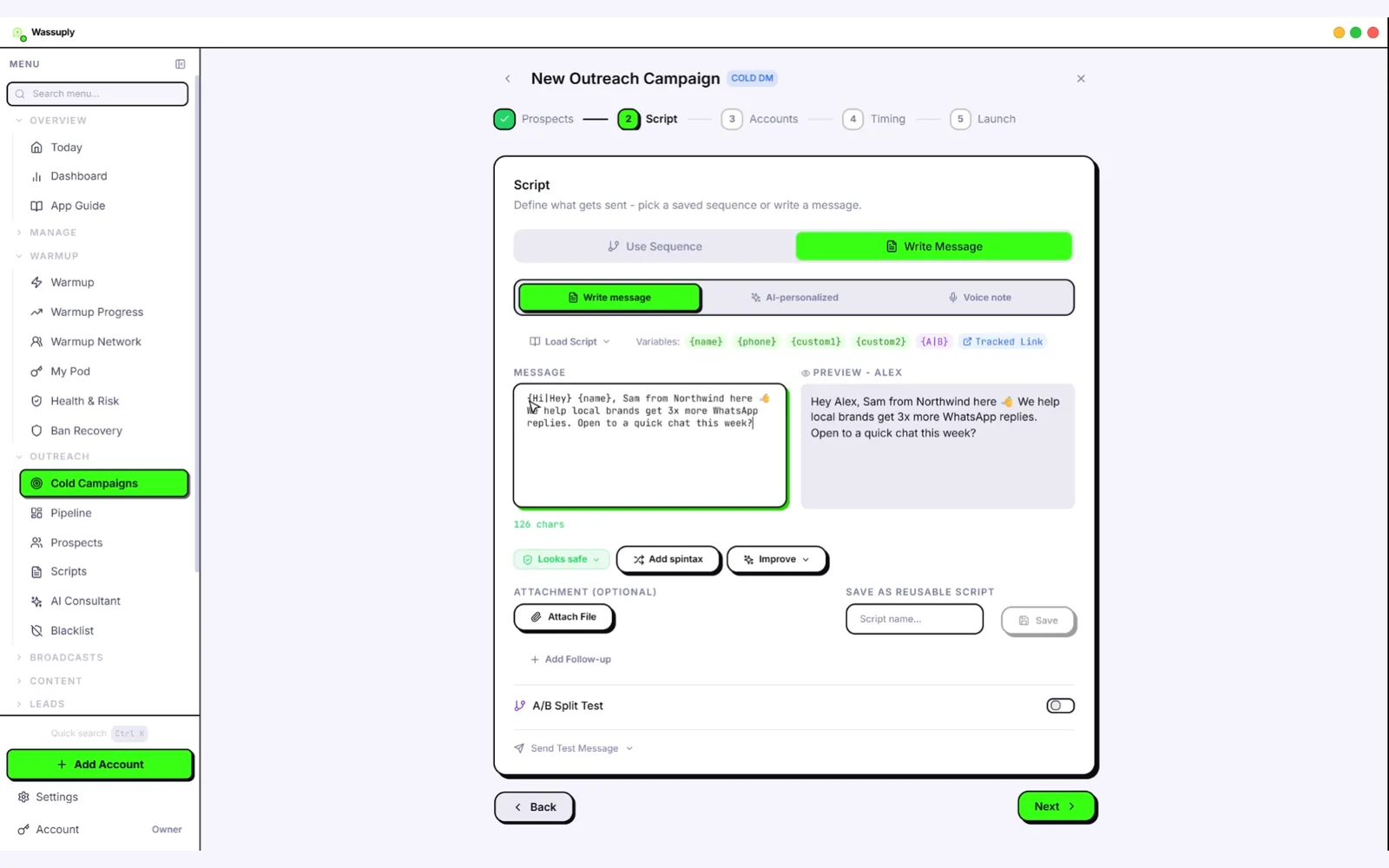
Sending uses random 30-90 second gaps, batches of 10 with breaks, blackout hours and a daily cap per number, and follow-ups stop the moment someone replies. It can't make a cold list warm, and no tool removes ban risk. The download is free; warming and sending need a licence, currently $397 one-time for lifetime access.
Add WhatsApp as a second channel, carefully
Warm your numbers, see a safe daily limit for each one and send personal WhatsApp follow-ups at a human pace from one Windows app.
Free account. Windows 10 and 11. Warming and sending need an active licence.
Frequently asked questions
Is cold email dead in 2026?
No, but it is harder. 2025 benchmarks put average reply rates between about 0.45% and 4.5% depending on how replies are counted, and plenty of senders still book meetings. What changed is the cost: stricter Gmail, Yahoo and Outlook sender rules, fuller inboxes and buyers who ignore irrelevant outreach mean small, targeted, authenticated sends now beat raw volume.
What is a good cold email reply rate in 2026?
It depends on how you count. Belkins measured 0.45% across 7.5 million emails sent in 2025, counting replies against every email sent. Instantly's platform average was 3.43%, with the top quartile at 5.5% or more, and Hunter's was 4.5%, or 3% for sales sequences. Compare yourself with a benchmark that uses your own formula, and track positive replies and meetings too.
Why did my cold email reply rate suddenly drop?
The usual causes are ones you can't see: mail moving to spam at one provider, spam complaints creeping above Google's 0.10% target, tired domains or copy that has been sent too many times. Opens often stay flat because tracking pixels can still fire, so they won't warn you. Check authentication, test placement at Gmail and Outlook separately, switch off open tracking and tighten the list before rewriting copy.
Do Google's bulk sender rules apply to cold email?
Formally they apply to anyone sending more than 5,000 messages a day to Gmail addresses, and Google says a sender who crosses that line once is treated as a bulk sender permanently. Many cold programmes stay below it per domain. But Yahoo sets no volume threshold, Outlook rejects unauthenticated mail from high-volume domains, and spam complaints hurt any sender, so meeting the requirements makes sense at any volume.
Should I turn off open tracking in cold email?
Yes, for most cold campaigns. Hunter found sequences with open tracking averaged a 4.4% reply rate against 7.4% without it, and Snov.io saw 1.08% against 2.36% across 44 million emails. Both are correlations rather than controlled tests, but open data is unreliable anyway, because Apple Mail Privacy Protection loads pixels whether or not anyone reads the email. Measure replies and meetings instead.
Is WhatsApp better than cold email?
Neither is better everywhere. WhatsApp suits markets where people already do business on it, warm leads and short follow-ups. Email suits formal first contact and prospects who see WhatsApp as personal. WhatsApp carries ban risk, its terms discourage bulk messaging, and there is no reliable public benchmark for cold WhatsApp replies. Test both on the same list and compare meetings booked; our WhatsApp vs email comparison sets out the trade-offs.