How to get clients without ads in 2026: what paid ads really cost, and what to do instead
You can get clients without ads by doing the slower work ads skip: asking your network for introductions, contacting a short list with a real reason, publishing answers buyers search for, and partnering with people who already serve your clients. This guide on how to get clients without ads starts with what paid ads really cost in 2026, then compares each no-ads channel on time, reply rates and how long it takes to work.
- Ads aren't dead, they're rent: Meta's average price per ad rose 12% year over year in Q2 2026 (Meta), and the leads stop when the spend stops.
- Search is steadier than social: search clicks now average $5.42, but cost per lead came down to $66.69 in LocaliQ's 2026 data.
- Start with referrals: your network is the fastest no-ads channel, but it needs a specific, regular ask.
- Outreach works at honest rates: published cold email reply rates run from 0.45% to 4.5% depending on how replies are counted, and LinkedIn, calls and WhatsApp each have their own trade-offs.
- Content, partners, communities and free tools compound: slow to start, but they keep producing after you stop.
Are paid ads still worth it in 2026?
Paid ads still work in 2026, but on social platforms they cost more every year, and they only produce leads while you pay. That is the honest case for learning how to get clients without ads: not that ads are dead, but that a business relying only on them is renting its pipeline.
Here are the latest figures from the platforms and the largest benchmark datasets:
| Ad metric | Latest figure | Trend | Source |
|---|---|---|---|
| Meta average price per ad | +10% in 2024, +9% in 2025, +12% in Q2 2026 (year over year) | Rising every year | Meta earnings releases: 2024, 2025, Q2 2026 |
| Meta median CPM | $15.06, August 2025 to July 2026 | Up 13.24% year over year | Triple Whale |
| Meta lead campaigns, cost per lead | $27.66 (2025) | Up 20.94% | WordStream |
| Search ads, average cost per click | $5.42 (2026) | Up from $5.26 in 2025 | LocaliQ; WordStream |
| Search ads, average cost per lead | $66.69 (2026) | Down from $70.11, the first overall fall in five years | LocaliQ; WordStream |
Read these with care. Meta's figure is a global average across every format and region, not a CPM, and Meta sold 12% more impressions in 2025 as well (Meta). Triple Whale's sample is over 40,000 brands, mostly e-commerce, so B2B advertisers may pay different prices.
Search is the counterpoint. LocaliQ's 2026 benchmarks, covering Google and Microsoft search from April 2025 to March 2026, show clicks still getting dearer while cost per lead came down, with business services paying $93.69 per lead (LocaliQ). So ad costs are not exploding everywhere. The real issue is structural: every lead has a price, you pay it every month, and the flow stops the day the budget does.
No-ads channels flip that trade: they cost time instead of money, start slower and tend to compound. Most businesses use both; this guide is about organic client acquisition, the half you own.
How to get clients without ads: which channels work?
You can get clients without paid ads through six channels: referrals and your network, cold outreach, content and search, partnerships, communities, and free tools or lead magnets. They differ mainly in how much time they take each week and how long they take to produce a client.
| Channel | Time each week | How long until it works | Best for |
|---|---|---|---|
| Referrals and network | 1 to 2 hours | Days to weeks | Anyone with past clients or a professional network |
| Cold outreach (email, LinkedIn, calls, WhatsApp) | 5 to 10 hours | 2 to 8 weeks | New businesses, new offers, specific target accounts |
| Content, SEO and answer engines | 3 to 6 hours | 3 to 12 months | Specialists who can answer buyer questions well |
| Partnerships | 1 to 3 hours | 1 to 3 months | Services that sit next to another provider's work |
| Communities | 2 to 4 hours | 1 to 3 months | Niches with active forums or groups |
| Free tools and lead magnets | A few days up front, then little | 1 to 6 months | Problems a checklist, calculator or audit can partly solve |
These ranges are our estimates from how each channel works, not measured benchmarks; no study compares them on the same basis. If your deals are $3k or more, the high-ticket version of this playbook works a smaller list more deeply: see how to get high-ticket clients.
Referrals and your network: where to start
Referrals and your network are the best place to start, because trust comes with the introduction and a deal can arrive within days. Referred customers also tend to be better customers: a peer-reviewed study of about 10,000 bank customers found a referred customer's value was at least 16% higher (Schmitt, Skiera and Van den Bulte, 2011). That is banking, not B2B, so read it as direction.
The catch is consistency. These Reddit threads are individual anecdotes, but they show both sides:
- In a February 2025 r/agency thread, the poster said their "last 6 leads were all referrals", four direct and two warm intros, won by meeting business owners and asking at the end. They also worried that referrals are inconsistent (r/agency, 2025).
- In a March 2025 r/LeadGeneration thread, a poster who had onboarded more than 15 clients in three months described closing two new ones within a week, both from referrals (r/LeadGeneration, 2025).
- In an August 2024 r/agency thread about first clients, the top answer was network first, then cold outreach. Another person asked a contact whether they knew anyone who needed the service, and the contact needed it themselves (r/agency, 2024).
How to run it: list 50 people who know your work and send each a specific ask, such as "do you know a clinic owner opening a second site this year?", rather than "let me know if you hear of anyone". Ask again when you deliver a result. Time: one to two hours a week, with results in days to weeks.
Cold outreach without ads: what reply rates are realistic?
Cold outreach is the most controllable form of client acquisition without ads, but published reply rates are low and measured in different ways. Cold email benchmarks for 2025 range from 0.45% to 4.5% depending on how replies are counted, LinkedIn and phone have their own figures, and there is no reliable public benchmark for cold WhatsApp.
| Channel | Published figure | What it measures | Source |
|---|---|---|---|
| Cold email | 0.45% | Unique replies per email sent, 7.5M emails, 2025 | Belkins |
| Cold email | 3.43% | Platform average reply rate, 2025 | Instantly |
| Cold email | 4.5% (3% for sales) | Average sequence reply rate, 31M emails, 2025 | Hunter |
| 26% acceptance, 7.2% reply | Connections per invite; replies per message sent, 2025 | Belkins | |
| Cold calling | 9.9% connect; about 370 dials per meeting | Live pickups per dial, 175,000+ dials, 2025 | Belkins |
| WhatsApp, opt-in campaigns | 72% median read rate (79.6% weighted) | Read receipts per delivered message, 382 brands, 2026 | Chatarmin |
| WhatsApp, cold outreach | No reliable public benchmark | Not measured publicly | None found |
Cold email
The gap between 0.45% and 4.5% is mostly method: Belkins counts unique replies against every email sent, while Instantly and Hunter report platform or sequence averages. One easy fix is to turn off open tracking. Hunter saw 4.4% replies with tracking on against 7.4% without, and Snov.io saw 1.08% against 2.36% (Hunter; Snov.io). Both are correlations, not proof that the pixel alone causes it.
Volume is the hidden cost. In a 2024 r/agency thread titled "Cold Email is dead", one agency owner described sending 20,000 to 30,000 emails and making 2,000 dials per client per month: "This typically yields 15 to 20 new business meetings." (r/agency, 2024). For the deliverability side, read why cold email doesn't work like it used to.
Belkins' 2025 study of more than 15 million LinkedIn touchpoints found an average connection acceptance rate of 26% and a 7.2% reply rate on messages sent (Belkins). Your profile and posts do part of the selling before anyone accepts.
Cold calling
Calling takes the most time, but it helps the other channels. Belkins' 2025 data across more than 175,000 dials found a 9.9% per-dial connect rate and roughly 370 dials per booked meeting (Belkins). Gong's analysis of over 300 million cold calls found prospects who were also called replied to email at 3.44%, against 1.81% otherwise, even when the call didn't connect (Gong Labs).
The best measured WhatsApp data covers opt-in campaigns, not cold outreach: Chatarmin's 2026 benchmark of 382 brands found a 72% median read rate (Chatarmin). The often-quoted 98% open rate has no traceable source, as our look at the real WhatsApp open rate explains. Chat-style messages can feel different from email: in a 2025 r/LeadGeneration thread comparing cold email with Instagram DMs, the top reply said "getting a DM feels like being discovered" (r/LeadGeneration, 2025).
Cold WhatsApp also carries ban risk. WhatsApp's terms of service treat bulk messaging and auto-messaging as impermissible, and WhatsApp is testing a monthly cap on messages to people who haven't replied (TechCrunch, October 2025). Warm new numbers first, keep volumes low, message only people you have a lawful basis to contact, and check whether bulk WhatsApp is legal where you sell.
Content, SEO and answer engines: the slow channel that compounds
Content gets you clients without ads by putting you on the shortlist while buyers research alone. In 6sense's 2025 research, 94% of buying groups had ranked their preferred vendors before first contact (6sense via Business Wire), and a SurveyMonkey and Reddit survey of 1,202 US decision-makers found 83% research before speaking to sales (SurveyMonkey, 2026).
More of that research now runs through AI tools: in Gartner's latest buyer survey, 45% of B2B buyers had used generative AI during a recent purchase (Gartner, May 2026). Pages that answer one question plainly, with specific facts, are easier for both search engines and AI tools to quote. Write that way: the answer first, proof after. Our forecast on how to get clients in 2027 covers where this is heading.
Social content counts too. In a July 2025 r/agency thread, a lead-generation agency founder who went from four months with no clients to five retainer clients in two weeks, with no paid ads, credited cold email plus consistent content and said "3 came from LinkedIn posts" (r/agency, 2025). Time: three to six hours a week, with results in three to 12 months for search; social posts can be quicker.
Partnerships: borrow trust someone else has built
A partnership gets you clients without ads by borrowing trust another business has already built with your buyer. Look for providers who serve the same clients before or after you without competing: a web developer and a copywriter, an accountant and a fractional CFO, a recruiter and an HR consultant.
In Hinge's 2015 survey of 523 professional services firms, 81.5% received referrals from people they had never worked with (Hinge Marketing). We know of no reliable benchmark for how many clients a partnership produces, so judge each partner by the introductions made in the first 90 days.
How to run it: pick three possible partners, offer something concrete (referrals back, a joint guide, a session for both client lists) and agree how introductions work. Time: one to three hours a week, with results in one to three months.
Communities, free tools and lead magnets
Communities and free tools work when they give before they ask: answering questions where buyers gather, or solving a small part of the problem you're paid to solve.
Communities
Buyers trust peers. In the SurveyMonkey and Reddit survey, 73% of US decision-makers trusted peer insights, more than vendor websites (55%) or search engines (54%) (SurveyMonkey). Reddit sponsored that study and "peer" includes anonymous comments, so weigh it accordingly.
Answering beats pitching. In the 2024 r/agency first-client thread, one person answered a question in detail on a platform and was approached by someone who read it (r/agency, 2024). In a December 2024 r/SMMA thread, a new agency owner's first $500-a-month retainer came from someone they had met seven years earlier at their mosque, who reached out after seeing their TikTok (r/SMMA, 2024).
Free tools and lead magnets
A calculator, checklist, template or short audit earns the first conversation by being useful. We know of no reliable benchmark for lead-magnet conversion, so build one and count the conversations it starts. Our own sending calculator is an example: a free tool that answers one practical question. Time: a few days to build, with results in one to six months.
A 30-day plan to get clients without ads
If you want one answer to how to get clients without advertising in 2026, this is it: run the fastest channels first and start the slow ones early, so something is producing conversations by day 30. It is an illustrative schedule, so adjust the volumes to your capacity.
- 1Days 1 to 3: choose one offer and one buyerWrite down the service, the price range and the client you want most. Gather your best two or three pieces of proof.
- 2Days 2 to 7: run a referral sprintList 50 people who know your work and send each a specific ask. Follow up once, a week later.
- 3Days 3 to 10: fix what buyers see firstUpdate your LinkedIn profile and your main service page so a referred buyer finds clear proof and a clear next step.
- 4Days 5 to 14: build a 100-account listPick named companies that fit, note a signal for each and turn off open tracking. If you will use WhatsApp, start warming new numbers now: 15 days minimum, 30 recommended.
- 5Days 10 to 30: start outreach in small batchesTen to 20 personalised messages a day across email and LinkedIn, plus calls to the best accounts. Add WhatsApp only once numbers are warmed, and only for contacts you have a lawful basis to message.
- 6Days 10 to 30: publish and show upPublish two to four answer-first posts based on questions prospects ask, and answer questions in two communities where your buyers spend time.
- 7Days 15 to 25: approach three partnersOffer a referral swap or a joint piece of content, and agree how introductions will work.
- 8Days 20 to 30: build one free tool or lead magnetA checklist, template or calculator that solves a small part of the problem you are paid to solve.
- 9Day 30: review and cutCount conversations, calls and proposals by channel. Keep the two that worked best and drop the rest.
Where does Wassuply fit in a no-ads plan?
Wassuply covers the WhatsApp part of a no-ads plan: warming numbers, sending paced outreach and tracking replies. It is a Windows 10 and 11 desktop app that drives normal WhatsApp and WhatsApp Business accounts through WhatsApp Web sessions, with no Business API, Meta verification or template approval.
While you work your network, your numbers chat with each other using natural lines from 10 built-in chat packs, with random 30 to 120 second gaps, only inside the hours you set. Health & Risk shows each number's days to warm, a safe daily limit of 30 to 250 messages depending on age, and a live 0 to 100 ban-risk score. Smart Send Protection is opt-in: turn it on and sending slows at 60 and pauses at 80.
Once numbers are warmed, campaigns import a CSV with phone, name, custom1 and custom2, write AI-personalised first messages with your own Claude, ChatGPT or DeepSeek API key, and send with random gaps, batches, breaks and a daily cap per number. Follow-ups stop the moment someone replies, and replies land on a Pipeline board.
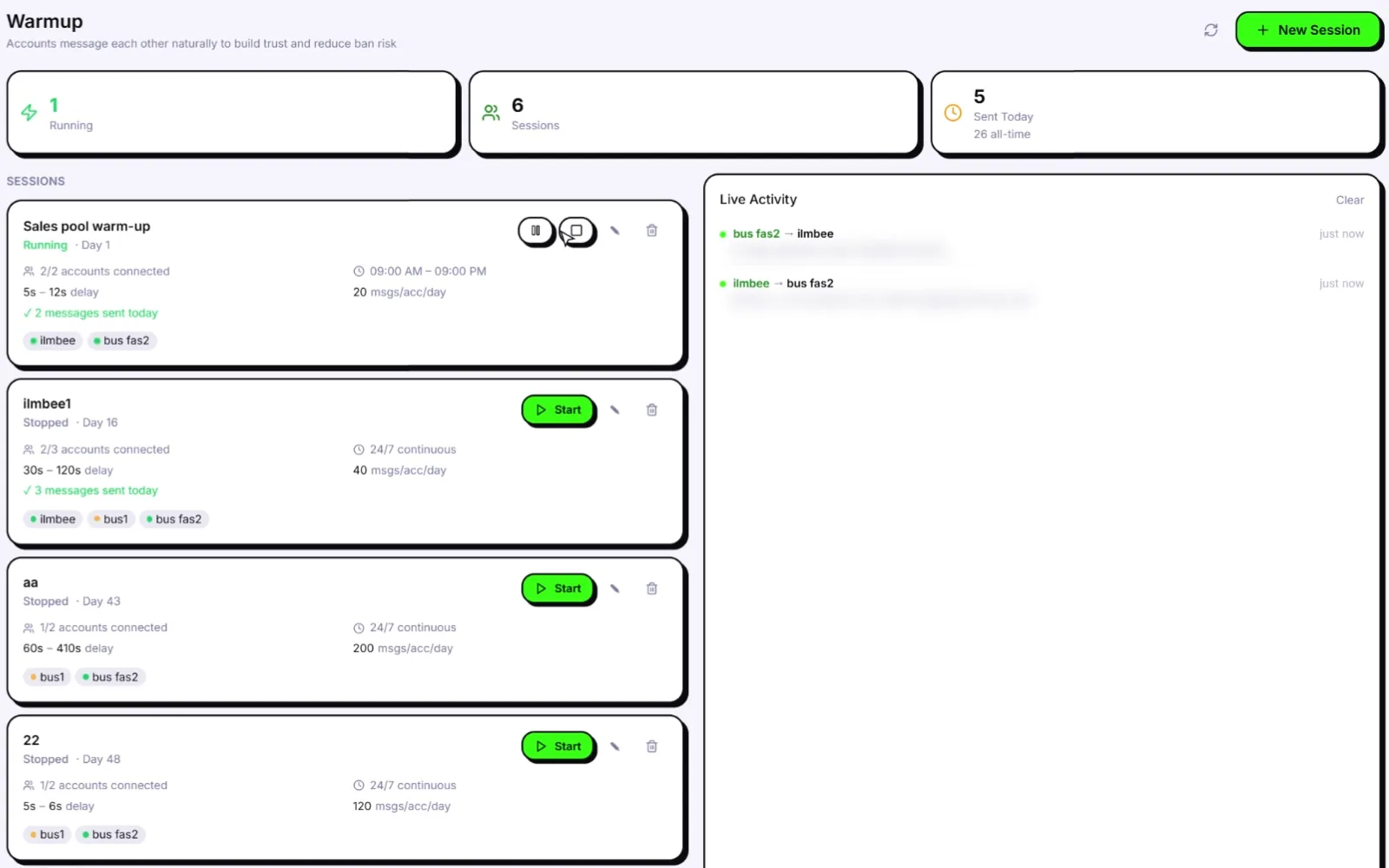
It doesn't replace referrals, content or partners, and cold outreach always carries ban risk. The download is free; warming and sending need a licence, $397 one-time on early-bird lifetime pricing. New to warm-up? Read how the WhatsApp warmer works.
Add WhatsApp to your no-ads plan, carefully
Warm your numbers while you work your network, then send paced, personalised outreach from one Windows app.
Free account. Windows 10 and 11. Warming and sending need an active licence.
Frequently asked questions
Can you really get clients without ads?
Yes. Many service businesses win their first clients through referrals, their network, direct outreach and content rather than ads, and agency owners on Reddit describe exactly that, though those are anecdotes. The trade-off is time: no-ads channels cost hours instead of money and take weeks or months to build, but they keep working when you stop paying.
What is the fastest way to get clients without paid ads?
Your existing network is usually fastest. Send 30 to 50 people who know your work a specific request, such as an introduction to one type of business, and follow up once. Direct outreach to a short, researched list comes next. Content, partnerships and communities take longer to start but tend to compound over the following months.
How much does it cost to get clients without advertising?
Mostly time: several hours a week across referrals, outreach and content, plus modest costs for tools such as email, data or messaging software. Compare that with paid search, where LocaliQ's 2026 benchmarks put the average cost per lead at $66.69, paid for every lead. No-ads channels move the cost from your budget to your calendar.
What reply rate should I expect from cold outreach?
It depends on the channel and how it is measured. Cold email benchmarks for 2025 range from 0.45% of all emails sent to a 4.5% average sequence reply rate. Belkins reports a 7.2% reply rate on LinkedIn messages. There is no reliable public benchmark for cold WhatsApp, so measure your own replies and booked calls.
Are paid ads dead in 2026?
No. Ads still produce leads, and search ad cost per lead actually came down in LocaliQ's 2026 data. What changed is price on social platforms: Meta's average price per ad rose 9% across 2025 and 12% year over year in Q2 2026 (Meta). Ads work best as an amplifier on top of channels you own, not as your only source of clients.
Is organic client acquisition better than paid ads?
Neither wins in every case. Organic client acquisition (referrals, content, outreach and partners) costs less money and builds assets that keep working, but it is slower and depends on your effort. Paid ads are quicker to switch on and easier to scale, but stop the moment the budget does. Most businesses do best with organic channels as the base and ads on top.