RCS vs WhatsApp in 2026: what RCS changes for business messaging, and what it doesn't
RCS vs WhatsApp is not a straight swap. For branded alerts and offers to opted-in customers in the US and parts of Europe, RCS is the upgrade from SMS, with a verified sender badge. For conversations in markets where WhatsApp is the default app, WhatsApp wins. For cold outreach, RCS is not an option: every business agent needs brand verification and launch approval.
- What RCS is: the mobile industry's upgrade to SMS, with read receipts, rich media and verified business senders inside the phone's default messaging app.
- iPhone: Apple added RCS in iOS 18 (September 2024) and business messages in iOS 18.1, but only where the carrier switches them on, and no official list says which US carriers do.
- Scale: Google counts more than 1 billion RCS messages a day in the US (May 2025), but only on its own Jibe platform. WhatsApp has more than 3 billion monthly users.
- Cost: RCS is billed per message, segment or session from carrier rate cards; Twilio lists US rich text at $0.0083 a segment. Ordinary WhatsApp accounts have no per-message fee.
- Outreach: RCS needs a verified brand agent, an RCS partner and carrier approval, so it suits opted-in customers, not cold outreach from personal numbers.
RCS vs WhatsApp: the short verdict
RCS is the better choice for branded messages to opted-in customers where texting is the default, mainly the US and parts of Europe. WhatsApp is the better choice for conversations in the many markets where it is already the main chat app.
The verdict by use case
| If you need... | Choose | Why |
|---|---|---|
| Branded alerts and offers to opted-in US customers | RCS, with SMS fallback | Lands in the default messaging app with a verified badge and falls back to SMS where RCS isn't available |
| Rich cards, carousels and reply buttons with no app to install | RCS | Built into Google Messages and, where carriers allow it, iPhone Messages |
| Reaching Android users who never installed WhatsApp | RCS | Google Messages had more than 1 billion RCS-enabled monthly users in November 2023 |
| Two-way sales conversations in WhatsApp-first markets | It is the app people already use: top in 70 of 100 countries Similarweb measured | |
| One business channel across many countries | WhatsApp Business API | One platform worldwide, while RCS launches depend on carriers country by country |
| Many conversations from several numbers, without the API | WhatsApp (with a warmer such as Wassuply) | RCS has no route for ordinary numbers; WhatsApp numbers must be warmed and paced to limit bans |
| Cold outreach from personal numbers | Not RCS | RCS business messages only come from verified, approved brand agents; on WhatsApp it carries ban risk and legal limits |
RCS business messaging vs WhatsApp side by side
Details and sources for each row are in the sections below. Prices and availability are as of October 2026.
| Factor | RCS for Business | |
|---|---|---|
| What it is | A carrier messaging standard, the upgrade to SMS, inside the phone's default app | A separate app owned by Meta, with more than 3 billion monthly users |
| Where it works | Android via Google Messages; iPhone on iOS 18.1 or later where the carrier enables business messages | Any smartphone with the app installed |
| Who can send as a business | Verified brand agents, launched with carriers, through an RCS partner | Anyone with an account; the Business API for scale, with templates |
| Sender identity | Brand name, logo and a "Verified" checkmark | A business profile; verification options on the API |
| If the phone can't receive it | Falls back to SMS | No fallback; the recipient needs WhatsApp |
| Cost | Per message, segment or session from carrier rate cards; Twilio US rich text $0.0083 a segment | Nothing per message on ordinary accounts; per delivered message on the API |
| Consent | Carrier messaging, so plan on SMS rules; STOP must be supported | Opt-in expected on the API; marketing law applies either way |
| Rich features | Rich cards, carousels, suggested replies and actions, read receipts | Images, documents, voice notes, read receipts |
| Best for | Branded alerts and offers to opted-in customers in the US and parts of Europe | Conversations in WhatsApp-first markets |
What is RCS messaging in 2026?
RCS (Rich Communication Services) is the mobile industry's upgrade to SMS: chat-style messages with read receipts and high-quality media, sent through the phone's built-in messaging app over mobile data or Wi-Fi. There are two kinds. Person-to-person RCS chat replaces texting between friends, and RCS for Business (formerly RCS Business Messaging, or RBM) lets verified brands send branded messages.
The standard behind it is the GSMA's Universal Profile, which Apple adopted for the iPhone. Google and Apple began rolling out end-to-end encryption for RCS chats between Android and iPhone on 11 May 2026, for iPhones on iOS 26.5 (then in beta) with a supported carrier. Google's post doesn't say whether business messages are covered.
Does RCS work on iPhone?
Yes for personal chats, partly for business messages. Apple released RCS support in iOS 18 on 16 September 2024, and says it works only in specific markets and needs carrier support. Business messages came in iOS 18.1, but each carrier has to switch them on. In January 2025, Twilio said two of the three major US carriers supported RCS business messaging across devices; it also puts iOS at about 57% of the US market, a vendor figure.
The current picture is unclear. Apple's RCS support page (May 2026) includes an "RCS Business Messages" switch that iPhone users can turn off. Apple's carrier list (September 2026) names 43 US and 19 Canadian carriers that support RCS on iPhone, but doesn't mark which ones deliver business messages. We found no official Apple or Google list of US carriers that do, so test on your customers' carriers before planning around it.
How does RCS business messaging work?
A brand sends RCS business messages through an "agent" that passes brand verification and launch approval by Google, the carriers or both. To build one, you register with Google as an RCS for Business partner or work with one: Google says partners can create agents for brands they manage.
- Verified senders. Google's RCS for Business overview promises a "Verified" icon. After verification and launch, Google Messages shows a checkmark next to the agent's name.
- Brand verification first. Google calls brand verification a prerequisite for launch. A brand employee with authority confirms the agent's details, and some carriers also require a token from a third-party verification authority.
- Launch approval per carrier. Launch reviews are run by Google, the carriers or both, depending on the carriers you pick. Google-managed launches typically take 1-3 business days once brand approval and assets are in; carrier-managed launches follow each carrier's own process.
- The business starts the chat. In Google's model, the agent sends the first message after a trigger in your own systems, such as an order. If a phone can't receive RCS, the platform returns an error and you fall back to another channel such as SMS.
- Opt-outs are mandatory. Agents must support STOP and its equivalents, and can't message that person again unless they opt back in.
- Rich messages. Rich cards combine media, text and suggestions in one message, carousels string several cards together, and suggested replies and actions give people buttons to tap instead of typing.
In short, RCS business messaging is built for known brands talking to their own customers. That is its strength, and it is why it doesn't work for cold outreach.
How many people use RCS? The figures that hold up
RCS volume is real but hard to pin down: the best figure is Google's "more than a billion RCS messages a day in the US" (May 2025), and it counts only Google's own traffic.
Google said in May 2025 that more than a billion RCS messages are sent every day in the US, as a 28-day average. T-Mobile then pointed out that this covers only traffic on Google's Jibe platform, and said its own customers send about 613 million a day (as reported by Android Authority). For scale, CTIA counted nearly 2.2 trillion US SMS and MMS messages in 2024, about 6 billion a day, so Google's RCS count was roughly a sixth of that (our arithmetic, across sources and years).
- Users. Google Messages passed 1 billion monthly active users with RCS enabled in November 2023, Google's last published count.
- UK reach. Google Messages reached 42% of UK online adults in May 2025, against 90% for WhatsApp (Ofcom).
- Penetration. Juniper Research puts RCS penetration above 80% in markets such as the US and France (February 2026).
- Revenue. Juniper forecasts mobile operators' RCS for Business revenue rising from $1.2 billion in 2025 to $3.1 billion in 2027. The 2027 number is a forecast, and $1.2 billion is Juniper's own figure for 2025.
- Availability. AWS supported RCS for Business in 22 countries as of May 2026, mostly in Europe and the Americas plus Singapore. Other providers list slightly different sets.
WhatsApp's numbers are on another scale. It has more than 3 billion monthly users (Meta, April 2025) and was the top messaging app in 70 of the 100 countries in Similarweb's 2025 ranking, which uses Android data.
How much does RCS business messaging cost compared with WhatsApp?
RCS business messages are paid per message, segment or session at prices set by carrier rate cards. WhatsApp charges per delivered message on its API and nothing per message on ordinary accounts.
| Channel | How it is billed | Who sets the price |
|---|---|---|
| RCS for Business, US | Rich text per 160-byte segment; rich media per message; each tap on a suggested action; a 24-hour session charge after 4 messages are exchanged | Each carrier's rate card |
| RCS for Business, outside the US | Non-conversational agents per message; conversational agents a flat rate per 24-hour conversation | Carriers, under Google's billing model |
| WhatsApp Business API | Per delivered message, by category and recipient country | Meta |
| WhatsApp, ordinary accounts | No per-message fee | None; you pay for SIMs, proxies and software |
Outside the US, Google's billing FAQ (updated August 2026) charges conversational agents a fixed rate per 24-hour conversation, which opens when the user replies within 24 hours. On 20 November 2025 Google merged its old "Basic" and "Single" categories into one "Non-conversational" category. The US follows its own model, set out in Google's US billing FAQ.
As a reference point, Twilio lists US RCS at $0.0083 per rich text segment and $0.022 per rich media message before carrier fees, the same base rates as its SMS and MMS (October 2026). On WhatsApp's API, Meta has charged per delivered message since 1 July 2025, with rates by message category and the recipient's country code. For the full SMS cost picture, see SMS vs WhatsApp for outreach.
Will RCS replace WhatsApp?
Not in the next few years. RCS is replacing plain SMS for brands in the US and parts of Europe, but WhatsApp is already the default chat app across most of the world, and business RCS still depends on each carrier.
Why RCS is mostly an SMS upgrade
RCS lives inside the default texting app and falls back to SMS, so it wins where texting is already the default. That is the US, where 32% of adults use WhatsApp (Pew, 2025) and Juniper puts RCS penetration above 80%, and parts of Europe such as France. For a US brand, RCS for Business is a better SMS: the same audience and the same consent rules, plus a logo, a verified badge and buttons.
Why WhatsApp stays the default in most markets
Where WhatsApp is already the habit, RCS competes with an app people open dozens of times a day, not with SMS. In the UK, 90% of online adults use WhatsApp and 42% use Google Messages (Ofcom, 2025). WhatsApp needs no carrier to switch anything on, while business RCS needs launch approval carrier by carrier and, on iPhone, carrier switches that are not all on.
The sober answer
Both channels are growing as paid business channels. Juniper expects operators' RCS for Business revenue to reach $3.1 billion in 2027, and Meta said paid messaging inside WhatsApp passed a $2 billion annual run rate in Q4 2025. These are different measures, so don't read them as market shares. For US brands, RCS is likely to absorb much of their plain SMS. For people who already chat on WhatsApp, we found nothing in the data suggesting they will switch.
What does RCS mean for outreach in 2026 and 2027?
RCS business messaging is a channel for a verified brand's opted-in customers, not a tool for cold outreach from personal numbers. Here is what it takes and where it fits.
- A verified brand agent, with a brand representative who can confirm it.
- An RCS partner, usually an aggregator or your existing messaging provider, or your own partner registration with Google.
- Launch approval from Google, each carrier or both, in each country you target.
- SMS fallback for phones that can't receive RCS.
- Consent and STOP handling. RCS is carrier messaging, and the ICO's definition of electronic mail covers text and image messages sent over a public network, so UK consent rules and US texting rules should be assumed to apply. Take legal advice.
Person-to-person RCS from your own phone is just texting with extras: no verified badge, no business tooling and the same marketing law as SMS. So for 2026 and 2027, a sensible split looks like this:
- US brands with opted-in customers: add RCS through your SMS provider for alerts and offers, with SMS fallback. Our SMS vs WhatsApp guide covers 10DLC and TCPA rules.
- Opted-in customers in WhatsApp-first markets: here the real RCS vs WhatsApp Business choice usually favours the WhatsApp Business API, which expects opt-in permission and approved templates. We compare it with ordinary numbers in Wassuply vs the WhatsApp API.
- One-to-one outreach in WhatsApp-first markets: ordinary WhatsApp numbers, warmed and paced, within the law. WhatsApp's Messaging Guidelines prohibit bulk and auto-messaging, so this carries ban risk. Read whether WhatsApp outreach works before you start.
What do people on Reddit report about RCS vs WhatsApp?
We found no Reddit thread in which a business reported RCS campaign results. The threads that exist, mostly in an RCS enthusiasts' forum, are about getting started. They are individual anecdotes, not data:
- r/UniversalProfile, 2024: a small Italian company's verified RCS business agent waited 3.5 months for launch approval, with no estimate from support. OP later wrote "Now it approved almost 4 months later", having applied to Google directly without a messaging partner. (thread)
- r/UniversalProfile, 2025: OP couldn't find any US business using RCS business messaging. Replies named only Best Buy for order pickups, Walgreens for prescription notices and possibly Sonic, and one said the Best Buy message didn't accept replies. (thread)
- r/UniversalProfile, 2025: enthusiasts started a list of brands using RCS business messaging because there are so few, with Asda's UK grocery updates as one example. One reply said "RCS Business messaging is so difficult to set up", adding that Google seems not to want businesses using it. (thread)
- r/whatsapp, 2024: on the WhatsApp side, a poster cold-messaging through a bulk-sender extension said their number was banned even at 50 messages a day. (thread)
How to start WhatsApp outreach safely
Start with one warmed number, a short list of people with a reason to hear from you, and slow sending. Four steps:
- 1Create a free accountSign up for Wassuply, download the Windows app and connect one number first.
- 2Warm the number for at least 15 daysThirty days is better for a brand-new number. Let it chat with your other numbers or a Warm-up Pod before any campaign.
- 3Start small and lawfulMessage people who expect contact, stay within the number's safe daily limit and check the marketing rules in each recipient's country.
- 4Pace, stop on reply and honour opt-outsUse random gaps and blackout hours, stop follow-ups when someone replies and remove anyone who asks you to stop.
Where Wassuply fits next to RCS
Wassuply is a Windows desktop app for warming up WhatsApp numbers and running cold WhatsApp outreach from unlimited numbers, sold as a one-time $397 lifetime licence during early access. It doesn't send RCS or SMS. Where RCS needs a verified brand agent and carrier approval, Wassuply works with the ordinary numbers you already have.
- No API, verification or templates. It drives normal WhatsApp and WhatsApp Business accounts through WhatsApp Web sessions, with no per-message fee.
- Many numbers, kept apart. Each number gets its own isolated session, browser fingerprint and optional proxy, so you can run several accounts from one PC.
- Warm-up and limits. Numbers warm up by chatting with each other or in Warm-up Pods, and Health & Risk gives each one a safe daily limit of 30 to 250 messages depending on its age.
- Conversation-style campaigns. AI-personalised first messages use your own Claude, ChatGPT or DeepSeek API key, voice notes are supported, and follow-ups stop the moment someone replies.
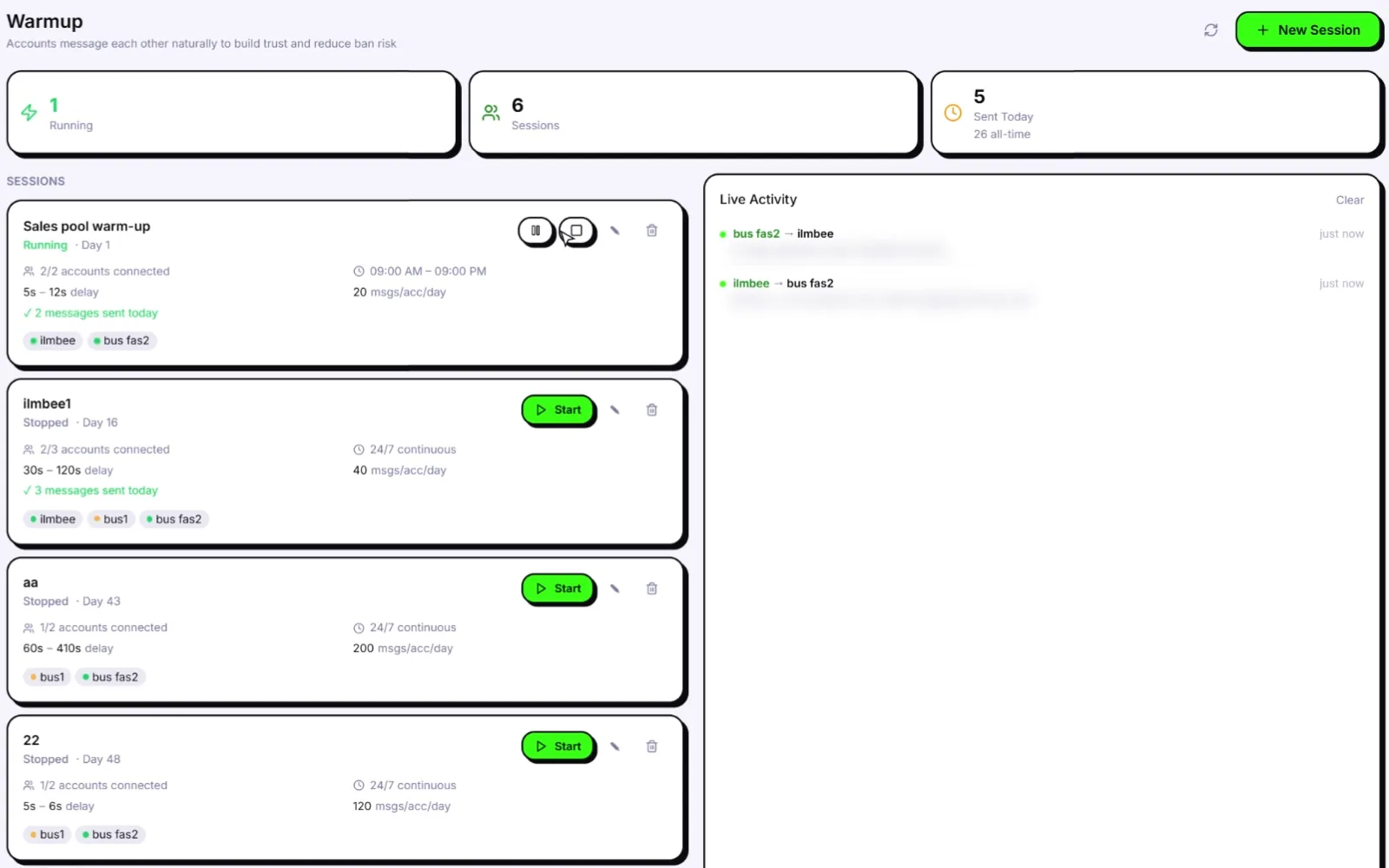
It won't give you a verified badge or remove ban risk. The app is free to download; connecting numbers, warming and sending need a licence, currently $397 one-time for lifetime access.
RCS for your alerts, WhatsApp for your conversations
Warm WhatsApp numbers, see a safe daily limit for each one and run paced one-to-one outreach from a Windows app, with no API, templates or per-message fees.
Free account. Windows 10 and 11. Warming and sending need an active licence.
Frequently asked questions
What is the difference between RCS and WhatsApp?
RCS is a carrier messaging standard built into the phone's default texting app, the upgrade to SMS. WhatsApp is a separate app owned by Meta, with more than 3 billion monthly users. For businesses, RCS messages come from verified brand agents approved by Google and the carriers and fall back to SMS, while WhatsApp reaches anyone with the app, through the Business API or ordinary accounts.
Will RCS replace WhatsApp?
Unlikely in the next few years. RCS is replacing plain SMS for brands in the US and parts of Europe, where texting is the default. WhatsApp is the top messaging app in 70 of the 100 countries Similarweb measured and reaches 90% of UK online adults (Ofcom, 2025), so people there already have a chat app. Business RCS also depends on each carrier switching it on.
Does RCS business messaging work on iPhone?
Partly. Apple added RCS in iOS 18 in September 2024 and RCS business messages in iOS 18.1, but each carrier has to enable business messaging. Twilio said in early 2025 that two of the three major US carriers supported it, and no official Apple or Google list shows which carriers deliver business messages to iPhones today. Users can also switch RCS business messages off.
How much does RCS business messaging cost?
Prices come from carrier rate cards. In the US, rich text is billed per 160-byte segment, rich media per message, each tap on a suggested action is billable, and a 24-hour session charge applies after four messages are exchanged. Elsewhere, Google bills per message or per 24-hour conversation. Twilio lists US rich text at $0.0083 a segment before carrier fees (October 2026).
Can I use RCS for cold outreach?
Not in practice. RCS business messages come from a brand agent that has passed brand verification and launch approval by Google, the carriers or both, usually set up through an RCS partner. Agents must honour STOP replies, and RCS is carrier messaging, so plan on the same consent rules as SMS. It suits opted-in customers, not cold lists or personal numbers.
Is RCS end-to-end encrypted?
Person-to-person RCS chats between Android and iPhone began getting end-to-end encryption on 11 May 2026, when Google and Apple started a joint rollout that needs iOS 26.5, then in beta, and a supported carrier. Google's announcement doesn't say whether business messages are included, so don't assume RCS business messages are end-to-end encrypted until Google or your provider confirms it.
Sources
- Apple Newsroom: iOS 18 is available today (September 2024)
- Twilio blog: Apple's iOS 18.1 release expands RCS to Business Messaging (October 2024, updated February 2025)
- Apple Support: Turn on RCS messaging on your iPhone (May 2026)
- Apple Support: Wireless carrier support and features for iPhone (September 2026)
- Google: End-to-end encrypted RCS messaging begins rolling out for Android and iPhone (May 2026)
- Google for Developers: RCS for Business overview (checked October 2026)
- Google for Developers: Register as a partner (September 2026)
- Google for Developers: Brand verification (September 2026)
- Google for Developers: Launch approval (October 2026)
- Google for Developers: How RCS for Business works (October 2025)
- Google for Developers: Send messages, rich cards and carousels (October 2026)
- Google: A billion RCS messages are sent every day in the U.S. (May 2025)
- Android Authority: T-Mobile responds to Google's RCS figure (2025)
- CTIA: 2025 Annual Survey Highlights (September 2025)
- Google: New features to celebrate Messages' 1 billion RCS users (November 2023)
- Ofcom: Online Nation 2025 (December 2025)
- Juniper Research: Operator RCS for Business revenue to reach $3 billion by 2027 (February 2026)
- AWS What's New: RCS for Business in 20 more countries (May 2026)
- TechCrunch: WhatsApp now has more than 3 billion users a month (May 2025)
- Similarweb: Most Popular Messaging Apps in 2025 (2025)
- Pew Research Center: Americans' Social Media Use 2025 (November 2025)
- Google for Developers: RCS for Business billing FAQ (August 2026)
- Google for Developers: RCS for Business US billing FAQ (August 2026)
- Twilio: SMS and RCS pricing, United States (October 2026)
- Meta for Developers: WhatsApp Business Platform pricing (checked October 2026)
- Motley Fool: Meta Q4 2025 earnings call transcript (January 2026)
- WhatsApp: Business Messaging Policy (checked October 2026)
- ICO: Guide to PECR, electronic mail marketing (checked October 2026)
- WhatsApp: Messaging Guidelines (September 2026)
Sources checked October 2026. Vendor figures are labelled as such in the text.