SMS vs WhatsApp for outreach in 2026: which channel should you use?
SMS vs WhatsApp has a split answer. For opted-in US customers and transactional alerts, SMS wins: it reaches every mobile number, while only 32% of US adults use WhatsApp (Pew, 2025). For conversations in WhatsApp-first markets, including the UK, where 90% of online adults use it (Ofcom, 2025), WhatsApp usually wins on cost, format and replies. Cold outreach is restricted on both.
- Reach: SMS reaches every US phone. WhatsApp leads in 70 of the 100 countries Similarweb measured and reaches 90% of UK online adults.
- Rules: US business texts need A2P 10DLC registration and must follow TCPA consent, Do-Not-Call, quiet-hours and opt-out rules. UK marketing texts to individuals need consent under PECR.
- Cost: a registered US text costs about $0.012 to $0.013 a segment on Twilio, a UK text $0.056. Ordinary WhatsApp accounts have no per-message fee.
- Read rates: both famous "98%" open rates are untraceable. WhatsApp's best measured figure is a 72% median, on opt-in campaigns.
- Risk: carriers filter and block texts; WhatsApp restricts or bans the number. Warm and pace WhatsApp numbers before outreach.
SMS vs WhatsApp: which is better for outreach?
Whether you are weighing SMS vs WhatsApp marketing or one-to-one outreach, neither channel wins everywhere: SMS is better for opted-in US audiences and alerts, and WhatsApp is better for conversations in markets where it is the default app. Pick by use case first, then by market.
The verdict by use case
| If you need... | Choose | Why |
|---|---|---|
| Marketing texts to opted-in US customers | SMS | Texting is built into every US phone; only about a third of US adults use WhatsApp |
| One-time passcodes, delivery and appointment alerts | SMS (or RCS where supported) | Arrives on any phone with no app, login or data plan |
| Two-way sales conversations in WhatsApp-first markets | It is where people already chat, with voice notes, images and read receipts | |
| Low-cost messages to UK, Indian or Brazilian contacts | No per-message fee on ordinary accounts, against $0.056 to $0.0832 per SMS segment on Twilio | |
| Reaching people without smartphones or mobile data | SMS | WhatsApp needs a smartphone and an internet connection |
| Many conversations from several numbers, without the API | WhatsApp (with a warmer such as Wassuply) | Ordinary numbers cost nothing per message, but each one must be warmed and paced to limit bans |
| Cold messages to US consumers' mobiles | Neither, without consent | TCPA, Do-Not-Call rules and carrier filtering apply to texts; WhatsApp's terms ban bulk messaging |
SMS vs WhatsApp side by side
Sources for every row are in the sections below. Prices and rules are as of October 2026.
| Factor | SMS | |
|---|---|---|
| Reach | Any mobile number; nearly 2.2 trillion US SMS and MMS in 2024 | More than 3 billion monthly users; used by 32% of US adults and 90% of UK online adults |
| What the recipient needs | A mobile number, no app or data | A smartphone, the app and a data or Wi-Fi connection |
| Registration (US) | A2P 10DLC brand and campaign registration for 10-digit numbers | None for ordinary accounts; business verification and templates on the API |
| Consent rules | TCPA, Do-Not-Call and quiet hours (US); PECR consent (UK) | The same marketing laws likely apply; WhatsApp's policy expects opt-in |
| Cost per message | About $0.012 to $0.013 a segment in the US with carrier fees; $0.056 to the UK | Nothing on ordinary accounts; per delivered message on the API |
| Read signal | None; SMS opens can't be measured | Read receipts, if the recipient has them on |
| Format | 160-character segments; MMS for images at extra cost | Text, images, documents, links and voice notes in one chat |
| What goes wrong | Carriers filter or block messages; fines can be passed on | The number is restricted or banned |
Which reaches more people: SMS or WhatsApp?
In the US, SMS reaches more people; in most other countries, WhatsApp does. Texting is built into every phone, while WhatsApp is an app people have to choose.
Americans exchanged nearly 2.2 trillion SMS and MMS messages in 2024, according to the wireless trade body CTIA. By contrast, 32% of US adults say they use WhatsApp (Pew Research Center, 2025), and WhatsApp reported more than 100 million monthly US users in July 2024.
Outside the US the picture flips. WhatsApp has more than 3 billion monthly users (Meta, April 2025) and was the top messaging app in 70 of the 100 countries in Similarweb's 2025 ranking, which uses Android data. In the UK, Ofcom found WhatsApp reached 90% of online adults in May 2025, with 74% using it daily. Google Messages, the Android app that carries SMS and RCS, reached 42%. Ofcom's list leaves out Apple's Messages app, so it isn't a full count of texting.
SMS still reaches people WhatsApp can't: basic phones, phones without a data plan and anyone who never installed the app. The practical question is where the people on your list actually talk.
What rules apply to SMS marketing in the US and UK?
In the US, business texts need A2P 10DLC registration and must follow the TCPA's consent, Do-Not-Call, quiet-hours and opt-out rules. In the UK, marketing texts to individuals need consent under PECR.
US: A2P 10DLC registration and fees
A2P 10DLC is the US registration system for business texts sent from ordinary 10-digit numbers. A2P means application-to-person, and Twilio says the requirement covers individuals and hobbyists too. Businesses can't register directly with The Campaign Registry, which runs the system; a provider such as Twilio registers the brand and each campaign (use case) for them.
Twilio has blocked all unregistered 10DLC traffic to US numbers since 1 September 2023. The Campaign Registry raised its fees on 1 August 2025: brand registration is now $4.50 and standard vetting $41.50, on top of a $15 one-time vetting fee per campaign and a monthly fee of $1.50 to $10 per campaign, depending on use case (Twilio Help Center, as of October 2026).
US: TCPA consent, quiet hours and opt-outs
- Written consent. Under the FCC's TCPA rules, telemarketing to a mobile number with an autodialer or a prerecorded voice needs the recipient's prior express written consent: a signed agreement, e-signatures included, that clearly authorises the seller and names the number. Whether your sending setup counts as an autodialer is a question for a lawyer.
- Do-Not-Call. The Do-Not-Call rules, including the national registry, cover telemarketing texts to mobile numbers, which the FCC codified in an order released in December 2023.
- Quiet hours. No telephone solicitation before 8 a.m. or after 9 p.m. in the recipient's local time.
- Opt-outs. Since 11 April 2025, people can revoke consent by any reasonable method. Replies such as "stop", "quit", "end", "revoke", "opt out", "cancel" or "unsubscribe" count automatically, and you must honour them within 10 business days. The FCC has delayed one part, the "revoke all" requirement, until 31 January 2027.
- One rule that never arrived. The FCC's one-to-one consent rule for lead generators was vacated by the Eleventh Circuit in January 2025.
UK: PECR consent and the limits of the soft opt-in
The ICO says you must not send marketing texts to individuals without specific consent. The soft opt-in is a narrow exception for your own previous customers, about similar products, with an opt-out offered when you collected their details and in every message. It never covers prospects or bought-in lists.
You may text corporate bodies without consent, but sole traders and some partnerships count as individuals. Since the Data (Use and Access) Act 2025, the ICO can fine PECR breaches up to £17.5 million or 4% of global turnover.
Does any of this apply to WhatsApp?
Partly. WhatsApp has no registration system for ordinary accounts, but marketing law follows the message, not the app. The ICO's guidance doesn't name WhatsApp, though it does cover direct messages on social media, so a cold WhatsApp marketing message to a UK individual or sole trader is likely covered by the same consent rule. Take legal advice for your market. WhatsApp adds its own layer: its Terms of Service list bulk messaging and auto-messaging as impermissible, and its Business Messaging Policy expects businesses to have opt-in permission. Our guide to cold WhatsApp messages and GDPR covers the basics.
How much does SMS cost compared with WhatsApp?
SMS charges for every 160-character segment you send. WhatsApp from an ordinary account costs nothing per message, and the official API charges per delivered message.
Twilio's US list price is $0.0083 per outbound segment, plus carrier pass-through fees on 10DLC: $0.0035 for AT&T, $0.0045 for T-Mobile and about $0.005 for Verizon and US Cellular (October 2026). That puts a registered US text at roughly $0.012 to $0.013 a segment before volume discounts (our arithmetic). Picture messages (MMS) cost $0.022 plus carrier fees.
Texts abroad cost more. Twilio lists outbound SMS at $0.056 a segment to the UK, $0.0832 to India and $0.0599 to Brazil. Longer texts split into several billed segments.
| 1,000 one-segment messages to... | SMS via Twilio (list price) | |
|---|---|---|
| US numbers | About $12 to $13, plus 10DLC fees | $0 per message on ordinary accounts |
| UK numbers | About $56 | $0 per message on ordinary accounts |
| Brazilian numbers | About $60 | $0 per message on ordinary accounts |
| Indian numbers | About $83 | $0 per message on ordinary accounts |
That is our arithmetic from Twilio's October 2026 list prices, before volume discounts. WhatsApp's zero has its own costs: SIMs, proxies, software and weeks of warm-up per number.
The official route is different. On the WhatsApp Business Platform, Meta has charged per delivered message since 1 July 2025, with rates set by message category (marketing, utility, authentication or service) and the recipient's country code. From 1 October 2026, service messages are also charged beyond a free tier of 1,000 a month per business number. Check Meta's rate card for your markets; we compare the two routes in Wassuply vs the WhatsApp API.
Do people read SMS and WhatsApp messages? Read rates and format
Nobody can measure an SMS open rate, and the measured WhatsApp figures come from opt-in campaigns, not outreach. Format is where the two channels really differ.
The "98% SMS open rate" is untraceable
SMS has no read receipt and no tracking pixel, so an SMS "open rate" can't be measured at all. The famous 98% traces to a 2010 white paper, and in February 2025 its publisher, Mobilesquared, said the figure no longer reflects today's mobile messaging. Its newer claim that 55% of SMS are read comes with no methodology, so treat it as an unverified vendor claim. CTIA still repeated the 98% to Congress in June 2025 testimony, without a citation.
SMS platforms measure clicks instead, on opted-in e-commerce lists. Klaviyo rates a US SMS campaign click rate of 8.9% to 14.5% as "good", and Omnisend's 2025 SMS campaigns averaged a 12.39% click rate. Neither covers cold outreach.
What WhatsApp read rates actually look like
WhatsApp's own "98% open rate" is just as untraceable: Meta's WhatsApp Business blog footnotes it to a vendor listicle that gives no source. The best measured figure is Chatarmin's 2026 benchmark: a 72.05% median and 79.6% weighted open rate across 382 brands' opt-in campaigns, counted from read receipts on delivered messages. These are opt-in marketing messages, not cold ones, and anyone with read receipts off counts as unread. More in our breakdown of the real WhatsApp open rate.
Format: rich media, voice notes and two-way chat
SMS is plain text in 160-character segments; pictures need MMS at a higher price. WhatsApp carries images, documents, links and voice notes in a thread that looks like any other chat. Users send 7 billion voice messages a day (WhatsApp, March 2022), and on-device transcripts (November 2024) let people read a voice note instead of playing it.
Don't assume voice wins, though. In YouGov's 17-market survey of November 2023, 66% preferred sending text and 7% audio, although only 38% in the UAE preferred text. No independent data shows voice notes lift reply rates in outreach. Both channels are two-way, but on WhatsApp a reply feels like chat rather than a response to an alert. RCS narrows part of the format gap for texts; see RCS vs WhatsApp.
Which is riskier: carrier filtering or a WhatsApp ban?
With SMS, carriers silently filter or block your messages and can pass on fines. With WhatsApp, the number itself gets restricted or banned, along with its chats.
SMS: filtering, blocking and fines
US wireless providers blocked more than 55 billion scam and spam texts in 2024, CTIA told Congress in June 2025 (its members' own figure, not independently checked). Filtering doesn't stop at scammers. Twilio's error 30007 means a message was filtered by Twilio or the carrier, even from a registered number, and Klaviyo warns that higher-than-average unsubscribe rates can lead to carrier limits or blocking.
Fines can follow. Since January 2024, T-Mobile has charged non-compliance fees that providers pass on to the sender: $2,000 per violation for phishing or smishing, $1,000 for illegal content and $500 for other breaches, according to a messaging provider's summary. Carriers have reason to be strict: Americans reported $470 million in losses to text scams in 2024 (FTC).
WhatsApp: restrictions and bans
WhatsApp's Messaging Guidelines (updated September 2026) prohibit bulk messaging, auto-messaging and auto-dialling, and list temporary or permanent suspension among the penalties. WhatsApp is also testing a monthly cap on messages to people who haven't replied, without saying what the limit is. Warming a new number for at least 15 days, ideally 30, and keeping daily volume low reduce the risk without removing it; our guide to avoiding WhatsApp bans covers the details.
What do people on Reddit report about SMS vs WhatsApp?
These are individual anecdotes from small threads, not data. None of them compares measured reply rates on the two channels.
- r/gohighlevel, 2025: asked whether to use SMS or WhatsApp for automated follow-ups, the top reply said to use the channel the prospect actually answers on: "If you're in the US/Canada, SMS is the way to go." A reply from the Netherlands said people there use WhatsApp and very little SMS. (thread)
- r/gohighlevel, 2024: an agency texting leads who had opted in through Facebook forms suddenly hit a 250-text limit. Replies explained that each sub-account has to climb tiered limits, with a 24-hour pause at each level, before it can send 3,000 or more texts a day. (thread)
- r/gohighlevel, 2025: asked about cold-texting homeowners, all three replies advised against it, citing penalties of up to $1,500 per unsolicited text and campaigns suspended for high opt-out rates. (thread)
- r/whatsapp, 2024: on the WhatsApp side, a poster cold-messaging through a bulk-sender extension wrote, "i used to send only to 50 numbers a day however it still got banned". (thread)
When does SMS win over WhatsApp?
SMS wins for US customers, for transactional alerts and for anyone without a smartphone or mobile data. In those cases, choosing WhatsApp just means reaching fewer people.
- US customers who opted in to texts. Texting is native in the US and only about a third of adults use WhatsApp. A registered 10DLC number and a clear opt-in is the established route.
- Transactional alerts and passcodes. Delivery updates, appointment reminders and one-time codes need to land on any phone, with no app to open and no login.
- People without smartphone data. Basic phones, people roaming without data and anyone on a tight data plan still get texts.
WhatsApp wins in the opposite cases: WhatsApp-first markets, conversations rather than broadcasts, international contacts and follow-ups that need a voice note, image or document. A quick test for your list:
- Mostly US consumers who opted in to texts? Use SMS.
- Sending alerts or passcodes? Use SMS, or RCS where it is supported.
- Contacts in a market where WhatsApp is the normal way to talk? Use WhatsApp.
- Want a back-and-forth conversation rather than a one-way notice? WhatsApp usually fits better.
- No consent and no lawful basis for contact? Don't send on either channel.
WhatsApp or SMS for business, then? Many teams use both: SMS for alerts, WhatsApp for conversations.
How to start WhatsApp outreach safely
Start with one warmed number, a small list of people who have a reason to hear from you, and slow sending. Four steps:
- 1Create a free accountSign up for Wassuply, download the Windows app and connect one number first.
- 2Warm the number for at least 15 daysThirty days is better for a brand-new number. Let it chat with your other numbers or a Warm-up Pod before any campaign.
- 3Start small and lawfulMessage people who expect contact, keep to the number's safe daily limit and check the marketing rules for each recipient's country.
- 4Pace, stop on reply and honour opt-outsUse random gaps and blackout hours, stop follow-ups when someone replies, and remove anyone who says stop.
Where Wassuply fits next to SMS
Wassuply is a Windows desktop app for warming up WhatsApp numbers and running cold WhatsApp outreach from unlimited numbers, sold as a one-time $397 lifetime licence during early access. It doesn't send SMS, so keep your texting provider for US alerts and opted-in campaigns, and use Wassuply for the WhatsApp side.
- No per-message fee. It drives ordinary WhatsApp and WhatsApp Business accounts through WhatsApp Web sessions: no Business API, no Meta verification, no template approval.
- Warm-up before outreach. Your numbers chat with each other using lines from 10 built-in chat packs, on random 30-120 second gaps inside the hours you set.
- Limits per number. Health & Risk gives each number a safe daily limit of 30 to 250 messages depending on its age, plus a live 0-100 risk score. Turn on Smart Send and it slows sending at 60 and pauses at 80.
- Paced campaigns. Import a CSV, personalise with merge fields and spintax, add voice notes, and send with random 30-90 second gaps, batches of 10 and blackout hours. Opt-outs get an automatic reply, and follow-ups stop the moment someone replies.
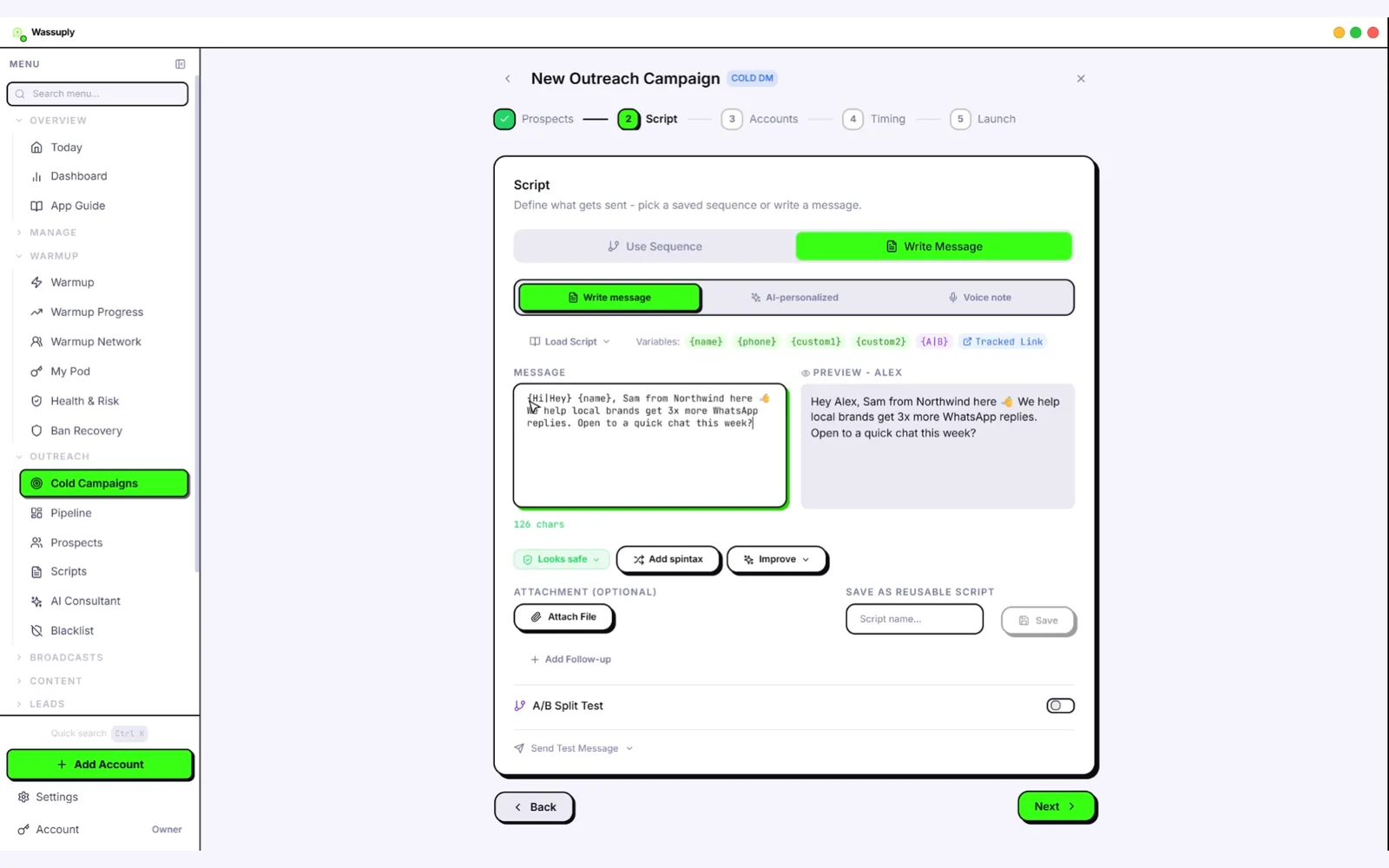
No tool removes ban risk or replaces consent. The app is free to download; connecting numbers, warming and sending need a licence, currently $397 one-time for lifetime access.
Run the WhatsApp side of your messaging without per-message fees
Warm new numbers, see a safe daily limit for each one and send paced, personalised follow-ups from one Windows app.
Free account. Windows 10 and 11. Warming and sending need an active licence.
Frequently asked questions
Is SMS better than WhatsApp for marketing?
It depends on the market. In the US, SMS reaches nearly every phone, while 32% of adults say they use WhatsApp (Pew, 2025), so SMS is usually the better choice for opted-in marketing there. In markets where WhatsApp is the default messaging app, WhatsApp tends to win on cost, rich media and two-way replies. On either channel, marketing law such as the TCPA in the US or PECR in the UK still applies.
Is WhatsApp cheaper than SMS?
Usually, especially outside the US. Ordinary WhatsApp and WhatsApp Business app accounts have no per-message fee, while Twilio lists outbound SMS at $0.056 a segment to UK numbers and $0.0832 to India (October 2026). A registered US text costs about $0.012 to $0.013 a segment once carrier fees are added. The official WhatsApp Business API charges per delivered message by category and country, so check Meta's rate card.
Do I need consent to send marketing texts in the US?
In most cases, yes. The FCC's TCPA rules require prior express written consent for autodialed telemarketing to mobile numbers, the Do-Not-Call rules cover texts, and solicitations are banned before 8 a.m. and after 9 p.m. in the recipient's time zone. Texts from ordinary 10-digit numbers also need A2P 10DLC registration, and opt-outs such as "stop" must be honoured within 10 business days. Take legal advice for your case.
Can I send cold text messages in the UK?
Not to individuals. Under PECR, the ICO says you must not send marketing texts to individuals without specific consent, and the soft opt-in covers only your own previous customers, never prospects or bought-in lists. You may text corporate bodies, but sole traders and some partnerships count as individuals. Since the Data (Use and Access) Act 2025, the ICO can fine PECR breaches up to £17.5 million or 4% of global turnover.
What is the open rate of SMS compared with WhatsApp?
There is no reliable SMS open rate, because texts have no read receipts, and the popular 98% traces to a 2010 white paper whose publisher says it no longer reflects today's messaging. WhatsApp's 98% is untraceable too. The best measured WhatsApp figure, from the vendor Chatarmin, is a 72.05% median open rate across 382 brands' opt-in campaigns in 2026. Cold messages are likely to be read less.
Can my number get blocked for sending too many texts or WhatsApp messages?
Yes, on both channels. US carriers filter and block texts, Twilio blocks unregistered 10DLC traffic outright, and CTIA says carriers blocked more than 55 billion spam texts in 2024. On WhatsApp, bulk and automated messaging breaks the rules and can lead to a restriction or a permanent ban of the number. Warming new WhatsApp numbers and sending slowly lowers that risk, but nothing removes it.
Sources
- Pew Research Center: Americans' Social Media Use 2025 (November 2025)
- Ofcom: Online Nation 2025 (December 2025)
- CTIA: 2025 Annual Survey Highlights (September 2025)
- TechCrunch: WhatsApp has 100M monthly active users in the US (July 2024)
- TechCrunch: WhatsApp now has more than 3 billion users a month (May 2025)
- Similarweb: Most Popular Messaging Apps in 2025 (2025)
- Twilio Docs: What is A2P 10DLC? (July 2026)
- The Campaign Registry: homepage (checked October 2026)
- Twilio Changelog: full blocking of unregistered US 10DLC traffic (September 2023)
- Twilio Help Center: Pricing and fees for A2P 10DLC (August 2025 fees)
- Cornell LII: 47 C.F.R. § 64.1200, delivery restrictions (amended August 2025)
- Federal Register: FCC Second Report and Order on robocalls and robotexts (January 2024)
- FCC: Order DA 26-12 extending the revoke-all waiver (January 2026)
- Wiley: 11th Circuit vacates FCC one-to-one consent rule (January 2025)
- ICO: Guide to PECR, electronic mail marketing (checked October 2026)
- ICO: One year on from the Data (Use and Access) Act (June 2026)
- WhatsApp: Terms of Service (checked October 2026)
- WhatsApp: Business Messaging Policy (checked October 2026)
- Twilio: SMS pricing, United States (October 2026)
- Twilio: SMS pricing, United Kingdom (October 2026)
- Twilio: SMS pricing, India (October 2026)
- Twilio: SMS pricing, Brazil (October 2026)
- Meta for Developers: WhatsApp Business Platform pricing (checked October 2026)
- Mobilesquared: SMS engagement rates dropping (February 2025)
- CTIA testimony to the House Energy and Commerce Committee (June 2025)
- Klaviyo: Campaign SMS and MMS benchmarks (October 2025)
- Omnisend: SMS marketing benchmarks (June 2026)
- WhatsApp Business blog: 4 ways marketing leaders should use WhatsApp (August 2023)
- Chatarmin: WhatsApp Open Rate Benchmark 2026 (September 2026)
- WhatsApp Blog: Making voice messages better (March 2022)
- WhatsApp Blog: Introducing voice message transcripts (November 2024)
- YouGov: Do consumers prefer messages in audio or text form? (February 2024)
- Twilio Docs: Error 30007, message filtered (checked October 2026)
- Textel: US carrier codes of conduct and non-compliance fines (undated)
- FTC: Top text scams of 2024 (April 2025)
- WhatsApp: Messaging Guidelines (September 2026)
- TechCrunch: WhatsApp will curb messages sent without a response (October 2025)
Sources checked October 2026. Vendor figures are labelled as such in the text.