Does WhatsApp outreach work? What real people on Reddit report
Does WhatsApp outreach work? It can, when the leads are warm or opted in, the market already does business on WhatsApp, and the number has been warmed and paced like a person, but it often ends in a ban when a new number sends the same text to a bought list. We read the Reddit threads to see what people actually report, and this is the honest roundup.
- Replies do come: one business that messaged its own lead-form leads on WhatsApp says most of them replied.
- So do bans: Reddit posters describe numbers banned at 50 messages a day, and appeals that fail.
- B2B is touchy: many professionals keep WhatsApp for people they know, so a cold pitch there can feel intrusive.
- The pattern: it works with warm or opted-in leads, relevant offers, warmed numbers and human pacing. It fails with cold blasts from new numbers.
- No clean success story: we found no verifiable Reddit thread where cold WhatsApp alone reliably won clients.
Does WhatsApp outreach work? The short answer
WhatsApp outreach works when the person receiving the message has some reason to expect it, and it breaks down when they don't. People who messaged warm leads on WhatsApp report that most of them replied. People who sent cold messages from fresh numbers report bans, sometimes within a week.
That split shows up again and again on Reddit, and it matches the little hard data that exists. Asking "does WhatsApp marketing work" in general gets you nowhere. The better question is whether your leads, market, offer and numbers fit the conditions where it does.
We looked for clean success stories and mostly found mixed ones
We went looking for Reddit threads where someone says cold WhatsApp outreach won them clients, ideally with numbers attached, and could not find a single clean, verifiable one. Search "WhatsApp outreach Reddit" and you get plenty of questions and vendor replies, but very few first-hand WhatsApp cold outreach results.
We read archived threads in r/agency, r/SMMA, r/LeadGeneration, r/coldemail, r/b2bmarketing, r/whatsapp and a few smaller subreddits. Very large ones such as r/sales were too big to search fully, so a success story may exist there. One widely shared "Reddit user" story about cold WhatsApp to Google Maps leads appears on a vendor blog, but we could not find the original thread, so we left it out.
What we did find was mixed: leads reply, deals sometimes start on WhatsApp, numbers get banned, and B2B buyers often dislike being approached there. That is why this post exists: if you are weighing WhatsApp outreach for clients, the failures teach more than a success screenshot.
What do Reddit users report about WhatsApp outreach?
Reddit users report three things: leads do reply on WhatsApp, numbers get banned even at modest volume, and many B2B prospects resent cold messages there. Here are the threads, grouped by what they show, with a paraphrase of each.
Replies come, and some deals start on WhatsApp
- r/whatsapp, 2024: most leads replied, then the number was banned. A business ran Meta lead-form ads and messaged each lead through the WhatsApp API two to three minutes after the form was filled. The poster says most replied. Then the number was banned for spam, and the appeal was rejected within seconds. A commenter with the same problem said their lesson was to stop following up with leads who go quiet. (thread)
- r/agency, 2024: a $10k client whose first talks were on WhatsApp. A new agency signed a $10k SaaS build that started as a Fiverr lead. In the replies, the founder says the first conversations happened on WhatsApp because the client wanted to talk directly. WhatsApp did not find the client, but it is where the deal moved. (thread)
- r/LeadGeneration, 2025: an inbound WhatsApp button that performs. A commenter who says they manage over $2M a year in Google Ads spend said clients using a WhatsApp button as their website's conversion action get great results. Another pushed back that it is expensive for small clients. This is inbound, not cold outreach. (thread)
Bans are real, even at low volume
- r/whatsapp, 2024: banned at 50 messages a day. The poster wanted to cold-message 500 to 1,000 numbers a day to win clients. Their number was banned even at 50 a day through a bulk-sender extension. Most replies were vendor pitches. (thread)
- r/whatsapp, 2023: a year of light use, then two bans. A second number that texted new Facebook Marketplace contacts a few times a week ran fine for a year, then was banned without warning. A replacement SIM was banned about a week later after messaging only a few people. (thread)
- r/whatsapp, 2024: a business number banned twice. The first unban took a month of sending evidence to WhatsApp. The second time, the email route was closed and the poster was told to appeal inside the app. (thread)
- r/whatsapp, 2024: repeated spam bans with a disputed cause. After changing number, the poster was banned for spam repeatedly and blamed messaging people who had not saved the number. Replies disputed that: one person was banned three times after messaging about five known contacts. The cause is unclear; how easily new numbers get flagged is not. (thread)
The common triggers, and what lowers the odds, are covered in our guide to avoiding WhatsApp bans.
Practitioners say to pace new numbers
- r/whatsapp, 2025: start small and raise slowly. Replies advise starting a new account at 20 to 50 messages a day and raising that by 10 to 20% a week, and say broadcast lists only reach people who saved your number. With three comments, this is what people tell each other, not tested proof. (thread)
In B2B, many people treat WhatsApp as personal
- r/b2bmarketing, 2025: "Whatsapp is for people I want to talk to." Asked whether WhatsApp could replace email for B2B newsletters, the top-voted reply said they would be annoyed and block any attempt. Others asked how you would even find a prospect's WhatsApp, and the poster noted that opt-in is required. (thread)
- r/SMMA, 2024: cold WhatsApp to businesses, no results yet. The poster planned 10 to 20 cold WhatsApp messages a day to businesses that show a WhatsApp number on their website. Replies said it depends on the offer. Nobody reported results. (thread)
Side by side, these threads describe one pattern. Replies came from people who already expected contact. Bans came from new numbers messaging strangers.
Why do people try WhatsApp at all? Cold email has got harder
People try WhatsApp because cold email has become harder to make work for many senders. In the r/coldemail threads, individual posters describe reply rates that collapsed within weeks, with no change on their side they could point to. These are personal reports, not an industry trend.
- r/coldemail, 2025: after two-plus years at about a 2% response rate, the poster fell to 0.8%. New copy, lower volume and two newly warmed domains did not help. Opens held near 19%, which commenters read as emails landing in spam. (thread)
- r/coldemail, 2025: an agency emailing local businesses went from 5-9% reply rates to 0.5-1% with almost no changes, while inbox tests still showed 98% placement. (thread)
- r/coldemail, 2024: a textbook setup (authentication, gradual warm-up, text-only, at most 20 a day per mailbox) dropped from 3% to under 0.5% replies in one week with the same copy. (thread)
- r/agency, 2024: in a "cold email is dead" thread, one agency owner described 20,000 to 30,000 emails and 2,000 calls per client each month to book 15 to 20 meetings. (thread)
No reliable source shows an industry-wide fall in reply rates. Published 2025 averages run from 0.45% (Belkins) to 3.43% (Instantly) and 4.5% (Hunter), mostly because each counts replies differently. What is documented is tighter filtering: since February 2024, Gmail and Yahoo have required bulk senders to authenticate, offer one-click unsubscribe and keep spam complaints low, and Outlook added authentication rules for high-volume senders in May 2025. We cover the email side in more depth in why cold email doesn't work like it used to.
None of this proves WhatsApp is better. It explains the appeal of a message that lands next to friends and family. The catch: WhatsApp is built for people who know each other, and the bans above show what happens when a number behaves otherwise.
How many people can WhatsApp reach, and do they read the messages?
WhatsApp reaches more than 3 billion people a month, and opt-in campaign messages are opened roughly three times out of four, well below the 98% figure that gets repeated everywhere.
Reach
- WhatsApp has more than 3 billion monthly users, a figure Mark Zuckerberg gave on Meta's earnings call in April 2025.
- It is the top messaging app in 70 of the 100 countries Similarweb examined in its 2025 ranking, which uses Android data. Facebook Messenger came top in none.
- Meta says about a billion people message a business each week across its messaging apps, which include WhatsApp, Messenger and Instagram.
In most of the countries measured, then, a WhatsApp message from a business is nothing unusual. Where email and LinkedIn still carry most business talk, the same message can feel like a stranger at the door. We look at what that reach means for selling in why WhatsApp works for sales.
Read rates: the 98% claim versus measured data
The "98% open rate" for WhatsApp is widely repeated but unsourced. Meta's own WhatsApp Business blog uses it, citing a Landbot statistics roundup that gives no source either. It may be borrowed from an old SMS figure: in 2025, Mobilesquared, which says it published the original 2010 SMS research, said its 98% read rate no longer reflects messaging today.
The largest measured benchmark we found comes from Chatarmin, a German WhatsApp marketing vendor. Across 382 brands and 11.8 million delivered messages from March to May 2026, campaigns averaged a 79.6% open rate weighted by volume, with the median brand at 72.05%. Opens were counted from read receipts, so people who switch read receipts off count as unopened. The report says no account reached 98% as a campaign average.
Two caveats. The data comes from the vendor's own customers, mostly opt-in e-commerce marketing, and the report says the sample is not representative. And there is no reliable public read-rate or reply-rate benchmark for cold WhatsApp outreach at all. Our breakdown of the real WhatsApp open rate goes through the method in detail.
When does WhatsApp outreach work, and when does it fail?
WhatsApp outreach works when the lead is warm or opted in, the market already uses WhatsApp for business, the offer is relevant and the number behaves like a person. It fails when a new number sends identical text to a list of strangers.
When it works
- Warm or opted-in leads. Every positive report above involves someone who had already raised a hand: a form fill, a click on a website button, a client who asked to talk on WhatsApp.
- Markets where WhatsApp is the default. Where people run their working day on WhatsApp, a business message is normal. Where they don't, it can feel intrusive.
- Relevant offers. As the r/SMMA replies put it, cold WhatsApp depends on the offer. A message about a problem the person actually has reads very differently from a pitch.
- Warmed numbers and human pacing. Numbers with a chat history, sending small daily volumes at irregular gaps, behave like people. Our glossary entry on WhatsApp sending limits covers what is and isn't known about the thresholds.
When it fails
- Cold blasts from new numbers. The ban threads share one detail: a fresh or recently changed number messaging people who had never heard of it.
- Identical text. The same pitch pasted to hundreds of people reads as spam, and the people receiving it are the ones who press block or report. Varying the wording with spintax helps, but it cannot rescue a bad list.
- Bought lists. Strangers who never asked to hear from you are the most likely to block you. WhatsApp is also testing a monthly cap on messages sent to people who have not replied, though it has not said what the limit will be.
| Factor | Works when | Fails when |
|---|---|---|
| Lead source | Form fills, inbound enquiries, past customers, referrals | Bought or scraped lists of strangers |
| Market | WhatsApp is the normal way to talk business | Prospects keep WhatsApp for friends and family |
| Number | Warmed for weeks, with a real chat history | A new SIM whose first messages go to strangers |
| Pace | Small daily volume, irregular gaps, business hours | Hundreds a day at a steady, machine-like rhythm |
| Message | Short, specific, clearly written for that person | The same pitch pasted to everyone |
| Follow-up | One light nudge, then stop | Repeated chasers to people who never answered |
How to make WhatsApp outreach work: a practical checklist
To make WhatsApp outreach work, fix the list first, the number second and the message third. Most of the failures on Reddit started with the list or the number, not the copy.
- Start with people who have a reason to hear from you: form fills, inbound enquiries, past customers and referrals before anyone cold.
- Warm every new number for at least 15 days before its first campaign, 30 if you can. See a new WhatsApp number's first 30 days.
- Keep volume low per number. Reddit advice for new accounts starts at 20 to 50 messages a day. Add warmed numbers to grow instead of pushing one harder.
- Pace like a person: random gaps, breaks between small batches, nothing at night in the recipient's time zone.
- Say why you are messaging in the first line, and keep it short enough to read in the notification.
- Vary the wording so no two people get identical text.
- Make replying easy: a yes or no question beats a calendar link.
- Stop when they reply or go quiet. One follow-up at most for people who never answered.
- Honour every opt-out at once.
- Check the law where your prospects live. GDPR and similar rules apply to WhatsApp too; see cold WhatsApp messages and GDPR.
- Keep spare numbers warming, so one ban doesn't stop the campaign.
- Measure replies and meetings, not messages sent.
An illustrative first message for a warm lead (the shape only, not copy from a real campaign):
Where Wassuply fits in WhatsApp outreach
Wassuply covers the number side of that checklist: warm-up, pacing and per-number limits. It is a Windows 10/11 desktop app that runs normal WhatsApp and WhatsApp Business accounts through WhatsApp Web, each number with its own isolated session, browser fingerprint and optional proxy. No Business API, Meta verification or template approval.
New numbers warm up by chatting with each other using natural lines from built-in chat packs, with random 30-120 second gaps inside the hours you set. Health & Risk reads each number's age and history and suggests days to warm, a safe daily limit and a first campaign size, next to a live 0-100 risk score. Turn on Smart Send and it slows sending at 60 and pauses at 80.
Campaigns run from a CSV with merge fields, spintax and optional AI-written first lines from your own Claude, ChatGPT or DeepSeek key. Sending uses random 30-90 second gaps, batches of 10 with breaks, blackout hours and a daily cap per number, and follow-ups stop the moment someone replies.
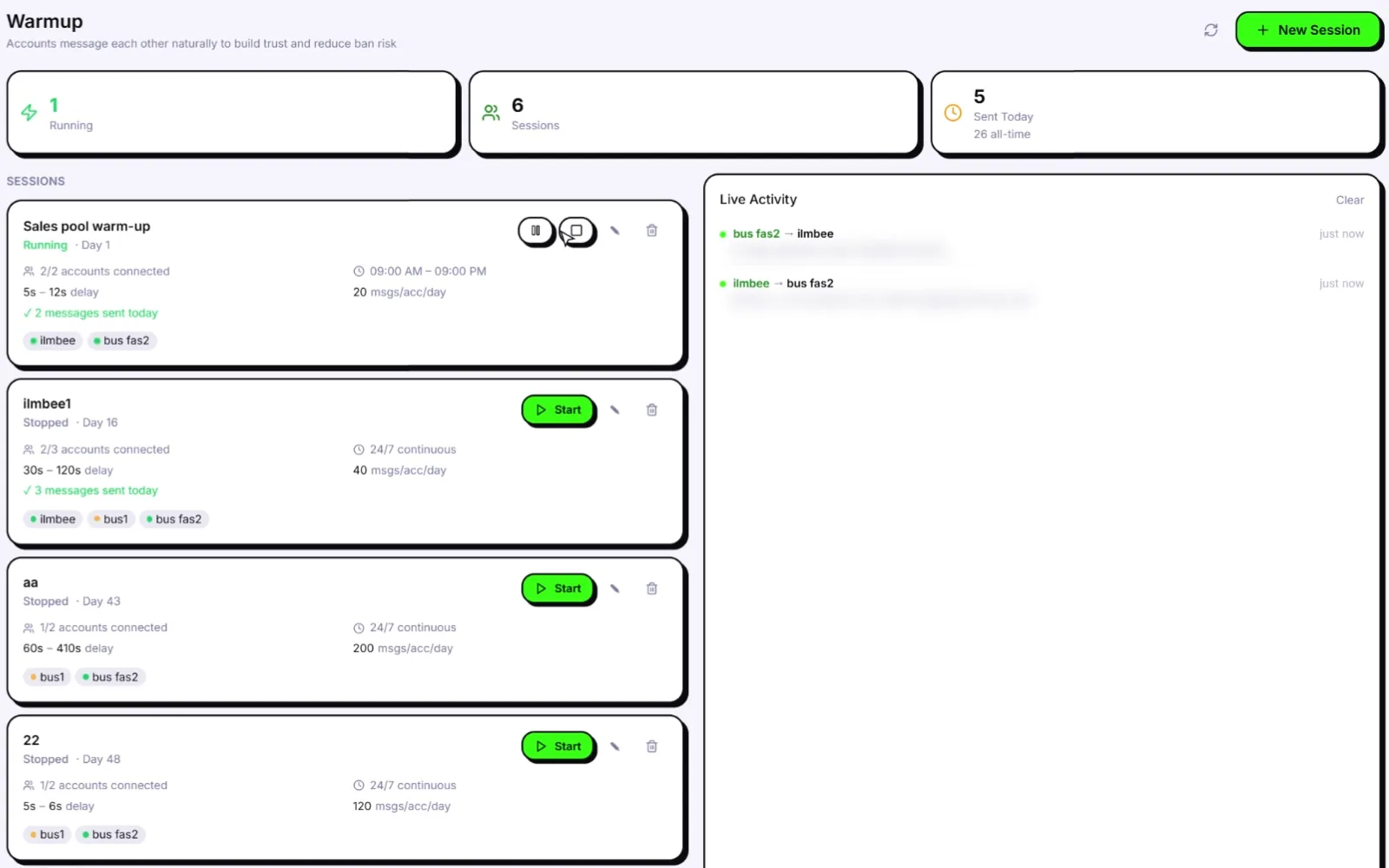
It cannot make a cold list warm or a weak offer relevant, and no tool removes ban risk. It makes the number warm-up and pacing parts of the checklist easier to stick to. The app is free to download; warming and sending need a licence, currently $397 one-time for lifetime access.
Make the number side of WhatsApp outreach easier to get right
Warm new numbers, see a safe daily limit for each one and send at a human pace from one Windows app.
Free account. Windows 10 and 11. Warming and sending need an active licence.
Frequently asked questions
Does WhatsApp outreach work for getting clients?
It can, but mostly with warm leads. Reddit reports show quick replies when businesses message their own form fills or inbound enquiries, and deals that move to WhatsApp once a client asks for it. We found no verifiable thread where cold WhatsApp alone reliably won clients. Treat cold WhatsApp as a channel for relevant, well-targeted messages from warmed numbers, not as a volume play.
Why do WhatsApp numbers get banned for outreach?
Bans usually follow a new or recently changed number messaging people who don't know it, sending near-identical text at volume, or collecting blocks and reports. Reddit posters describe bans at 50 messages a day and even after messaging a handful of people, so there is no guaranteed safe number. Warming the number, pacing sends and messaging people who expect contact all lower the risk.
How many WhatsApp messages can I send a day without getting banned?
WhatsApp publishes no safe daily number for personal or Business app accounts. Advice shared on Reddit is to start a new account at 20 to 50 messages a day and raise it slowly. Number age and history matter most: Wassuply's Health & Risk suggests a safe daily limit of 30 to 250 per number depending on age, which is a guide rather than a guarantee.
Is WhatsApp outreach better than cold email?
It depends on the lead. For warm or opted-in contacts in markets where WhatsApp is the default, it suits a quick, personal back-and-forth. For cold B2B prospects who see WhatsApp as private, email is often less intrusive. Published 2025 cold email reply-rate averages run from 0.45% to 4.5% depending on method, and WhatsApp adds a ban risk of its own. Many teams use both.
What reply rate can I expect from WhatsApp outreach?
There is no reliable public benchmark for cold WhatsApp reply rates, and anyone quoting one should show the source. The best measured data covers opt-in campaigns: Chatarmin's 2026 benchmark found a 72.05% median open rate across 382 brands. Don't expect cold messages to strangers to match it. Track replies per 100 messages for each number instead.
Is it legal to send cold WhatsApp messages?
It depends on where your recipients live and how you got their numbers. In the EU and UK, data protection law such as GDPR covers the phone numbers you hold and how you use them, and WhatsApp's own terms discourage bulk and automated messaging. Take legal advice for your market. Our guide to cold WhatsApp messages and GDPR covers the basics.