WhatsApp open rate in 2026: the real numbers, and where 98% came from
The WhatsApp open rate everyone quotes, 98%, has no primary source. The best measured figure is lower: in opt-in marketing campaigns from several hundred brands in 2026, Chatarmin counted a 79.6% read rate weighted by volume and a 72% median per brand. For cold messages nobody publishes a figure at all. Here is why, how WhatsApp compares with email, and what to measure instead.
- 98% is unsourced: Meta's own blog footnotes it to a Landbot listicle that cites nothing, and it most likely descends from a 2010 SMS statistic.
- Best measured figure: 79.6% weighted and 72.05% median per brand (Chatarmin 2026, opt-in campaigns, read receipts divided by delivered messages).
- Cold read rates: nobody publishes them. There is no neutral dataset, read receipts can be switched off, and messages to people who blocked you are never delivered.
- Email opens are broken too: Apple Mail loads tracking pixels without a read, and Apple made up 76.56% of Litmus-tracked opens in September 2026.
- Measure this instead: reply rate, positive reply rate, meetings booked, and blocks or opt-outs.
What is the real WhatsApp open rate?
The best measured WhatsApp open rate is roughly 72-80% for opt-in marketing campaigns, not 98%. Chatarmin, a German WhatsApp marketing platform, measured a 79.6% open rate weighted by message volume across 382 brands and 11.8 million delivered messages from mid-March to May 2026. The median brand came in at 72.05%.
How it was measured matters. An "open" in that study is a read receipt (two blue ticks) divided by messages delivered, and anyone who has switched read receipts off counts as unopened, so the real figure may be a little higher. On the older basis of messages sent rather than delivered, the same platform measured 65.2% from June 2025 to February 2026. Chatarmin puts that jump of about 14 points down to the change of method, not to people reading more.
The report is open about its limits. The brands are its own customers, mostly in e-commerce, the campaigns are manually sent newsletters, sales and launches, and it says the sample is not representative. The median is calculated over a slightly larger group of brands (414) than the weighted average. And on the famous figure, it is blunt: "No account reaches the often-quoted 98% as a campaign average."
Where does the 98% WhatsApp open rate come from?
The 98% WhatsApp open rate comes from marketing copy, not measurement. Follow the citations back and they end at a listicle that names no source, and the number itself most likely started life as an SMS statistic from 2010.
- 1Vendors and platforms repeat itTwilio, Adobe's documentation and many messaging vendors quote a 98% WhatsApp open rate. Twilio's November 2025 article links to its own 2024 guide, which cites Meta's WhatsApp Business blog.
- 2Meta's blog cites a listicleIn August 2023 the WhatsApp Business blog claimed a 98% open rate against 20% for email. Its footnote points to a Landbot statistics roundup from September 2022, not to any Meta data.
- 3The listicle cites nothingLandbot's page, first published in 2021 and updated in 2022, states the 98% figure with no source. That is where the documented chain ends.
- 4The likely origin: a 2010 SMS figureThe claim that 98% of SMS messages are read comes from a 2010 white paper, Conversational Advertising, which Mobilesquared says it published (Marketing Dive credits SinglePoint). In February 2025 Mobilesquared said neither that figure nor its companion claim, that 90% are read within three minutes, reflects messaging today. Its latest data puts SMS read rates at 55%, without a published method.
The last step is an inference. No document shows the SMS number being copied across to WhatsApp, but vendor roundups use the same 98% for both channels. Pages that credit Gartner with a 98% SMS open rate don't link to any Gartner publication either, and the 45-60% WhatsApp click-through rate that often travels with it is just as untraceable.
WhatsApp read rate vs open rate: what a blue tick measures
On WhatsApp, an "open" is really a read receipt: two blue ticks showing the recipient has read your message. No hidden image has to load for it to register, so it is a cleaner signal than an email open, but it undercounts.
- Grey ticks are not reads. One grey tick means sent, two grey ticks mean delivered to the phone, and only blue means read (WhatsApp Help Center).
- Read receipts can be switched off. Anyone can turn them off in their privacy settings, and then you never see blue ticks from them in a one-to-one chat, however closely they read. Group chats are the exception: receipts there are always sent.
- Delivery isn't guaranteed. A message to someone who has blocked you stays on one grey tick and is never delivered, and WhatsApp says it keeps the signs of a block deliberately ambiguous. One tick can also just mean the phone is off or out of coverage (WhatsApp Help Center).
That gives you the key difference in any WhatsApp vs email open rate comparison: the two channels err in opposite directions. Email open rates overcount, because privacy features load the tracking pixel without anyone reading. WhatsApp read rates undercount, because some readers never send a receipt. Neither is a precise measure of attention.
Why is there no WhatsApp open rate for cold messages?
Nobody publishes a WhatsApp open rate for cold messages because there is no neutral source of the data, and the signal behaves differently with strangers. Every figure that exists comes from businesses messaging their own opted-in customers.
- No neutral dataset. WhatsApp publishes no read rates. Meta's Marketing Messages API documentation reports a delivery gain (up to 9% more messages delivered than the Cloud API, for high-engagement messages) but no read rate, and its in-product benchmark compares templates with similar businesses without an absolute number. We found no methodology-backed read-rate benchmark from Twilio, Infobip, Gupshup or Bird either.
- Opt-in and cold are different populations. Chatarmin's customers message people who signed up to hear from a shop. A stranger getting a message from an unknown number is in a different position, and nothing in opt-in data tells you how they behave.
- Read receipts are a floor. Everyone with receipts switched off counts as unread, and nobody knows what share of a cold list that is.
- Blocked and unsaved contacts behave differently. Someone who blocks you after the first message never receives the next, which sits on one grey tick. Broadcast lists only reach people who have saved your number, so a broadcast to a cold list mostly goes nowhere. And WhatsApp is testing a monthly cap on messages to people who haven't replied, with a reply resetting the count, though it hasn't said what the limit will be.
Anyone quoting a cold WhatsApp open rate should be able to say whose messages, sent to whom, measured how. If they can't, treat the number as marketing. What people actually report from cold WhatsApp, good and bad, is collected in does WhatsApp outreach work.
WhatsApp vs email open rate: why the comparison breaks down
Comparing WhatsApp and email open rates mostly compares two different measurement errors. Email opens have been unreliable since Apple launched Mail Privacy Protection in 2021, and WhatsApp reads are counted from receipts that some people never send.
Apple announced Mail Privacy Protection in June 2021 and shipped it with iOS 15 that September. With it switched on, Apple Mail downloads remote content, including tracking pixels, in the background whether or not the person engages. Three months after launch, privacy-protected opens were already 41% of the opens Litmus tracked. By September 2026, Apple as a whole, privacy-protected opens included, accounted for 76.56% of opens tracked by Litmus. That data leans towards consumer marketing email, so read it as a share of tracked opens rather than of people.
Cold email benchmarks still report opens. Hunter puts the average at 30% and Woodpecker's median is 26%, but Woodpecker calls open rate the noisier of its two metrics and Smartlead no longer treats it as a reliable measure for cold email. Why that matters for email outreach is covered in why cold email doesn't work anymore and the death of email open rates.
| Measure | ||
|---|---|---|
| What counts as an open | A tracking pixel loading | Two blue ticks (a read receipt) |
| Direction of error | Overcounts: Apple Mail loads pixels without a read | Undercounts: readers with receipts off never register |
| Best published figure | Cold email: 26% median (Woodpecker), 30% average (Hunter), both inflated | Opt-in marketing: 72.05% median, 79.6% weighted (Chatarmin) |
| Cold outreach figure | Published, but unreliable | Not published anywhere |
| The number worth comparing | Replies and meetings | Replies and meetings |
Note what the table pits against each other: the WhatsApp figure covers opt-in marketing to customers, the email figures cover cold outreach to strangers. Meta's own blog compared 98% for WhatsApp with 20% for email, which sets an unsourced number against an unspecified one.
What should you measure instead of WhatsApp open rate?
Measure what happens after the read: reply rate, positive reply rate, meetings booked, and blocks or opt-outs. These count the same way on every channel, no privacy feature inflates them, and on WhatsApp they also warn you when a number is at risk.
| Metric | What it tells you | How to track it on WhatsApp |
|---|---|---|
| Reply rate (contacts who replied ÷ contacts messaged) | Whether your targeting and first line work | Count chats with any reply inside a fixed window, such as seven days, per number and per list |
| Positive reply rate (interested replies ÷ contacts messaged) | Whether the offer is relevant to that list | Tag every reply as interested, not now or no, and count the first group |
| Meetings booked (per 100 contacts messaged) | Whether the channel produces sales conversations | Log each call or meeting against the campaign and number it came from |
| Blocks, reports and opt-outs (per 100 contacts) | Whether the list expected to hear from you, and an early warning on number risk | Count "stop" and "not interested" replies. WhatsApp won't tell you who blocked you, so watch for messages stuck on one grey tick and for warnings on the number |
| Read rate (blue ticks ÷ delivered) | A rough floor on attention, useful only against your own history | Compare with your own past campaigns, never with a published 98% |
Blocks deserve as much attention as replies. On email a bad list costs you deliverability; on WhatsApp it can cost you the number. Our guide to avoiding WhatsApp bans covers the patterns that tend to get numbers flagged, and why WhatsApp works for sales covers where replies on the channel come from.
How to measure your own WhatsApp read and reply rates
To measure your own WhatsApp message open rate in 2026, count against delivered messages, keep each list separate and compare only with your own history. A short routine:
- Use delivered messages as the denominator for read rate, and report delivery rate (delivered ÷ sent) on its own, so wrong numbers show up as a list problem.
- Split results by list source. Inbound leads, past customers and cold lists will never share one benchmark.
- Fix the reply window, such as seven days, so campaigns are comparable.
- Change one thing at a time (the first line, the offer or the audience) and send each version to a comparable group.
- Record opt-outs and suspected blocks per 100 contacts, and pause any list that produces more than its peers.
- Track meetings per number and per list, so the channel is judged on sales conversations.
- Treat read rate as a floor, never as the headline.
If you want a WhatsApp marketing open rate to plan around, your own read rate on delivered messages, measured this way over a few campaigns, is a better guide than any number on a vendor page.
Where Wassuply fits
Wassuply doesn't change how WhatsApp counts reads, and it can't make an unsourced 98% true. What it handles is the part of the result you control on the sending side. It is a Windows 10/11 desktop app that runs normal WhatsApp and WhatsApp Business accounts through WhatsApp Web sessions, with no Business API, Meta verification or template approval, and each number in its own isolated session with its own browser fingerprint and optional proxy.
New numbers warm up by chatting with each other before their first campaign, and Health & Risk suggests a safe daily limit per number along with a live 0-100 risk score. Turn on Smart Send and it slows sending at 60 and pauses at 80. Campaigns run from a CSV with merge fields and spintax, at random 30-90 second gaps in batches of 10, with follow-ups that stop the moment someone replies and an automatic reply for opt-outs.
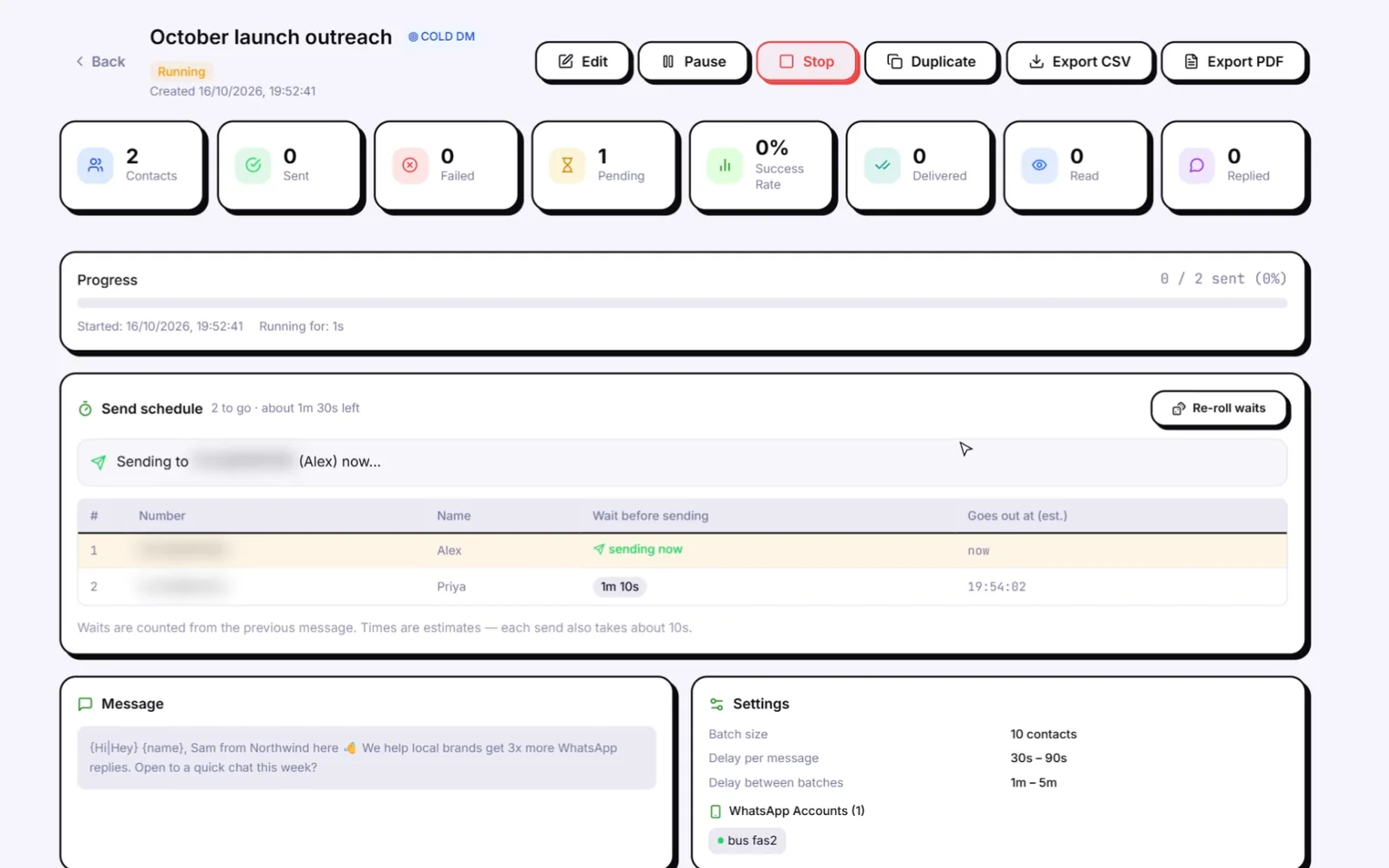
Each campaign shows delivered, read and replied counts, so the rates in this post can be worked out per campaign, and replies go to a Pipeline CRM board. No tool removes ban risk, and WhatsApp's own rules discourage bulk and automated messaging. The download is free; warming and sending need a licence, currently $397 one-time for lifetime access.
Measure WhatsApp on replies, not ticks
Warm your numbers, send at a human pace and see delivered, read and replied counts for every campaign in one Windows app.
Free account. Windows 10 and 11. Warming and sending need an active licence.
Frequently asked questions
What is the average WhatsApp open rate?
The best measured figure is a 79.6% open rate weighted by volume, with a 72.05% median per brand, from Chatarmin's 2026 benchmark of opt-in marketing campaigns. Opens were counted from read receipts against delivered messages, so people with receipts switched off count as unopened. There is no published average for cold messages, and the often-quoted 98% has no primary source.
Is the WhatsApp open rate really 98%?
No measured source supports it. Meta's WhatsApp Business blog used the figure in 2023 but footnoted a Landbot listicle that gives no source, and it most likely descends from a 2010 SMS statistic whose publisher said in 2025 it no longer reflects messaging. Chatarmin's 2026 benchmark, the largest measured one we found, reports no account reaching 98% as a campaign average.
What is the difference between WhatsApp read rate and open rate?
On WhatsApp they are the same thing: a message counts as opened when it shows two blue ticks, the read receipt. Email opens rely on a tracking pixel loading, which Apple Mail can trigger without anyone reading. Because WhatsApp users can switch read receipts off, a WhatsApp read rate is a floor, while an email open rate is usually an overcount.
Is WhatsApp open rate higher than email?
For opt-in marketing, measured WhatsApp read rates of about 72-80% sit well above published email open rates, but the comparison is weak. Email opens are inflated by Apple Mail Privacy Protection, WhatsApp reads are deflated by people who switch receipts off, and the samples differ. For cold outreach there is no published WhatsApp figure to compare at all. Compare replies and meetings instead.
How do I know if someone read my WhatsApp message?
Two blue ticks mean the message was read. Two grey ticks mean it reached their phone, and one grey tick means it was sent but not yet delivered. If the person has turned read receipts off, you won't see blue ticks in a one-to-one chat even after they read it, and a message to someone who has blocked you stays on one tick.
What is a good WhatsApp reply rate for cold outreach?
No reliable public benchmark exists for cold WhatsApp reply rates, so treat any figure quoted without a source and method as marketing. Results depend on the list, the market, the offer and the number's history. Set your own baseline instead: track replies, positive replies, meetings and opt-outs per 100 contacts for each list and number. Our WhatsApp outbound benchmarks guide shows how.