WhatsApp for sales: why it works (and when it doesn't)
WhatsApp for sales works because buyers already spend their day there, messages get read, and conversations move in minutes instead of days. It backfires with cold strangers in conservative B2B markets, irrelevant pitches and new numbers that blast. This guide sets out the evidence on both sides, using only numbers we could trace to a source.
- Buyers are already there: WhatsApp has more than 3 billion monthly users and is the top messaging app in 70 of the 100 countries Similarweb studied.
- Messages get read: measured opt-in campaigns are opened about 72-80% of the time. The popular 98% figure has no traceable source.
- It is conversational: short replies and voice notes make for quick back-and-forth, so answering fast matters.
- Meta is betting on it: click-to-WhatsApp ad revenue grew 60% in a year, a sign that buyers answer businesses there.
- Where it fails: cold strangers in conservative B2B markets, irrelevant pitches, new numbers sending at volume, and ignoring privacy law.
Why use WhatsApp for sales?
Why WhatsApp works for sales comes down to placement: it puts your message where your buyer already talks to everyone else, in a format built for quick replies. Five things do most of the work:
- Reach. Your buyers are probably already on it, often all day.
- Attention. Messages in opt-in campaigns get read most of the time.
- Format. Short replies, voice notes and fast back-and-forth suit a sales conversation.
- Momentum. Meta's own revenue shows buyers answering businesses there.
- Speed. You can answer while the buyer is still interested.
Each of these holds for people who expect to hear from you. Most of them weaken or reverse for strangers, which is why the second half of this post matters as much as the first. For the ground-level view, we collected what Reddit users report about WhatsApp outreach.
Your buyers are already on WhatsApp
WhatsApp has more than 3 billion monthly users, so for most sales teams the open question is whether their buyers use it for work.
- Mark Zuckerberg put WhatsApp at more than 3 billion monthly users in April 2025. Meta has not published a newer WhatsApp-only figure.
- Similarweb's 2025 ranking found it was the top messaging app in 70 of the 100 countries it examined, using Android data.
- DataReportal's Digital 2026 report says 54% of internet users aged 16 and over use WhatsApp each month, and it is the social platform most often named as a favourite, by 17.4% of social media users.
- In the US, WhatsApp passed 100 million monthly users in 2024, according to Zuckerberg.
For sales, the business side matters more. Meta says about a billion people message a business each week across WhatsApp, Messenger and Instagram. That is a lot of buyers who already expect to talk to companies inside a chat app, which is the real case for WhatsApp for business sales. In countries where WhatsApp is the default for work, a sales conversation there is simply normal.
WhatsApp messages get read, but not 98% of them
Opt-in WhatsApp marketing messages are opened roughly 72-80% of the time in the largest measured benchmark. That is high, but well short of the 98% on most vendor pages.
The measured data comes from Chatarmin, a German WhatsApp marketing vendor. Across 382 brands and 11.8 million delivered messages from March to May 2026, the volume-weighted open rate was 79.6% and the median brand reached 72.05%, counting read receipts against delivered messages. People with read receipts switched off count as unopened, and the sample is the vendor's own, mostly e-commerce customers.
The 98% figure is widely repeated but unsourced. Meta's WhatsApp Business blog uses it with a footnote to a vendor listicle that cites nothing. It may have been carried over from a 2010 SMS statistic whose publisher, Mobilesquared, said in 2025 that it no longer reflects messaging today. Our guide to the real WhatsApp open rate follows the trail.
For a salesperson, a read message is a chance at a reply. Email opens are much harder to trust, because Apple Mail Privacy Protection, when switched on, downloads remote content, including tracking pixels, whether or not the person engages. And there is still no public read-rate or reply-rate benchmark for cold WhatsApp messages, so treat any figure you see for cold outreach with suspicion.
WhatsApp sales conversations are short, fast and personal
Sales conversations on WhatsApp move faster because the format rewards short replies: a line of text, a voice note, a photo, a quick "yes, call me at four". In a 2025 r/LeadGeneration thread, the top reply argued that email feels like work and gets deleted in batches, while a direct message makes the reader feel noticed. That thread was about Instagram DMs, but the point carries over to WhatsApp.
Two data points show the pace, with caveats. A peer-reviewed study of about 6.4 million personal WhatsApp messages from 111 young adults found that 57.82% were replies composed within a minute, though that covers friends and family, not buyers. And Superchat, a messaging vendor, found its business customers answered customer messages on WhatsApp in a median 18.2 minutes, against 45.2 minutes for email, using 2022 data from over 1,000 customers.
Voice notes are worth using too. A short voice note from a real person carries tone and effort that a templated email cannot, and it is a native part of the app. Save it for after someone replies rather than using it as a cold opener.
Why speed to reply matters
Answer fast, because interest fades quickly. The best-known study is old and about inbound web leads, not WhatsApp: in Harvard Business Review's 2011 analysis of 1.25 million leads, firms that tried to contact a lead within an hour were nearly seven times as likely to qualify it as firms that waited even an hour longer.
WhatsApp makes that speed easier, because replies arrive as chat notifications rather than sitting in a crowded inbox. In practice, someone should watch replies during working hours and move interested buyers to a call while the conversation is warm.
Meta's revenue shows buyers answering businesses on WhatsApp
Meta's earnings show businesses paying more and more to start WhatsApp conversations, which only makes sense if buyers answer them.
- Revenue from click-to-WhatsApp ads grew 60% year over year in Q3 2025, according to Meta's CFO, Susan Li.
- Paid messaging inside WhatsApp passed a $2 billion annual run rate in Q4 2025, and US click-to-message ad revenue grew more than 50% year over year.
- Meta's "other revenue" line passed $1 billion in a quarter for the first time in Q2 2026 ($1,007 million). Li attributed its growth mainly to WhatsApp paid messaging and subscriptions.
Read these as a signal about buyer behaviour, not proof that cold messages work. They describe ads that open a chat and messages sent through Meta's paid platform, mostly to people who clicked or opted in.
Meta is also guarding the inbox: WhatsApp is testing a folder that moves messages from large businesses out of the main chat list. Buyers want to talk to businesses on WhatsApp, on their own terms. If you build outbound systems, we cover where WhatsApp fits in a GTM engineer's stack.
WhatsApp vs email vs LinkedIn vs cold calls for sales conversations
No channel wins every sale. On the figures we could source, WhatsApp suits buyers who already use it and expect contact, email handles cold first contact at volume, LinkedIn adds professional context, and calls give the most direct conversation at the highest time cost per meeting.
| Channel | Sourced figure | Conversation style | Main drawback |
|---|---|---|---|
| Opt-in campaigns opened 72-80% of the time (Chatarmin, 2026). No public benchmark for cold outreach. | Short messages, voice notes, quick back-and-forth | Ban risk for new or fast-sending numbers; some B2B buyers see it as private | |
| 2025 cold reply-rate averages from 0.45% (Belkins) to 4.5% (Hunter), depending on how replies are counted | Longer and more formal, slower back-and-forth | Spam filtering and bulk-sender rules at Gmail, Yahoo and Outlook | |
| 7.2% reply rate on messages sent, 26% of connection requests accepted (Belkins, 2025) | Professional context; both sides can see each other's profile | Only reaches people who are active on LinkedIn | |
| Cold calls | Average rep connects with 5.4% of prospects (Gong); about 370 dials per booked meeting (Belkins, 2025) | Live, two-way and immediate | Time-heavy: every conversation needs someone on the phone |
These figures come from different vendors measuring different things, so compare them loosely. The useful point is that each channel has a job, and they help each other: Gong found that prospects who were also cold called replied to email at 3.44%, against 1.81% for those who weren't. WhatsApp can be one of those touches once a buyer is warm. For the email side, see why cold email doesn't work like it used to.
When doesn't WhatsApp work for sales?
WhatsApp sales outreach fails when the buyer never expected to hear from you, the message isn't relevant, the number looks like a spammer, or you ignore privacy law.
Cold strangers in conservative B2B markets
This is the biggest limit on WhatsApp B2B sales: in many markets, WhatsApp is private space. In a 2025 r/b2bmarketing thread asking whether WhatsApp could replace email newsletters, the top-voted reply said they would be annoyed and block any attempt, because WhatsApp is for people they actually want to talk to. Others asked how you would even find a prospect's number.
Where business runs on email and LinkedIn, a cold WhatsApp from a stranger can cost more goodwill than it wins. How strongly this applies varies by country and industry.
Irrelevant outreach
Irrelevant messages hurt on any channel, and buyers say so. Gartner found that 73% of B2B buyers actively avoid suppliers who send irrelevant outreach, from a survey of 632 buyers in 2024. In a later survey, 67% said they prefer a sales rep-free experience.
An irrelevant pitch in a personal chat list is harder to shrug off than an email, which makes a block or a report more likely. Relevance comes from research and personalisation; our guide to AI personalisation for WhatsApp covers doing it at volume.
Ban risk from new numbers and blasting
New numbers that message strangers at volume get banned, sometimes fast. Reddit posters describe a number banned at 50 messages a day through a bulk-sender extension, and a replacement SIM banned within about a week after messaging only a few people. Meta's official API is no shield either: one business lost its API number for spam after messaging its own lead-form leads, most of whom had replied.
WhatsApp is also testing a monthly cap on messages to people who haven't replied, and has not said what the limit will be. Warming numbers first and pacing sends lowers the risk; our guide to avoiding WhatsApp bans covers the main triggers.
Privacy law
Selling on WhatsApp doesn't exempt you from data protection law. In the EU and UK, GDPR applies to the phone numbers you collect and how you use them, and other countries have their own rules. WhatsApp's own terms also ask people not to send bulk or automated messages.
Know where each number came from and your legal basis for using it, and honour opt-outs at once. Our guide to cold WhatsApp messages and GDPR goes into detail, though it is not legal advice.
How to sell on WhatsApp without burning numbers
Sell on WhatsApp without burning numbers by warming each number first, keeping volume low and varied, and only messaging people with a reason to hear from you.
- 1Choose leads who expect contactForm fills, inbound enquiries, past customers, referrals and businesses that publish a WhatsApp number for enquiries. Record where every number came from.
- 2Warm every new numberGive a new number at least 15 days of normal chat before its first campaign, and 30 if you can. The WhatsApp warm-up timeline shows what each stage looks like.
- 3Keep daily volume lowTens a day per new number, not hundreds. Add warmed numbers to grow instead of pushing one number harder.
- 4Write a relevant first lineSay who you are, why them and what is in it for them, in two lines or fewer. Merge fields, spintax or AI-written openers keep the wording varied.
- 5Pace like a personRandom gaps between messages, breaks between small batches, and nothing at night in the buyer's time zone.
- 6Reply fast and move to a callWatch replies during working hours. Qualify with a short voice note or call while the buyer is still engaged.
- 7Stop chasing silenceOne follow-up at most to people who never replied. Remove anyone who asks you to stop, straight away.
- 8Watch each number's healthIf a number gets warnings or restrictions, stop sending from it, let it rest, and keep spare numbers warming.
An illustrative opener for a business that lists WhatsApp for enquiries (the shape only, not copy from a real campaign):
Where Wassuply fits in a WhatsApp sales process
Wassuply is a Windows 10/11 desktop app for the outreach side of WhatsApp sales: warming numbers, sending paced first messages and catching replies. It runs normal WhatsApp and WhatsApp Business accounts through WhatsApp Web, each number with its own isolated session, browser fingerprint and optional proxy, so there is no Business API or template approval.
Before a number sells, it warms up: your numbers chat with each other using natural lines from built-in chat packs on random 30-120 second gaps. Health & Risk suggests days to warm, a safe daily limit and a first campaign size from each number's age and history, and shows a live 0-100 risk score. Turn on Smart Send and it slows sending at 60 and pauses at 80.
For the selling, you import a CSV of leads without saving them as contacts, then personalise with merge fields, spintax or AI-written first messages from your own Claude, ChatGPT or DeepSeek key. Voice notes are supported, including AI voice notes through your own ElevenLabs key. Follow-ups stop the moment someone replies, opt-outs get an automatic reply, and replies land on a Pipeline CRM board.
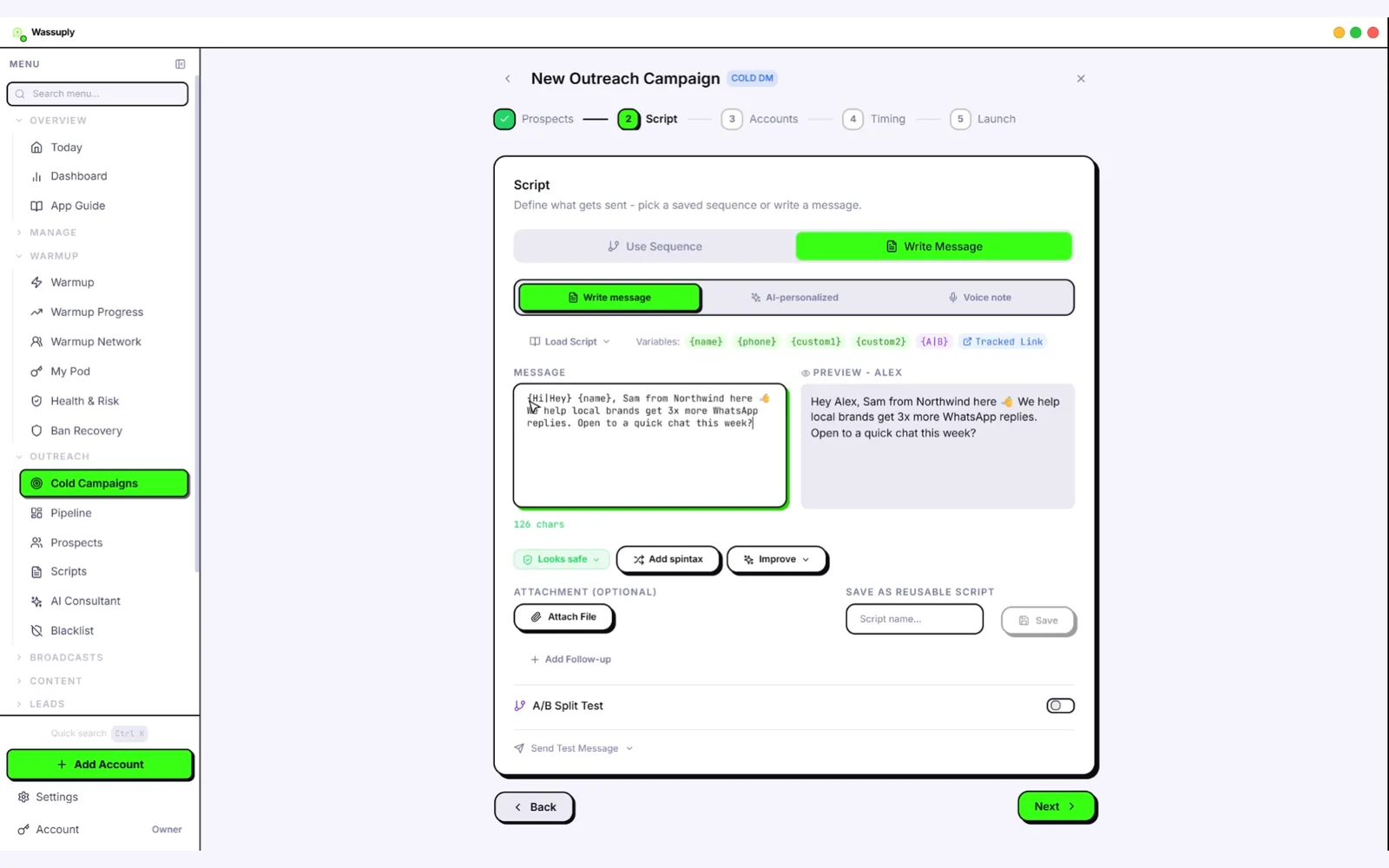
It won't fix a bad list or an irrelevant offer, and no tool removes ban risk. It makes the disciplined version, warmed numbers and paced sends, easier to run every day. The download is free; warming and sending need a licence, $397 one-time during early access.
Run WhatsApp sales outreach at a human pace
Warm your numbers, send personalised first messages and track replies on one board, from a Windows desktop app.
Free account. Windows 10 and 11. Warming and sending need an active licence.
Frequently asked questions
Is WhatsApp good for B2B sales?
It can be, especially in countries where WhatsApp is the normal business channel and with buyers who already know you. In markets where professionals keep WhatsApp for friends and family, cold B2B messages often land badly. A practical approach is to open with email, LinkedIn or an inbound form, then move to WhatsApp once the buyer is happy to talk there.
Why does WhatsApp work better than email for sales?
For warm buyers it often does, because messages land in the same chat list as friends and family, measured opt-in campaigns are opened about 72-80% of the time, and replies tend to be short and quick. Email is still easier for cold first contact at scale. Which channel works better depends on who you are messaging and whether they expect to hear from you.
Can you cold message prospects on WhatsApp?
You can, but it carries more risk than email. New numbers that message strangers get banned easily, WhatsApp's terms discourage bulk and automated messaging, and privacy law such as GDPR still applies. If you do it, target businesses that invite WhatsApp contact, keep volume low, warm your numbers first and stop at the first sign of disinterest.
What is the real WhatsApp open rate?
The often-quoted 98% has no traceable source. The largest measured benchmark, Chatarmin's 2026 study of 382 brands and 11.8 million delivered messages, found a 79.6% volume-weighted open rate and a 72.05% median for opt-in campaigns. People with read receipts switched off count as unopened. There is no public benchmark for cold outreach.
How do I avoid getting banned when selling on WhatsApp?
Warm each new number for at least 15 days before its first campaign, 30 if you can. Keep daily volume low, vary your wording, send at a human pace in business hours and only message people with a reason to hear from you. Stop chasing people who never replied. None of this removes ban risk, but together these habits lower it.
Do I need the WhatsApp Business API to sell on WhatsApp?
No. Many small teams sell from the regular WhatsApp Business app. The Business API suits high-volume, opted-in messaging and involves Meta verification and approved message templates. Desktop tools such as Wassuply run normal WhatsApp and WhatsApp Business accounts through WhatsApp Web instead. API numbers can be banned too: one r/whatsapp poster lost an API number for messaging their own leads.