Cold calling vs WhatsApp in 2026: connect rates, rules and when each one wins
Cold calling vs WhatsApp is rarely either-or. Calls still win for complex deals, urgent decisions and markets where WhatsApp isn't the default, because a live conversation handles objections fastest. WhatsApp wins with prospects who ignore unknown numbers, for follow-up after a missed call and where it is the normal business channel. The strongest setup usually pairs a call with a short message.
- Connect rates are low: Belkins measured 9.9% per dial in 2025, or roughly 370 dials per meeting, and Gong puts the average rep at 5.4% of prospects.
- Unknown numbers get screened: 80% of US adults told Pew in 2020 that they don't generally answer calls from unknown numbers.
- Rules: US calls fall under the TCPA and Do Not Call rules, with most B2B calls exempt from DNC; UK calls must be screened against the TPS and CTPS.
- Calls still win for complex deals, urgent decisions and markets where WhatsApp isn't the default.
- Best combination: a short WhatsApp message before or after the call. Gong found prospects who were also called replied to email at 3.44% against 1.81%.
Cold calling vs WhatsApp: the short verdict
Pick up the phone when the deal is complex or the decision is urgent; use WhatsApp when people screen calls, when you need to follow up, or when your market already lives on it.
| If you need... | Choose | Why |
|---|---|---|
| Discovery on a complex, high-value deal | A call | Questions, objections and tone are handled live |
| A decision this week | A call | A conversation settles it in minutes; a message can sit unread |
| To reach people who screen unknown numbers | WhatsApp first | 80% of US adults say they don't generally answer unknown callers (Pew, 2020) |
| Follow-up after a missed call | A two-line message is easier to answer than a voicemail is to return | |
| Buyers in markets where WhatsApp isn't the default | A call (or email) | Use the channel your buyers already answer |
| Owner-run businesses in WhatsApp-first markets | It is the top messaging app in 70 of 100 countries in Similarweb's 2025 Android data | |
| Many conversations from several numbers, without the API | WhatsApp (with a warmer such as Wassuply) | Dedicated, warmed and paced numbers lower ban risk, though nothing removes it |
Cold calling vs messaging: full comparison
A call buys you a live conversation, if someone answers. A message buys you a place in the chat list, whether or not they are free. Sources for each row are in the sections below.
| Factor | Cold calling | |
|---|---|---|
| How it reaches people | Rings now; needs them free to talk | Waits in the chat list until they choose to read it |
| Unknown-sender problem | 80% of US adults say they don't generally answer unknown numbers (Pew, 2020) | Delivered either way, but it can be ignored, blocked or reported |
| Measured results | 9.9% of dials connect; about 370 dials per meeting (Belkins, 2025) | No neutral benchmark for cold messages |
| Labelling and enforcement | Caller-ID apps and carriers flag numbers as spam | Numbers get restricted or banned for bulk or automated behaviour |
| Rep time per touch | Live time on every dial | Seconds per message, sent in paced batches |
| Objection handling | Real time | Asynchronous; voice notes add tone |
| US rules | TCPA, Do Not Call (most B2B calls exempt), 8am to 9pm for homes | Privacy and marketing law still apply; WhatsApp's terms ban bulk messaging |
| UK rules | Screen against the TPS and CTPS | PECR likely covers marketing messages to sole traders |
| Worst case | A spam-labelled number nobody answers | A banned number, with its chats |
| Best for | Complex deals, urgent decisions, low-WhatsApp markets | Follow-up, call screeners, WhatsApp-first markets |
Is cold calling dead in 2026?
No, cold calling still books meetings in 2026, but it takes a lot of dials: Belkins measured a 9.9% per-dial connect rate across 175,000+ dials in 2025, or roughly 370 dials per meeting.
Connect rates, and how each source counts them
Every source below sells calling software or outbound services, and each uses a different denominator.
| Source | Figure | How it is measured |
|---|---|---|
| Belkins (2025 data) | 9.9% of dials; 24.5% of prospects; 4.6% of conversations booked a meeting | 175,000+ dials; a connect means a live human picked up |
| Gong Labs (July 2024) | 5.4% of prospects for the average rep; 13.3% for the top quartile | 300M+ cold calls; Gong says "of prospects" and doesn't define the denominator precisely |
| Gong Engage (2024 dialler data) | 1.9% to 2.9% median SDR connect rate; 4.8% to 8.9% top quartile | "Connected" includes outcomes such as "not interested" |
| Cognism (2026 report) | 2.7% "success rate"; 1.55 calls to reach a prospect | 200K+ calls from WHAM data; success rate is not defined |
Skill matters as much as volume. In Gong's model of 800 dials a month, the average rep books 2 meetings and a top rep 18, because top reps connect more often and book meetings in 16.7% of conversations, against 4.6%. That is a model built on Gong's rates, not an observed count.
When is the best time to cold call?
Most data points to mid-morning, but the sources disagree on the day.
- Cognism, early 2026 (WHAM data, 200K+ calls): 10 to 11am is the most effective window, 2 to 3pm also performs well, and Thursday stands out.
- Orum, 2024 data: connect rates peak at 10am local time and start dipping at 2pm. Monday had a slightly higher connect rate, while Tuesday and Wednesday led for conversations and meetings.
- Gong, 2024 dialler data: Tuesday and Wednesday mornings, 9am to noon, have the highest connect rates. An older Gong guide based on 100k cold calls (about 2022) found 11am to noon and 4 to 5pm best, with Wednesday and Thursday giving a 49% improvement in booking rates.
Test windows on your own list. WhatsApp has no equivalent benchmark, so send inside the recipient's working hours.
Why do most people ignore unknown numbers?
Most people screen unknown numbers because so many are unwanted: Hiya, which sells caller-ID products, found nearly a third of unknown calls worldwide were unwanted in the first half of 2024.
The best independent figure is older. Pew Research Center's survey of 10,211 US adults in July 2020 found 80% don't generally answer their cellphone when an unknown number calls, only 19% generally pick up, and 67% let the call go and check voicemail. Hiya reports that 86% of unknown calls go unanswered in its 2026 report, against 80% in its 2025 release. Hiya doesn't say whether those figures are measured or self-reported, so read them as what consumers say.
Spam labels hit legitimate callers too
Even a hand-dialled business number can be labelled as spam by carriers and caller-ID apps. Hiya flagged 13.7 billion suspected spam calls in Q2 2025, about 150 million a day. In Hiya's 2023 survey of more than 2,000 business workers who use the phone, 39% knew their outbound calls were being flagged as spam and 48% were unsure or didn't know. Both are vendor figures.
WhatsApp's version of this risk is enforcement against the number rather than a label. In 2019 WhatsApp said it removed over two million accounts a month for bulk or automated behaviour, and over 75% of them had no recent user report, which suggests it acts on sending patterns, not just complaints.
What are the rules for cold calling in the US and UK?
In the US, cold calls fall under the TCPA and the Do Not Call rules, though most B2B calls are exempt from the DNC provisions; in the UK, you must screen against the TPS and CTPS. This is a summary as of October 2026, not legal advice.
United States
The Telephone Consumer Protection Act (TCPA) is the US law behind the FCC's calling rules, and the National Do Not Call Registry is the federal list of numbers whose owners have opted out of telemarketing calls.
- Autodialled or prerecorded calls to mobiles need the called party's prior express consent, and telemarketing calls of that kind need prior express written consent, under 47 CFR § 64.1200. The same rules ban telephone solicitations to homes before 8am or after 9pm.
- B2B exemption: the FTC says most calls to a business made to sell to that business are exempt from the Do Not Call provisions. Telemarketers who are covered must check the registry at least every 31 days, and fines run up to $53,088 per violation.
- Mobiles on the registry: the FCC's enforcement page says advertising calls to mobile numbers on the Do Not Call Registry are prohibited, even when dialled by hand, unless there is an established business relationship or written consent. A "business" prospect on a personal mobile deserves extra care.
- One-to-one consent: the FCC's 2023 rule requiring consent to name one seller at a time was vacated by the Eleventh Circuit on 24 January 2025 before it took effect, and law firms report the FCC formally removed it in 2025.
United Kingdom
The TPS (Telephone Preference Service) is the UK register of people who have opted out of unsolicited sales calls, and the CTPS is its equivalent for companies. Under PECR, live marketing calls to any number on either register are unlawful unless that person has specifically consented to your calls, even an existing customer. For B2B lists the ICO says you must screen against both the CTPS and the TPS, because sole traders and some partnerships register on the TPS. Since 5 February 2026 the ICO can fine up to £17.5 million or 4% of global turnover for breaches such as nuisance calls.
Is WhatsApp a way round the rules?
No. The ICO's definition of electronic mail includes social-media direct messages and similar stored messages, so a WhatsApp marketing message to a sole trader likely needs consent or a soft opt-in, and messages to companies still need your identity and an opt-out. WhatsApp's own Business Messaging Policy expects opt-in, and its Terms of Service ban bulk messaging and auto-messaging. Take legal advice for your market; our guide to cold WhatsApp messages and GDPR covers the basics.
How to pair a cold call with a WhatsApp message
Use WhatsApp around the call, not instead of it: a short message before the call, a follow-up after a missed one, and a voice note when it suits the person. Gong found that prospects who were also cold called replied to email at 3.44% against 1.81%, even when the call didn't connect. No study has measured calls plus WhatsApp, so treat the pairing as something to test.
Where WhatsApp helps
- Before the call. A one-line message saying who you are and when you will ring gives an unknown number a name.
- After a missed call. Pew found 67% of US adults let unknown calls go and check voicemail (2020), so a short message next to the voicemail gives them a way to answer without calling back.
- Voice notes. WhatsApp users send 7 billion voice messages a day (WhatsApp, March 2022), and a voice note keeps the tone of a call without needing the person free. Use them selectively: YouGov's 17-market survey (November 2023) found 66% prefer sending text and 7% audio, though only 38% preferred text in the UAE. Since November 2024, transcripts let people read a voice note instead of playing it.
- Faster follow-up. Send the deck, calendar link or answer you promised while the call is fresh. A classic HBR study of inbound web leads found firms that tried to make contact within an hour were nearly seven times as likely to qualify the lead; that was late-2000s inbound data, but speed still counts.
An illustrative call-plus-WhatsApp sequence
- 1Day 1: a heads-up messageOnly to numbers you are allowed to contact. Say who you are, why them, and when you will call.
- 2Day 2: call in your best windowMid-morning is a sensible start until your own data says otherwise.
- 3No answer: voicemail plus two linesMention the call and ask one question they can answer in a word.
- 4Day 4: one voice note or one useful resourceOnce, not on repeat. If there is still no reply, stop.
- 5Stop on reply and book the callMove proposals to email so everyone in the buying group can see them.
What do people on Reddit report about cold calling vs WhatsApp?
Individual anecdotes, not data:
- r/coldcalling, 2023: asking whether cold calling still works, OP said SDRs they knew reported 95% of their calls going to voicemail, and that about 80% of OP's own B2B calls did. The top reply said it works better B2B than B2C, and one commenter warms leads with automated LinkedIn and WhatsApp messages before calling, using what they say is their own tool. (thread)
- r/sales, 2023: a long-time outbound seller called it the hardest it has ever been, and one reply said "Feel like I hardly get anyone on the phones these days, just bunch of voicemails." Others said the phone still works: one booked 4 meetings in a week after email dried up, and another got 4 of 4 pickups by calling twice in a row. (thread)
- r/agency, 2024: in a "cold email is dead" thread, one agency owner said they send 20,000 to 30,000 emails and make 2,000 dials per client a month to book 15 to 20 meetings. (thread)
- r/agency, 2024: a new agency that signed a $10k client said their first conversations happened on WhatsApp because the client wanted to talk directly by phone. (thread)
When do cold calls still beat WhatsApp?
Calls still beat WhatsApp when the deal is complex, the decision is urgent, or your buyers don't use WhatsApp for business.
- Complex deals. Gartner puts B2B buying groups at five to 16 people (May 2025), and Forrester counts 13 internal stakeholders plus nine external influencers in a typical decision (January 2026). Discovery and objections across that many people need live conversations.
- Markets where WhatsApp isn't the default. WhatsApp leads in 70 of 100 countries in Similarweb's 2025 Android data, which leaves 30 where another app leads. Check your buyers before you switch.
- A published business line. A direct line on a website is an invitation to call; a private mobile number isn't an invitation to message.
- An account you can't lose. A spam label slows a calling number down; a WhatsApp ban removes the number and its chats.
Using WhatsApp instead of cold calling works best when people screen calls, sit in meetings all day or need a link more than a conversation. For other channel trade-offs, see LinkedIn vs WhatsApp outreach, SMS vs WhatsApp outreach and why WhatsApp works for sales.
How to start WhatsApp outreach safely
Start small, with numbers you can afford to lose and contacts who expect to hear from you.
- 1Create a free accountSign up and download the app, then connect a dedicated number rather than the one on your business card.
- 2Warm each number for at least 15 daysThirty is better. A WhatsApp warmer builds normal-looking chat history before the first campaign; see a new number's first 30 days.
- 3Start with your call list's warmest contactsPeople you spoke to, who asked for something, or who gave you their number. Keep each number under its safe daily limit.
- 4Pace, and stop on replyRandom gaps, working hours only, follow-ups that stop on a reply, and every opt-out honoured. Our guide to avoiding WhatsApp bans covers the rest.
Where Wassuply fits next to your dialler
Wassuply handles the message side of a call-plus-WhatsApp sequence; it doesn't make calls. Wassuply is a Windows desktop app for warming up WhatsApp numbers and running cold WhatsApp outreach from unlimited numbers, sold as a one-time $397 lifetime licence during early access.
- Separate, warmed numbers. Each WhatsApp or WhatsApp Business number runs in its own isolated WhatsApp Web session with its own browser fingerprint and optional proxy, with no Business API or template approval.
- Voice notes. Send voice notes, including AI voice notes and a clone of your own voice made with your own ElevenLabs key. ElevenLabs' use policy bans cloning someone's voice without consent and requires AI disclosure where the law demands it.
- Sending that respects working hours. Blackout hours, daily caps per number, random 30-90 second gaps, batches of 10 and random 1-5 minute breaks.
- Limits per number. Health & Risk gives each number a safe daily limit of 30 to 250 depending on its age and a live 0-100 risk score; Smart Send, if you turn it on, slows sending at 60 and pauses at 80.
- Stop on reply. Follow-ups stop the moment a contact replies, opt-outs get an automatic reply, and replies land on a Pipeline CRM board.
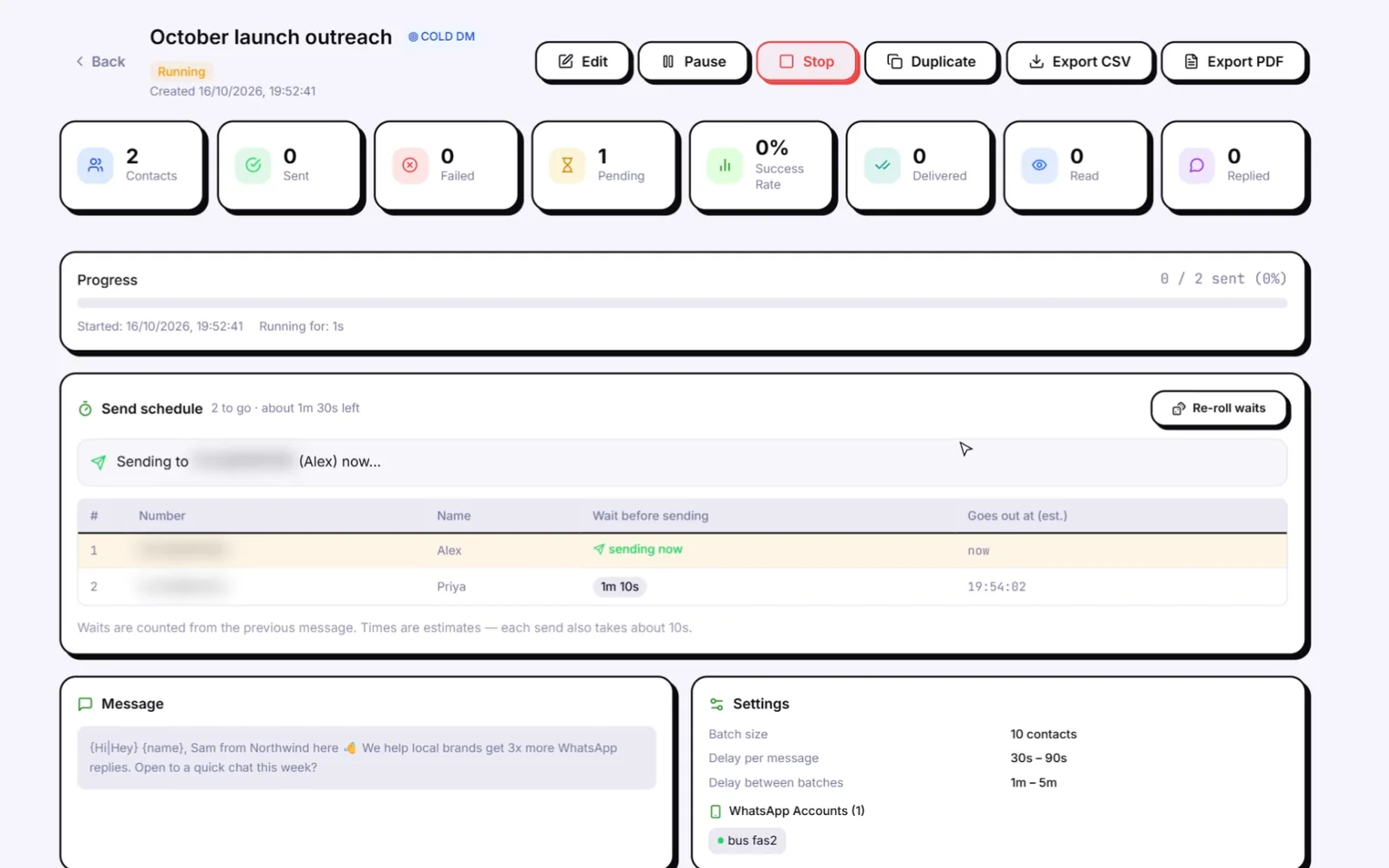
It won't replace the call or make a cold list warm, and no tool removes ban risk. The download and account are free; warming and sending need a licence, currently $397 one-time for lifetime access.
Put a WhatsApp message on either side of every call
Warm a dedicated number, then send short heads-up and follow-up messages, or voice notes, at a human pace from one Windows app.
Free account. Windows 10 and 11. Warming and sending need an active licence.
Frequently asked questions
Is cold calling dead in 2026?
No, but it takes a lot of dials. Belkins measured a 9.9% per-dial connect rate across 175,000+ dials in 2025, or roughly 370 dials per meeting, and Gong found the average rep connects with 5.4% of prospects. Calls still work best for complex deals and urgent decisions, and Gong found prospects who were also called replied to email more often, even when the call didn't connect.
What is a good cold calling connect rate?
It depends on how it is counted. Belkins reported 9.9% of dials reaching a live person in 2025, and 24.5% of prospects reached at some point. Gong found the average rep connects with 5.4% of prospects and the top quartile with 13.3%. Compare your numbers with a benchmark that uses the same denominator: per dial, per prospect or per conversation.
Should I cold call or WhatsApp a prospect first?
If the prospect publishes a business line and the deal is complex, call first. If they are likely to screen unknown numbers, or WhatsApp is the normal business channel in their market, a short WhatsApp message saying who you are and when you will ring can make the call less of a surprise. Only message numbers you are allowed to contact, and stop as soon as they say no.
Can WhatsApp replace cold calling?
Not fully. WhatsApp reaches people who ignore unknown calls and suits follow-up, links and voice notes, but a chat is weaker for discovery, objection handling and urgent decisions. It also carries a different risk: WhatsApp's terms ban bulk messaging and auto-messaging, and numbers can be banned. WhatsApp usually works best around your calls rather than instead of them.
Is B2B cold calling legal in the UK?
Yes, with conditions. Under PECR you must not make live marketing calls to numbers on the TPS or CTPS unless that person has specifically consented to your calls, and the ICO says B2B lists must be screened against both, because sole traders register on the TPS. Since 5 February 2026 the ICO can fine up to £17.5 million or 4% of global turnover.
What is the best time to cold call?
Mid-morning is the most consistent answer. Cognism's 2026 report names 10 to 11am as the best window, with 2 to 3pm also strong and Thursday the standout day. Orum's 2024 data shows connect rates peaking at 10am local time, and Gong's 2024 dialler data favours Tuesday and Wednesday mornings. The sources disagree on the day, so test windows on your own list.
Sources
- Belkins: Cold calling benchmarks (June 2026)
- Gong Labs: The hidden power of cold calling, insights from 300M calls (July 2024)
- Gong Help: Engage analytics, benchmarks and best practices (updated June 2026)
- Gong: 9 Secret Elements of Highly Effective Cold Calls (undated, about 2022)
- Cognism: Cold Calling Report 2026 (early 2026)
- Orum: Cold calling 2025 (January 2025)
- Pew Research Center: Most Americans don't answer cellphone calls from unknown numbers (December 2020)
- Hiya: State of the Call 2026 (2026)
- Hiya: Hiya Launches Caller Reputation (September 2025)
- Hiya: Global Phone Spam and Fraud Report, first half of 2024 (August 2024)
- Hiya: Global Call Threat Report Q2 2025 (2025)
- Hiya: Are your business calls being flagged as spam? (June 2023)
- Cornell LII: 47 CFR § 64.1200, Delivery restrictions (current text, checked October 2026)
- FTC: Q&A for Telemarketers and Sellers About DNC Provisions in TSR (updated 2026)
- FCC Enforcement Bureau: Unlawful Communications (checked October 2026)
- US Court of Appeals, Eleventh Circuit: Insurance Marketing Coalition v. FCC (January 2025)
- Troutman Pepper Locke: FCC's Final Rule on Consent Kills One-to-One Consent Requirement (September 2025)
- ICO: Telephone marketing, Guide to PECR (checked October 2026)
- ICO: Business-to-business marketing (checked October 2026)
- ICO: Statement on the commencement of the Data (Use and Access) Act (February 2026)
- WhatsApp: Stopping Abuse white paper (February 2019, mirrored copy)
- WhatsApp: Terms of Service (effective January 2021)
- WhatsApp Business: Business Messaging Policy (updated September 2026)
- WhatsApp Blog: Making Voice Messages Better (March 2022)
- WhatsApp Blog: Introducing Voice Message Transcripts (November 2024)
- YouGov: Do consumers prefer sending and receiving messages in audio or text form? (February 2024)
- Harvard Business Review: The Short Life of Online Sales Leads (March 2011)
- Gartner: 74% of B2B Buyer Teams Demonstrate Unhealthy Conflict (May 2025)
- Forrester: The State of Business Buying, 2026 (January 2026)
- Similarweb: Most Popular Messaging Apps in 2025 (2025)
- ElevenLabs: Prohibited Use Policy (updated October 2026)
Sources checked October 2026. Vendor figures are labelled as such in the text.