LinkedIn vs WhatsApp outreach in 2026: limits, reply data and when to use each
LinkedIn vs WhatsApp outreach comes down to who you sell to. For cold B2B prospecting, especially enterprise buyers in the US and UK, LinkedIn usually wins: profiles show role and company, and connecting with strangers is normal there. WhatsApp usually wins once a conversation exists and in markets where it is the default business channel. The best setup uses both: connect on LinkedIn, then move to WhatsApp with permission.
- Cold B2B prospecting: LinkedIn usually wins, because you can find people by role and a connection request from a stranger is normal there.
- Follow-up and WhatsApp-first markets: WhatsApp usually wins, because replies happen in a chat and, in many countries, it is the default way to talk to businesses.
- Limits: LinkedIn publishes no weekly invitation number (vendors report roughly 100), gives free members 5 personalised notes a month and caps InMail credits by plan.
- Automation: LinkedIn's User Agreement bans bots and unauthorised automation, and WhatsApp's terms ban bulk and auto-messaging. Both can restrict or ban you.
- Best sequence: connect and engage on LinkedIn, then move to WhatsApp once the person shares their number or agrees to it.
LinkedIn vs WhatsApp outreach: the short verdict
Use LinkedIn to find and open conversations with professionals you don't know yet, and WhatsApp to keep those conversations moving once there is a reason to. The table gives the call for common situations.
| If you need... | Choose | Why |
|---|---|---|
| To reach decision-makers by job title at companies you've never spoken to | Profiles show role, company and shared connections, and a request from a stranger is normal there | |
| Enterprise or corporate buyers in the US and UK | LinkedIn, then email | A professional setting; many corporate buyers treat WhatsApp as personal |
| Fast follow-up after someone has engaged | A chat suits quick back-and-forth, voice notes and sending a link or document | |
| Owner-run businesses in markets where WhatsApp is the default | It is the top messaging app in 70 of 100 countries in Similarweb's 2025 Android data | |
| Hundreds of automated connection requests a week | Neither | LinkedIn's User Agreement bans unauthorised automation, and restrictions hit your own profile |
| Many conversations from several numbers, without the API | WhatsApp (with a warmer such as Wassuply) | Dedicated, warmed and paced numbers lower ban risk, though nothing removes it |
LinkedIn vs WhatsApp for sales: full comparison
LinkedIn gives you context and a professional setting; WhatsApp gives you a direct line and a faster conversation. Sources for each row are in the sections below.
| Factor | ||
|---|---|---|
| Audience size | "+1.3B" member accounts, not active users | More than 3 billion monthly users |
| Setting | Professional network, work identity | Personal chat app, next to friends and family |
| What you see first | Job title, company, shared connections, recent posts | Usually a name and a photo |
| What you need to start | A profile, plus a connection request or an InMail credit | The person's mobile number |
| Volume limits | Unpublished invitation limit; 5 personalised notes a month on free accounts; InMail credits by plan | No published limit; a monthly cap on unanswered messages is being tested |
| Automation rules | User Agreement section 8.2 bans bots and unauthorised automation | Terms of Service ban bulk messaging and auto-messaging |
| Penalty | Invitation restrictions (typically a week) up to account suspension | Temporary restriction or a ban of the number |
| Reply data | Vendor benchmarks: 26% acceptance and 7.2% reply (Belkins, 2025) | No neutral benchmark for cold messages |
| Cost | Free; Sales Navigator Core US$119.99 a month billed monthly | Free app; you pay for numbers, proxies and software |
| Whose account is at risk | Your own professional profile | The sending number, which can be a dedicated one |
| Best for | Cold B2B prospecting, enterprise, finding people by role | Follow-up, WhatsApp-first markets, owner-operators |
Reach: member accounts are not active users
LinkedIn's About page lists "+1.3B" members (checked October 2026), and its last dated figure was "nearly 1.3 billion members" in October 2025. Members are registered accounts, not active users, and LinkedIn does not publish monthly active users, so the audience you can actually reach in a given week is smaller and unknown.
WhatsApp has more than 3 billion monthly users, according to Mark Zuckerberg in April 2025. Similarweb's 2025 Android data ranked it the top messaging app in 70 of the 100 countries it examined. In the US, WhatsApp reported more than 100 million monthly users in 2024, so check where your own buyers chat before you pick a channel.
Context matters as much as size: LinkedIn shows role, company and shared connections before you write a word, while WhatsApp needs a mobile number first, which many professionals don't publish.
What are LinkedIn outreach limits in 2026?
LinkedIn limits invitations, personalised notes and InMail, but it publishes no weekly invitation number. Here is what LinkedIn's own help pages say, as of October 2026.
Connection requests
LinkedIn says all members, Basic and Premium, are subject to invitation limits, that a restriction "typically lasts one week" and that it can't remove or shorten the wait. LinkedIn doesn't publish a number; automation vendors report roughly 100 invitations a week (Hublead, 2026), and say it varies with account age, plan and acceptance rate.
LinkedIn's restrictions page lists three triggers: many invitations in a short time, many invitations ignored, left pending or marked as spam, and suspected use of an automation tool. Most restrictions lift within a week, but too many outstanding invitations can mean waiting up to a month. Networks are capped at 30,000 first-degree connections.
Free (Basic) members can add a personal note to only five connection requests a month, so on a free account everything after the fifth request goes out without a note.
InMail credits by plan
InMail lets you message people you aren't connected to, and each paid plan gets a monthly allowance of credits. LinkedIn Help lists these, as of October 2026:
| Plan | InMail credits a month | Most you can hold |
|---|---|---|
| Premium Career | 5 | 15 |
| Premium Business | 15 | 45 |
| Recruiter Lite | 30 | 120 |
| Sales Navigator (Core, Advanced, Advanced Plus) | 50 | 150 |
LinkedIn says Sales Navigator users can't buy additional InMail credits. A credit comes back for every InMail that gets a response within 90 days, and a "Not interested" decline counts. LinkedIn claims "InMails drive 3X higher response rates than emails" but gives no method, sample or date, and the InMail response-rate ranges quoted on vendor blogs have no underlying data. LinkedIn's own 2022 study of recruiter InMails found the shortest ones, under 400 characters, got a response rate 22% above the average.
How much does Sales Navigator cost?
Sales Navigator Core costs US$119.99 a month billed monthly, or US$1,079.88 a year, and Advanced costs US$159.99 a month or US$1,799.88 a year, on LinkedIn's pricing page as of October 2026. Advanced Plus has custom pricing. In pounds, Core is £94.99 a month or £959.88 a year, and Advanced £130.00 a month or £1,499.88 a year. Prices may exclude VAT and are subject to change.
Can you get banned on LinkedIn for automation?
Yes. LinkedIn's User Agreement, effective 3 November 2025, bans bots and unauthorised automation in section 8.2, and LinkedIn says it may restrict or suspend accounts it suspects of using automation tools.
Section 8.2 rules out using "bots or other unauthorized automated methods" to access the service, add or download contacts, or send or redirect messages, and section 3.4 lets LinkedIn restrict, suspend or terminate an account for a breach. Its help page on automated activity says LinkedIn doesn't allow third-party software or browser extensions that scrape or automate activity, and a restricted member has to disable the tool before access returns.
The biggest LinkedIn benchmarks come from automation vendors, so they describe accounts that accept this risk. On LinkedIn the account at risk is your own professional profile; WhatsApp outreach can run from a dedicated number, which carries its own ban risk.
What reply rates does LinkedIn outreach get?
Recent benchmarks put LinkedIn connection acceptance between about 21% and 29%, but reply rates can't be compared across sources because each counts replies differently. All three sources below sell outreach tools or services.
| Source | Acceptance | Reply rate | How it is counted |
|---|---|---|---|
| Belkins (2025 data) | 26% | 7.2% | Replies divided by messages sent; 15.1M+ Expandi touchpoints plus 14,077 Belkins records |
| Expandi (May 2025 to April 2026) | 28.5% | 10.4% of messages; 3.0% reply to the connection note | 13.2M connection requests and 6.7M messages from 13,302 accounts; messages include follow-ups, InMails and emails |
| HeyReach (12 months to September 2026) | 20.75% median | 22.22% median | Replies divided by conversations started, not messages sent; 96,051 campaigns |
Read the methods, not just the numbers. In Belkins' own client campaigns, 18.7% of invited prospects accepted, below its blended 26%. Expandi's acceptance ranged from 19.9% in apparel and fashion to 36.5% in staffing and recruiting. HeyReach's 22% looks high because it divides by conversations already started, and 10.7% of its campaigns with accepted connections got no replies at all.
There is no neutral benchmark for cold WhatsApp messages. The best measured WhatsApp figure covers opt-in marketing, not cold outreach: the vendor Chatarmin found a 72.05% median open rate across 382 brands' campaigns in 2026, counted from read receipts. Opens are not replies, so the only fair LinkedIn outreach vs WhatsApp test is your own. Our guide to the real WhatsApp open rate explains where the popular figures come from.
Is WhatsApp good for B2B outreach?
WhatsApp is good for B2B outreach where it is the normal way businesses talk, and for follow-up once a contact has engaged. It is a poor fit for cold messages to corporate buyers who treat it as private, which is why choosing LinkedIn or WhatsApp for B2B usually depends on the market.
Where WhatsApp is stronger
- It is the default in many markets. WhatsApp is the top messaging app in 70 of 100 countries in Similarweb's 2025 Android data, so a WhatsApp message to a business owner there doesn't feel out of place.
- It is conversational. A chat invites a quick, short answer to a yes-or-no question.
- Voice notes. WhatsApp users send 7 billion voice messages a day (WhatsApp, March 2022), and since November 2024 recipients can turn on on-device transcripts and read them instead. Use them sparingly: YouGov's 17-market survey (November 2023) found 66% prefer sending text and 7% audio. A vendor claim that voice notes double LinkedIn reply rates (ElevenLabs and lemlist, July 2025) comes with no sample or method.
- A separate sending identity. Outreach can run from dedicated numbers rather than your personal profile.
Where WhatsApp is riskier
- Bans. WhatsApp's Terms of Service list bulk messaging, auto-messaging and auto-dialling as impermissible, and its Messaging Guidelines (updated September 2026) allow temporary or permanent suspension. In 2019 WhatsApp said it removed over two million accounts a month for bulk or automated behaviour.
- A cap on unanswered messages. WhatsApp has been testing a monthly limit on messages to people who haven't replied (TechCrunch, October 2025), without saying what the limit is.
- Privacy norms. Many professionals treat WhatsApp as personal, and WhatsApp's Business Messaging Policy expects that people gave you their number and opted in. In the UK, the ICO counts social-media direct messages as electronic mail under PECR, so a cold WhatsApp marketing message to a sole trader likely needs consent. Take legal advice; our guide to cold WhatsApp messages and GDPR covers the basics.
What do people on Reddit report about LinkedIn vs WhatsApp?
These are individual anecdotes, not data.
- r/sales, 2023: a US seller who connected with an India-based prospect on LinkedIn was asked to move to WhatsApp, and wondered whether that was a scam sign. The top reply said "In many countries outside the US whatsapp is one of the primary communication tools used." (thread)
- r/agency, 2024: in an email vs LinkedIn thread, one commenter claimed LinkedIn response rates of 10-15% against 2-3% for good cold email, then disclosed that they run a LinkedIn lead-generation agency. The first reply found LinkedIn harder to scale than email, and another said two automated accounts averaged 1.5 discovery calls a day. (thread)
- r/linkedin, 2024: a member's account was temporarily restricted after they used an automation tool, and both replies said LinkedIn had been cracking down on automation all year. (thread)
- r/agency, 2024: in a thread about cold DMs, one commenter said they booked several million over two years mainly through LinkedIn networking conversations, about 75% of their sales. (thread)
- r/b2bmarketing, 2025: asked whether WhatsApp could replace B2B email newsletters, the top-voted reply said they would be annoyed and block any attempt: "Whatsapp is for people I want to talk to." (thread)
How to use LinkedIn and WhatsApp together
Connect and build context on LinkedIn, then move to WhatsApp only once the person has shared their number, agreed to it, or the switch is the natural next step. No published study measures LinkedIn-plus-WhatsApp sequences, but Gong found a second channel helps in general: prospects who were also cold called replied to email at 3.44% against 1.81%. Relevance matters more than the channel, since Gartner found 73% of B2B buyers actively avoid suppliers who send irrelevant outreach (June 2025). An illustrative sequence:
- 1Day 1: connect with a reasonSend requests to people you have researched. On a free account you get five personalised notes a month, so save them for your best-fit prospects.
- 2Days 2 to 7: engage before you pitchComment usefully on a recent post or share something relevant to their role. Don't pitch in the first message after they accept.
- 3Day 7 or later: one LinkedIn messageShort and specific, with one question. If they reply, keep going on LinkedIn until there is a reason to switch.
- 4Ask before you switchOffer WhatsApp as an option when you have something to send or a call to arrange. If they share their number, that is your opening.
- 5On WhatsApp, pick up where you left offMention the LinkedIn conversation in the first line, stop follow-ups as soon as they reply, and send proposals by email so the wider buying group can see them.
Two illustrative messages, first on LinkedIn, then on WhatsApp once they agree:
For more sequence ideas across email, calls and chat, see our multichannel outreach guide and the comparison of cold calling vs WhatsApp.
How to start WhatsApp outreach safely
Start small, with numbers you can afford to lose and contacts who expect to hear from you.
- 1Create a free accountSign up and download the app, then connect a dedicated number rather than your personal one.
- 2Warm each number for at least 15 daysThirty is better. A WhatsApp warmer gives a new number normal-looking chat history before its first campaign; see a new number's first 30 days.
- 3Start with your warmest LinkedIn contactsPeople who replied, shared their number or asked for something. Keep each number under its safe daily limit.
- 4Pace, and stop on replyRandom gaps, working hours only, follow-ups that stop on a reply, and every opt-out honoured. Our guide to avoiding WhatsApp bans has the rest.
Where Wassuply fits next to LinkedIn
Wassuply covers the WhatsApp half of the sequence; it doesn't touch LinkedIn, where you keep connecting and messaging by hand. Wassuply is a Windows desktop app for warming up WhatsApp numbers and running cold WhatsApp outreach from unlimited numbers, sold as a one-time $397 lifetime licence during early access.
- Dedicated numbers, kept apart. Each WhatsApp or WhatsApp Business number runs in its own isolated WhatsApp Web session with its own browser fingerprint and optional proxy. There is no Business API, Meta verification or template approval.
- LinkedIn context in the message. Import contacts from a CSV with phone, name, custom1 and custom2 columns, for example the topic you discussed in custom1, without saving anyone on a phone. AI-personalised first messages are written per contact with your own Claude, ChatGPT or DeepSeek API key.
- Voice notes. Send voice notes, including AI voice notes and a clone of your own voice made with your own ElevenLabs key. ElevenLabs' use policy bans cloning someone's voice without their consent.
- Limits per number. Health & Risk gives each number a safe daily limit of 30 to 250 messages depending on its age, plus a live 0-100 risk score. Turn on Smart Send and it slows sending at 60 and pauses at 80.
- Stop on reply. Follow-up sequences stop the moment a contact replies, and replies land on a Pipeline CRM board.
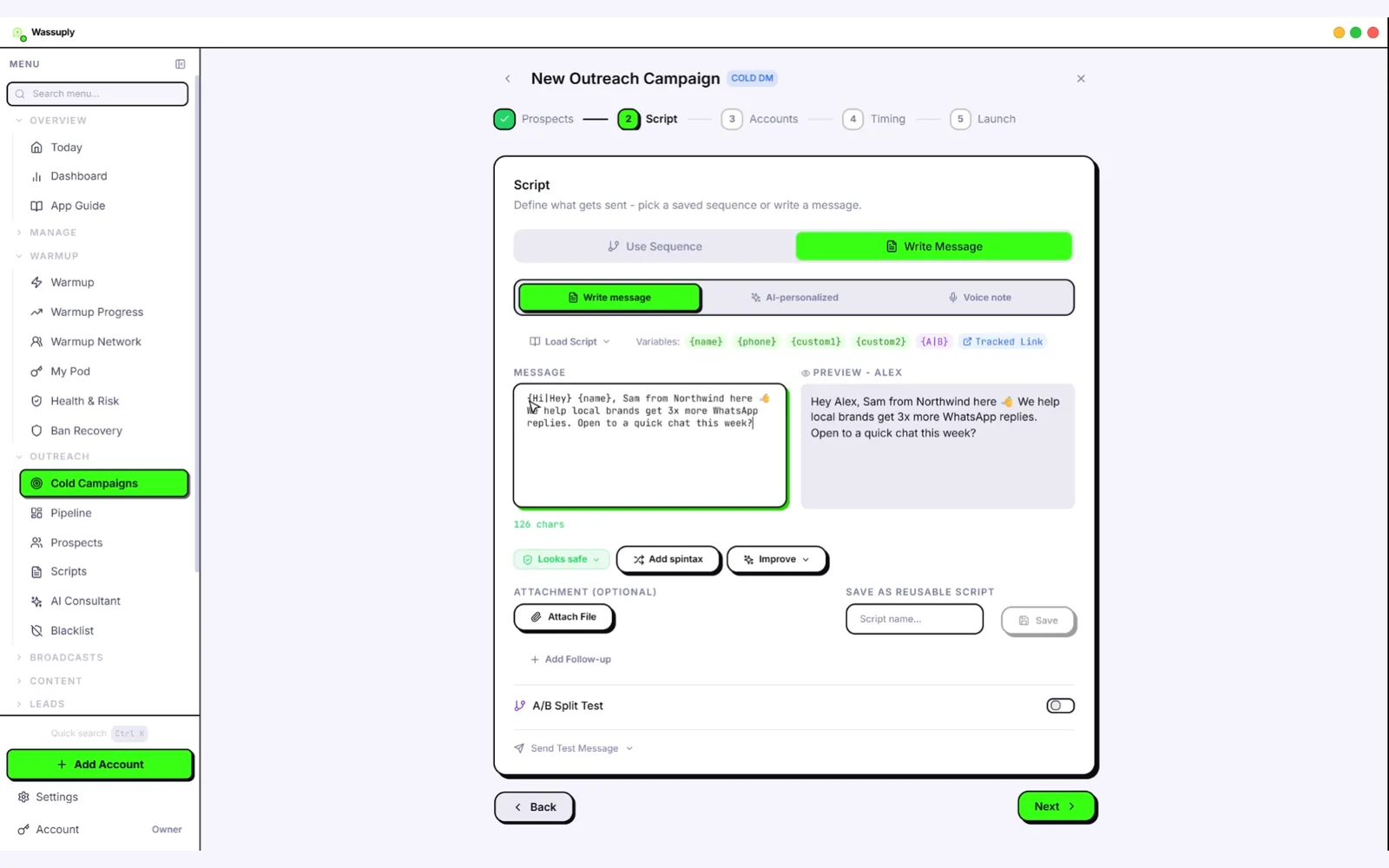
It won't make a cold list warm, and no tool removes ban risk. The download and account are free; warming and sending need a licence, currently $397 one-time for lifetime access. For the wider picture, see why WhatsApp works for sales.
Take your LinkedIn conversations to WhatsApp, at a human pace
Warm a dedicated number, import the contacts who said yes and follow up with paced, personalised messages from one Windows app.
Free account. Windows 10 and 11. Warming and sending need an active licence.
Frequently asked questions
Is LinkedIn or WhatsApp better for B2B outreach?
For cold B2B prospecting, LinkedIn is usually better: you can find people by role, see their company and send a connection request without needing a phone number. WhatsApp is usually better for follow-up once someone has engaged, and for owner-run businesses in markets where WhatsApp is the default. Many teams use both, starting on LinkedIn and moving to WhatsApp once the contact shares a number or agrees to it.
How many LinkedIn connection requests can I send per week?
LinkedIn doesn't publish a number. Its help page says every member, free or Premium, is subject to invitation limits, and that a restriction typically lasts one week. Automation vendors report a ceiling of roughly 100 invitations a week, varying with account age and acceptance rate. Requests that are ignored, left pending or marked as spam count against you, so smaller, better-targeted batches are safer.
Can you get banned on LinkedIn for using automation tools?
Yes. Section 8.2 of LinkedIn's User Agreement, effective 3 November 2025, bans bots and unauthorised automated methods for adding contacts or sending messages, and section 3.4 lets LinkedIn restrict, suspend or terminate accounts that breach it. LinkedIn's help pages say it may restrict accounts it suspects of using automation tools, and a restricted member must disable the tool before access returns.
How many InMails do you get with Sales Navigator?
Sales Navigator Core, Advanced and Advanced Plus each include 50 InMail credits a month, and you can hold up to 150, according to LinkedIn Help (checked October 2026). You can't buy extra credits. A credit comes back for each InMail that gets a response within 90 days, including a decline. Premium Business gets 15 credits a month and Premium Career gets 5.
Is it OK to message a LinkedIn contact on WhatsApp?
It is fine when they have given you their number or agreed to move the conversation, and risky when you found the number elsewhere. Many professionals treat WhatsApp as personal, WhatsApp's Business Messaging Policy expects opt-in, and in the UK a cold marketing message to a sole trader likely needs consent under PECR. Ask on LinkedIn first, and take legal advice for your market.
What is a good LinkedIn connection acceptance rate?
Recent vendor benchmarks put average acceptance between about 21% and 29%. Belkins reported 26% for 2025, Expandi 28.5% from May 2025 to April 2026, and HeyReach a 20.75% median across 96,051 campaigns. Rates vary by industry: Expandi saw 19.9% in apparel and fashion and 36.5% in staffing. All three sell outreach tools or services, and much of their data comes from automated campaigns.
Sources
- LinkedIn: About LinkedIn (checked October 2026)
- LinkedIn: Q1 Business Highlights and Momentum (October 2025)
- LinkedIn Help: Invitation limit reached (checked October 2026)
- LinkedIn Help: Types of restrictions for sending invitations (checked October 2026)
- Hublead: LinkedIn Invitation Limit 2026 (2026)
- LinkedIn Help: InMail message credits and renewal process (checked October 2026)
- LinkedIn Help: Understand InMail credits in Sales Navigator (checked October 2026)
- LinkedIn Sales Solutions: 6 InMail Templates that Can Help You Break Through (undated)
- LinkedIn Talent Blog: These InMails get the best response rates (May 2022)
- LinkedIn Sales Solutions: Compare Plans and Pricing (checked October 2026)
- LinkedIn: User Agreement (effective November 2025)
- LinkedIn Help: Automated activity on LinkedIn (checked October 2026)
- Belkins: LinkedIn outreach study (updated June 2026)
- Expandi: LinkedIn Outreach Benchmarks 2026 (May 2026)
- HeyReach: LinkedIn Outreach Benchmark Report 2026 (September 2026)
- Chatarmin: WhatsApp Open Rate Benchmark 2026 (September 2026)
- TechCrunch: WhatsApp now has more than 3 billion users a month (May 2025)
- Similarweb: Most Popular Messaging Apps in 2025 (2025)
- TechCrunch: Mark Zuckerberg says WhatsApp has 100M monthly active users in the US (July 2024)
- WhatsApp Blog: Making Voice Messages Better (March 2022)
- WhatsApp Blog: Introducing Voice Message Transcripts (November 2024)
- YouGov: Do consumers prefer sending and receiving messages in audio or text form? (February 2024)
- ElevenLabs: lemlist doubles outbound reply rates at scale with AI voice notes (July 2025)
- WhatsApp: Terms of Service (effective January 2021)
- WhatsApp: Messaging Guidelines (updated September 2026)
- WhatsApp: Stopping Abuse white paper (February 2019, mirrored copy)
- TechCrunch: WhatsApp will curb the number of messages people and businesses can send without a response (October 2025)
- WhatsApp Business: Business Messaging Policy (updated September 2026)
- ICO: Business-to-business marketing (checked October 2026)
- Gong Labs: The hidden power of cold calling, insights from 300M calls (July 2024)
- Gartner: 61% of B2B Buyers Prefer a Rep-Free Buying Experience (June 2025)
- ElevenLabs: Prohibited Use Policy (updated October 2026)
Sources checked October 2026. Vendor figures are labelled as such in the text.