How to get high-ticket clients without ads: a step-by-step system for 2026
How to get high-ticket clients comes down to trust that exists before the first call: a referral, proof the buyer found on their own, or a first message so specific it could only be for them. Ads rarely build that trust for a $3k to $50k+ deal. This guide explains why high-ticket buyers behave differently, which channels win them without paid ads, and a 100-account system you can start this week.
- High-ticket means more people and more risk: B2B buying groups run from five to 16 people, and most buying groups rank a favourite vendor before they contact a seller.
- Trust beats reach: referrals, your network and proof-led content produce high-ticket deals without ads because the buyer arrives already half-convinced.
- Outbound works when the list is small: 100 researched accounts, a real signal for each and a personalised first message beat thousands of generic sends.
- Speed and follow-up close the gap: reply within the hour, follow up on a set rhythm, and stop the moment they reply.
- WhatsApp suits the middle of the deal: fast replies, voice notes and staying in the thread after the call. Keep first contact with cold corporate buyers on email or LinkedIn.
What is a high-ticket client?
A high-ticket client is one whose deal is big enough that a single signature changes your month. For most agencies, consultants, coaches, freelancers and B2B service sellers, that means roughly $3k to $50k or more, paid as a project or a retainer. There is no official threshold: a $5k project is high-ticket for a solo designer and routine for a 40-person agency.
What really makes a client high-ticket is the risk that comes with the price: they want more proof, involve more people and take longer to decide. A $4,000-a-month retainer over 12 months is a $48,000 decision, and the buyer treats it like one.
Tactics built for quick purchases (an ad, a landing page, a discount) rarely move someone about to commit tens of thousands. This guide covers high-ticket client acquisition without paid ads. For smaller offers, our guide on how to get clients without ads covers the broader playbook.
Why do high-ticket buyers behave differently?
High-ticket buyers behave differently because they have more to lose: they decide in groups, shortlist before they talk to you, lean on people they trust and favour whoever responds first.
They buy as a group
Gartner's survey of 632 B2B buyers found buying groups ranging from five to 16 people across as many as four functions, and 74% of buyer teams showed "unhealthy conflict" during the decision (Gartner, May 2025). Forrester counts 13 internal stakeholders and nine external influencers in a typical decision (Forrester, January 2026). The studies count differently, so treat them as a range.
So the person who replies is rarely the only person who decides. Your proposal will be forwarded to people you have never spoken to, and it has to make sense without you in the room.
They pick a favourite before first contact
Most buyers have a shortlist before they speak to any seller. In 6sense's 2025 Buyer Experience Report, covering more than 4,000 buyers, 94% of buying groups had ranked their preferred vendors before first contact, and that early favourite won 77% of the time (6sense via Business Wire). The same report puts the balance between independent research and seller engagement at roughly 60/40.
Your job before the first call is to get onto that shortlist: through a referral, through proof they find on their own, or through a message relevant enough that they add you. Our forecast on how to get clients in 2027 explains why this will matter even more next year.
They trust people they know
Nielsen's 2021 global survey of more than 40,000 consumers found 88% trust recommendations from people they know more than any other channel (Nielsen). That is consumer data, but the instinct does not switch off at work. A peer-reviewed study of about 10,000 bank customers found referred customers were worth at least 16% more than comparable non-referred ones (Schmitt, Skiera and Van den Bulte, 2011).
A referral is not a free pass, though. In Hinge's survey of 523 professional services firms, 51.9% of referred prospects ruled a provider out before talking to them (Hinge Marketing, 2015). The referral gets you looked at; your public proof decides whether you get the call.
They reward speed
In a Harvard Business Review study of 1.25 million sales leads, firms that tried to contact a lead within an hour were nearly seven times as likely to qualify it as firms that waited even an hour longer (Oldroyd, McElheran and Elkington, HBR, 2011). The data is old and covers inbound web leads, but the principle holds for a $20k enquiry: whoever answers well and first sets the tone.
Which channels bring high-ticket clients without ads?
Five channels produce most high-ticket clients without ads: referrals and your network, proof-led content, targeted outbound to a small researched list, partnerships, and direct conversational follow-up. Each builds trust before the first call, which ads struggle to do at this price.
Agency owners on Reddit describe the same mix. These are individual accounts, not data:
- In a 2024 r/agency thread about the biggest client each person had landed, the top answer came from replying to an in-house job ad and pitching an agency instead. Other answers credited a referral, a networking group and personalised cold emails (r/agency, 2024).
- In a 2024 r/agency thread about $100k-plus deals, the top reply credited a reputation built over time in a very specific niche. Another described a deal of about $180k: "Comes from referral." (r/agency, 2024).
- In a 2024 r/agency thread about cold DMs, one commenter said about 75% of their sales came from LinkedIn networking conversations (r/agency, 2024).
1. Referrals and your network
Referrals close fastest because the trust arrives with the introduction. Ask past clients and contacts for one specific kind of introduction, such as "a founder who has just raised and needs a sales site", at set moments like project handover. Vague asks get vague answers.
2. Proof-led content
Publish the specific work buyers want to see: a teardown of a problem you solved, real numbers from a project (with permission), or a plain answer to a question buyers ask before they buy. It puts you on shortlists you don't know exist. It is slow, but it keeps working after you stop.
3. Targeted outbound to a small list
For high-ticket deals, outbound is about precision, not volume. Gartner found that 73% of B2B buyers actively avoid suppliers who send irrelevant outreach (Gartner, June 2025), so a generic sequence to 5,000 people can cost you buyers you would have won later. Our guide to signal-based selling lists signals worth tracking, and if email is your main channel, read why cold email doesn't work like it used to.
4. Partnerships
A partner already serves your buyer without competing with you: an accountant, a developer, a recruiter. They hand you buyers who already trust someone they know. We know of no reliable benchmark for partner-sourced deals, so judge each partner by introductions, not promises.
5. Direct conversational follow-up
Once a buyer shows interest, the deal moves in conversation: quick answers, a call, a message the day after the proposal. Be the vendor who is easy to talk to, in the channel the buyer prefers.
How the channels compare
No public study compares these channels on the same basis, so these values are qualitative.
| Channel | Time to first deal | Cost | Best for |
|---|---|---|---|
| Referrals and network | Fast: days to weeks once you ask | Your time; sometimes a referral fee | Anyone with past clients or a professional network |
| Proof-led content | Slow: usually months | Writing time, a little design or editing | Specialists in a clear niche who can show results |
| Targeted outbound (100 accounts) | Medium: weeks to a few months | Research time, data and sending tools | New offers, new markets, or anyone short of referrals |
| Partnerships | Medium to slow: weeks to months | Time to build trust; sometimes a revenue share | Services that sit next to another provider's work |
| Conversational follow-up | Speeds up every other channel | Your daily attention | Turning interest into calls and signed deals |
What does a real high-ticket win look like?
Real high-ticket wins usually start smaller and messier than the final number suggests. Two Reddit threads show how.
In an October 2024 r/agency thread, a new agency owner described landing their first $10k client: a SaaS build with $3k paid upfront, from a Fiverr lead closed off the platform. In a reply, the poster explained that the first conversations happened on WhatsApp because the client wanted to talk directly by phone: "we talked on whatsapp at first was just to discuss the project" (r/agency, 2024). No ad was involved, and the deal moved to the channel the client chose.
In a February 2025 r/LeadGeneration thread, a waterproofing contractor reconnected with an engineer from an old lost deal, cold-emailed the plant's maintenance manager and got a meeting. The first order was two buckets at about $400 each. Two years later they won the bid for a project of over 10,000 square metres (r/LeadGeneration, 2025).
Both are single anecdotes, not proof, but the pattern is worth copying: a warm thread to start, a conversation in the buyer's preferred channel, and patience after a small first yes.
How to get high-ticket clients: a step-by-step system
The most dependable way to find high-ticket clients without ads is to work a short list deeply: 100 accounts, a reason to contact each one now, a personalised first message, a steady follow-up rhythm, a call and a clear proposal. Run it alongside referrals and content, not instead of them.
- 1Define one offer and one buyerPick the service you most want to sell, its price range, and the type of company that needs it most. A narrow offer makes every later step easier.
- 2Build an ideal-client list of 100 accountsChoose 100 named companies that fit. For each, note the likely decision maker plus one or two others in the buying group.
- 3Find a signal for each accountA signal is a reason to contact them now: a new hire, a funding round, a new location, a job ad, a slow website. No signal, no message; check again next month.
- 4Write a personalised first messageOpen with the signal, connect it to a problem you solve, offer one useful thing and ask a small question. Keep it short enough to read on a phone.
- 5Follow up on a set rhythmPlan four or five touches over about three weeks, across two channels, each adding something new. Stop the moment they reply, and for good if they say no.
- 6Move to a callWhen they reply with interest, offer two specific times within 48 hours, and answer questions within the hour during working hours.
- 7Send the proposalSend it within a day of the call, in their words: the problem, the outcome, two or three priced options and a date for the next step. Make it easy to forward to the buying group.
- 8Stay in the threadAfter the proposal, keep talking in the channel the buyer prefers: answer objections, confirm the next date. This is where many deals stall.
An example first message (illustrative)
This is an illustrative example, not a proven template. It assumes you build booking websites for clinics and the prospect has just opened a second location.
It is about them, it shows you have looked, and the ask is small: "Want me to send them over?" is easier to accept than a 30-minute call. If AI writes your first lines, check each one by hand; our guide to AI personalisation for WhatsApp explains how.
A follow-up rhythm for high-ticket prospects
Every follow-up has to earn its place. In Instantly's 2025 data, 58% of cold email replies came from the first email and 42% from follow-ups (Instantly). RAIN Group found sellers report needing an average of eight touches to get an initial meeting, though that is self-reported and dates from 2018 (RAIN Group). An illustrative rhythm:
- Day 1: the first message, on the channel that fits the buyer (email or LinkedIn for most cold B2B).
- Day 4: connect on LinkedIn or respond to something they posted, with no pitch.
- Day 7: a second message with one new piece of value, such as the three fixes.
- Day 12: a short check-in on a second channel, or a call if you have a lawful reason to use their number.
- Day 20: a polite close-the-loop message. Then stop, and recheck the account in 90 days.
Where does WhatsApp help high-ticket deals?
WhatsApp helps high-ticket deals most after first contact, when speed and a personal tone matter: fast replies, voice notes and staying in the thread after the call. In many markets it is where clients prefer to talk: Similarweb's Android data has WhatsApp as the top messaging app in 70 of the 100 countries it examined (Similarweb).
- Fast replies. Chat suits quick back-and-forth on scope, dates and prices. Superchat's 2022 data from more than 1,000 of its customers found businesses answered customers in a median 18.2 minutes on WhatsApp against 45.2 minutes by email (Superchat). That is vendor data about businesses, not prospects.
- Voice notes. A 60-second voice note walking through two pricing options feels more personal than a PDF. Use them once the buyer has engaged, not as a cold opener.
- Staying in the thread after the call. The proposal goes out and the deal goes quiet. A short message the next day, asking whether their partner had questions on option B, keeps it moving without another meeting.
For the wider case, see why WhatsApp works for sales.
When to stay on email or LinkedIn
Stay on email or LinkedIn until the buyer invites you into their chats. Many professionals keep WhatsApp for people they know. In a 2025 r/b2bmarketing thread asking whether WhatsApp could replace email newsletters, the top reply said they would block any attempt: "Whatsapp is for people I want to talk to." (r/b2bmarketing, 2025).
- First contact with a cold corporate buyer, especially where WhatsApp is mostly personal.
- Anything the buying group must forward, sign or file: proposals, contracts, procurement documents.
- Regulated sectors with rules about which channels staff may use.
- Any number you have no lawful basis to message. Read our guide to cold WhatsApp and GDPR first.
WhatsApp's own terms of service treat bulk messaging and auto-messaging as impermissible, and WhatsApp is testing a monthly cap on messages to people who haven't replied (TechCrunch, October 2025). High-ticket selling fits those limits: a handful of relevant messages, not blasts.
Where does Wassuply fit in high-ticket client acquisition?
Wassuply covers the WhatsApp part of this system: warming your numbers, sending personalised first messages and follow-ups at a human pace, and tracking replies. It is a Windows 10 and 11 desktop app that runs normal WhatsApp and WhatsApp Business accounts through WhatsApp Web sessions, with no Business API or template approval.
You import a CSV with phone, name, custom1 and custom2 columns and put each account's signal in a custom field. AI-personalised first messages are written per contact with your own Claude, ChatGPT or DeepSeek API key, and voice notes can be AI-generated through your own ElevenLabs key. Follow-up sequences stop the moment a contact replies, and replies land on a Pipeline board.
New numbers need warming first: at least 15 days before a first campaign, 30 recommended. Health & Risk shows each number's safe daily limit and a live 0 to 100 ban-risk score.
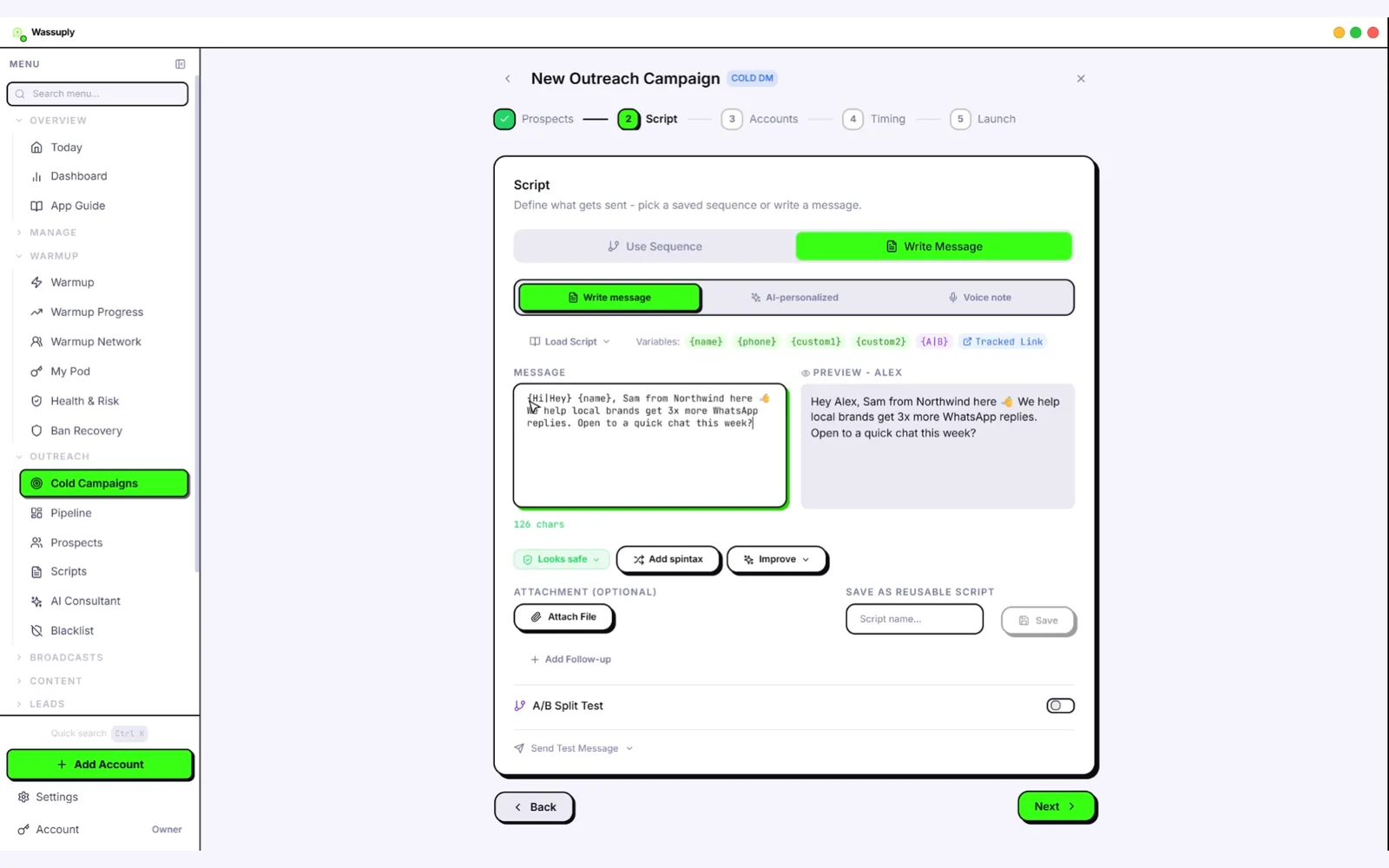
It won't find your 100 accounts or write your offer, and cold outreach always carries some ban risk. The download is free; warming and sending need a licence, $397 one-time on early-bird lifetime pricing. See also our page for agencies.
Keep high-ticket conversations moving on WhatsApp
Warm your numbers, send personalised first messages to a short list and keep every reply on one Pipeline board.
Free account. Windows 10 and 11. Warming and sending need an active licence.
Frequently asked questions
What is considered a high-ticket client?
A high-ticket client is one whose deal is large compared with your usual sale, typically $3k to $50k or more for a service business, paid as a project or a retainer. There is no official threshold. What sets these clients apart is the decision itself: more people are involved, more proof is needed and it takes longer, so they are won through trust rather than impulse.
How do I find high-ticket clients without ads?
Start with referrals and your network, and ask for one specific kind of introduction. Publish proof-led content that shows real work in a narrow niche. Then build a list of 100 researched accounts, contact each one with a relevant reason and a personalised message, and follow up on a set rhythm. Partners who already serve your buyers can add introductions over time.
How long does it take to land a high-ticket client?
It varies widely, and there is no reliable benchmark for service businesses. A referral can close in days. Outbound to a fresh list usually takes weeks to months, and larger B2B purchases take longer still: 6sense's 2025 research put average B2B buying cycles at about 10 months. Plan a pipeline that pays off over a quarter, not a week.
Does cold outreach work for high-ticket clients?
It can, if it is precise. Gartner found that 73% of B2B buyers actively avoid suppliers who send irrelevant outreach, so mass sequences do more harm at high price points. A short list of well-chosen accounts, each contacted because of a real signal with a message only they could receive, is the version that fits high-ticket sales.
Should I use WhatsApp with high-ticket clients?
Use WhatsApp when the client prefers it, which is common in markets where it is the default messenger. It suits quick questions, voice notes and keeping a deal moving after a call. For a cold first contact with a corporate buyer, email or LinkedIn is usually the safer choice, and you need a lawful basis to message any number.
How many prospects do I need to land one high-ticket client?
There is no trustworthy universal number, because it depends on your offer, price and market. As a reference point from one channel, Belkins' 2025 cold calling data needed roughly 370 dials to book one meeting. A focused list of 100 researched accounts, worked properly over a month, is a sensible first test. Track replies, calls and proposals, then adjust.