WhatsApp voice notes for sales: what the data says and when to send one
WhatsApp voice notes for sales work best after a prospect has replied, or with a warm lead, not as a cold opener. No independent study shows that voice notes lift reply rates; the claims that they double replies come from vendors that sell voice tools. Most people still prefer text, so keep each note short and pair it with a one-line text.
- Hugely popular between people who know each other: WhatsApp users sent 7 billion voice messages a day in 2022, the latest figure.
- No proof of a reply lift: claims that voice notes double replies are vendor marketing with no published method, and none measured WhatsApp.
- Text is still preferred: in YouGov's 17-market survey, 66% preferred sending text and 7% audio; the UK is the most text-heavy market and the UAE the most audio-friendly.
- How to use them: after a reply or with warm leads, under about 30-45 seconds, always with a one-line text the prospect can skim.
- AI voices: clone only your own voice, with consent, and never impersonate anyone. ElevenLabs' policy bans cloning without explicit consent.
Do WhatsApp voice notes for sales get more replies?
Nobody has shown that they do. We found no independent, academic or pollster study of voice notes in cold outreach, and none at all for WhatsApp voice notes in sales.
The "double replies" figures are vendor marketing. In a case study on ElevenLabs' blog, lemlist says LinkedIn voice notes got twice the reply rate of text-only DMs, with no sample, dates or method. Amplemarket claims a 150% lift for its LinkedIn voice AI, and SalesRobot claims a 47% reply rate with voice notes against 13% for text. All of these companies sell voice or outreach tools, all measured LinkedIn rather than WhatsApp, and none published how replies were counted.
That doesn't mean voice notes fail. A voice note carries tone and effort that text can't, and it is a native part of WhatsApp. Whether that helps depends on who receives it and when, which is what the rest of this guide covers.
| If you need... | Choose | Why |
|---|---|---|
| A first message to someone who doesn't know you | Text | Skimmable at a glance, and most people prefer sending text |
| A follow-up after the prospect replied | A short voice note plus a one-line text | Adds tone and effort once there is a conversation |
| To explain options or pricing quickly | A voice note under about 45 seconds, or a call | Faster to say than to type, easier to follow |
| Outreach in the UK, US or other text-first markets | Text first | YouGov found the UK the most text-heavy of 17 markets |
| Outreach in audio-friendly markets such as the UAE | Text, with a voice note as an option | More people there welcome audio, but text still leads |
| Voice notes across many warmed numbers, without the API | WhatsApp (with a warmer such as Wassuply) | Ordinary accounts, AI voice notes on your own ElevenLabs key, follow-ups that stop on reply |
How popular are WhatsApp voice messages?
Very popular between people who already talk to each other. WhatsApp said in March 2022 that its users send 7 billion voice messages a day on average, and it hasn't published a newer figure. The same update added playback outside the chat, pausing while recording, waveforms and 1.5x or 2x playback speed.
That number describes friends, family and colleagues. It says nothing about how people feel about a voice note from a stranger who wants to sell them something, which is the real question for WhatsApp voice message outreach.
Transcripts change how voice notes are read
Since November 2024, WhatsApp can transcribe voice messages on the recipient's device, so not even WhatsApp sees the text. Users switch it on in Settings, then Chats, then Voice message transcripts, and it launched with a few languages. For sales, this means your note may be read rather than heard: the first sentence has to make sense as text. You also can't assume transcripts are on.
View-once voice isn't for sales
WhatsApp added view-once voice messages, which disappear after one listen, in December 2023. Skip them in outreach: a prospect who wants to replay your price or next step can't.
Do people prefer voice notes or text?
Most people prefer text. In YouGov's 17-market survey (online, November 2023, 500 to 2,001 adults per market), 66% preferred sending text messages, 7% preferred audio and 21% liked both equally. The markets differ sharply:
| Market | Prefer sending text | What else YouGov found |
|---|---|---|
| All 17 markets | 66% | 7% prefer sending audio; 21% like both equally |
| UK | 83% | The most text-heavy market in the survey |
| US | 68% | For receiving, 65% prefer text and 6% audio |
| UAE | 38% | 17% prefer receiving audio, the highest of any market; 46% like both equally |
In India, about 40% liked receiving both formats equally. Britain was already text-first in 2022: YouGov found 63% of UK smartphone users had never sent a voice note, 47% had never received one, and more disliked sending them (36%) than liked it (16%). Only among 18 to 24-year-olds did more people like receiving voice notes (43%) than dislike it (28%).
Younger Britons may be shifting. A Twilio-commissioned survey of 2,000 UK adults in 2026 found 24% of Gen Z send voice notes several times a day, against 5% of Gen X. Twilio sells communications tools and didn't name the pollster. For outreach, the data points one way: lead with text, and check the market's culture before you plan a voice-first sequence.
Voice notes vs text outreach: which should you send?
Send text first, and add a voice note when the prospect has engaged, when the point is easier to say than type, or when the market is comfortable with audio.
| Factor | Text | Voice note |
|---|---|---|
| Skimmable at a glance | Yes | Only with transcripts on, or a text line beside it |
| Works in a meeting or on a train | Yes | Needs headphones or a quiet moment |
| Carries tone and warmth | Limited | Yes |
| Preference data | 66% prefer sending text (YouGov) | 7% prefer sending audio |
| Time to produce | Seconds, with merge fields | A recording per contact, or an AI voice |
| Best moment | First touch, quick follow-ups, logistics | After a reply, warm leads, explaining options |
| Risk if it misses | Easy to ignore | Can feel intrusive from a stranger |
How to send a sales voice note that gets heard
Keep it short, personal and easy to skim. These are working guidelines, not tested rules: no published data sets an ideal length or format for voice notes in cold outreach.
- Send it after a reply or to a warm lead: someone who filled in a form, met you at an event or asked a question. Not as a cold first message.
- Keep it under about 30-45 seconds. This is a guideline, not a benchmark: long enough for one point, short enough to finish.
- Always add a one-line text so the prospect can skim the point and reply without listening.
- Put the name and the reason in the first sentence, because transcripts and previews show the start.
- Make one ask: a yes or no question, a time for a call or permission to send something.
- Record somewhere quiet and talk normally; don't read a script word for word.
- Check the market's culture: text-first in the UK and US, more room for audio in the UAE.
- Never use view-once for sales, and stop the moment someone asks you to.
An illustrative pairing, sent after a prospect asked about options:
The text line does the work for anyone who can't listen; the voice note adds the tone.
How to add a voice note to a WhatsApp outreach sequence
Put the voice note where it has the best chance: after the prospect has shown interest. An illustrative sequence:
- 1Open with textA short first message with one specific reason for contact and one question. No audio yet.
- 2Follow up once, in text, then stopA new reason to reply a few days later. Silence is an answer, and WhatsApp is testing a monthly cap on messages to people who haven't replied.
- 3After a reply, send the voice noteAnswer their question or walk through options in under about 45 seconds, with a one-line text summary.
- 4Move to a callUse the warmth of the note to ask for a short call, then send the proposal in writing.
- 5Compare your own numbersTrack replies and meetings for leads who got a voice note against those who got text only. That is the only benchmark you can trust.
What do people on Reddit say about voice notes in outreach?
Reddit shows both sides. These are individual anecdotes, not data:
- r/agency, 2024: a practitioner sends voice notes of under 30 seconds as a soft bump after an unanswered cold call, by hand for about 50 accounts at a time, and prefers LinkedIn and WhatsApp because people check them more and can reply in the thread, while admitting they have no data. In the same thread, one reply said they hate getting voice notes and either ignore them or ask for text. (thread)
- r/whatsapp, 2024: a recipient listed their complaints: rambling, hard to hear, too long, needing a quiet place, slower than reading, and no way to find a phone number or address again. They asked senders to check with the recipient first: "Voice messages are the worst." (thread)
- r/whatsapp, 2023: a user who finds voice notes unsearchable and a waste of time asked WhatsApp for a way to block them, and said they now block and report people who keep sending them. (thread)
- r/whatsapp, 2024: on follow-ups in general, a business that messaged its own form leads through the WhatsApp API says most replied, but the number was banned for spam anyway. A commenter in the same position concluded that you shouldn't keep following up leads who go quiet. (thread)
If a call suits the buyer better than audio, see cold calling vs WhatsApp.
Can you use AI voice notes and voice cloning for outreach?
Yes, but only with your own voice and within the voice provider's rules. An AI voice note is speech generated from text, in a stock voice or a cloned one; a voice clone is a model of a real person's voice built from recordings of them.
Wassuply's AI voice notes and voice cloning run on your own ElevenLabs API key, so ElevenLabs' rules apply to every voice you create. Its Prohibited Use Policy (updated 9 October 2026) bans:
- cloning or impersonating a living person's voice without their explicit and informed consent or other valid authorisation;
- impersonating organisations;
- voice models made from recordings of anyone under 18;
- content for spam, or for automated calling or messaging that is unlawful or lacks legally required consent.
The same policy requires clear disclosure that people are dealing with AI where the law requires it, or where staying quiet would materially mislead them. ElevenLabs' Terms of Service make you warrant that you hold all the rights needed for any voice you upload, and its higher-quality Professional Voice Cloning adds a verification step in which the voice owner reads an on-screen text aloud.
AI doesn't change WhatsApp's rules either. Its Terms of Service forbid bulk messaging and auto-messaging whatever the format, so an AI voice note to a stranger is no safer than a text. For how voice notes compare on other channels, see LinkedIn vs WhatsApp for outreach and our cold outreach channel scorecard.
How to start WhatsApp outreach safely
Voice notes or not, a new number needs a slow start.
- 1Create a free accountSign up free and download the Windows app. Connecting numbers, warming and sending need an active licence.
- 2Warm each new number for at least 15 days30 days is better. Your numbers chat with each other at random gaps inside the hours you set; see how the WhatsApp warmer works.
- 3Start with text, to people who expect youStay inside each number's safe daily limit and honour opt-outs. Check the rules for your market in our guide to cold WhatsApp and GDPR.
- 4Save voice notes for repliesLet sequences stop when someone answers, then send the voice note. Our guide to avoiding WhatsApp bans covers pacing.
Where Wassuply fits for voice notes
Wassuply is a Windows desktop app for warming up WhatsApp numbers and running cold WhatsApp outreach from unlimited numbers, sold as a one-time $397 lifetime licence during early access. It runs ordinary WhatsApp and WhatsApp Business accounts through WhatsApp Web sessions, with no Business API or template approval. For voice notes, the relevant parts are:
- Three ways to write a message: a written message with merge fields and spintax, an AI-personalised first message from your own Claude, ChatGPT or DeepSeek key, or a voice note.
- AI voice notes and voice cloning through your own ElevenLabs key, so ElevenLabs' consent rules govern every voice.
- Follow-up sequences that stop the moment a contact replies, with replies landing on a Pipeline CRM board.
- Pacing: random 30-90 second gaps, batches of 10, 1-5 minute breaks and a safe daily limit of 30 to 250 messages per number, set by its age.
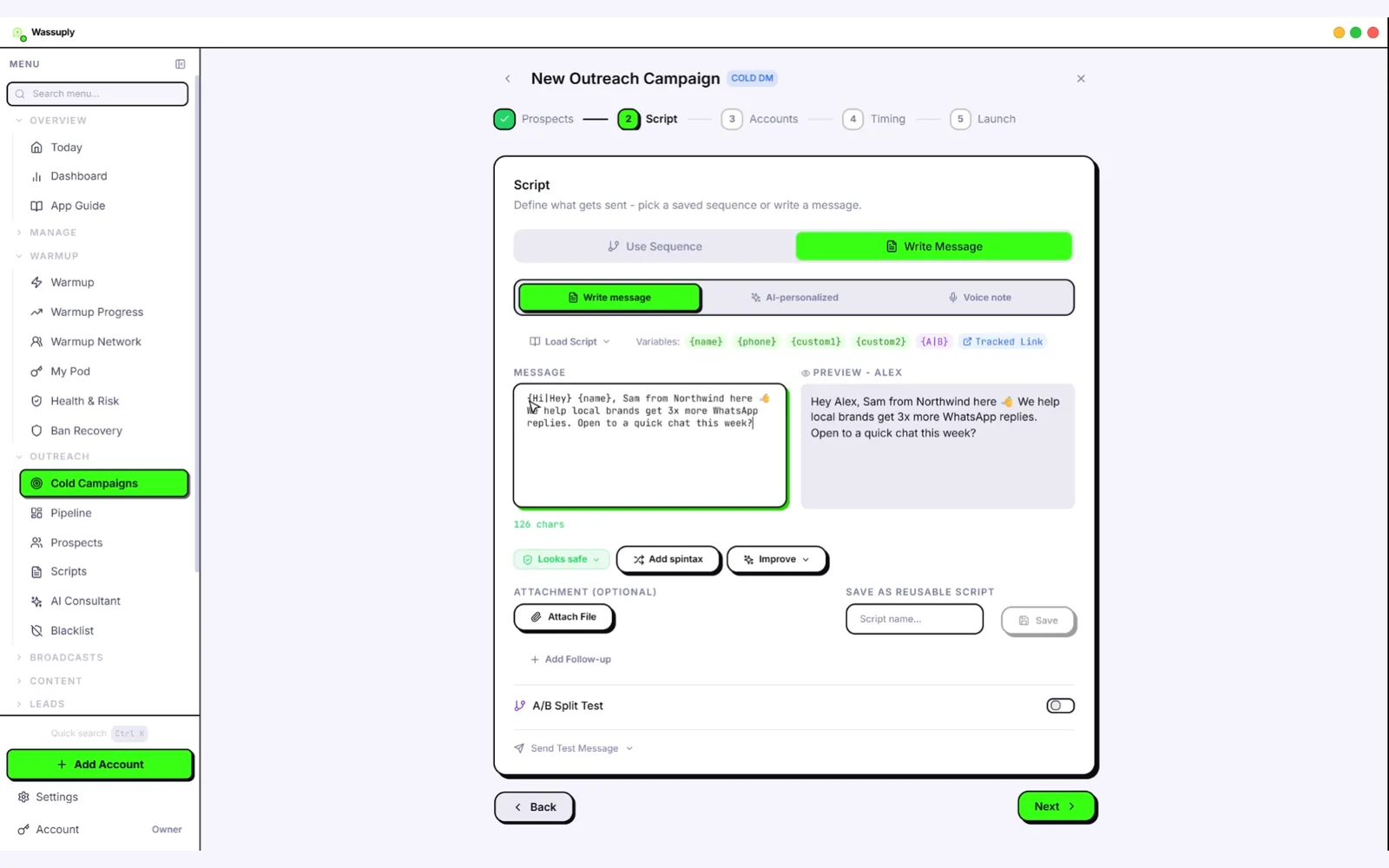
No tool removes ban risk, and a voice note won't make a cold list warm. The download and account are free; warming and sending need a licence (see pricing). For the bigger picture on why the channel suits sales, read why WhatsApp works for sales.
Use voice notes where they help, at a pace WhatsApp accepts
Warm your numbers, keep each one under a safe daily limit and add text or AI voice notes to follow-ups that stop the moment a prospect replies.
Free account. Windows 10 and 11. Warming and sending need an active licence.
Frequently asked questions
Are voice notes good for sales?
They can be, at the right moment. A short voice note carries tone and effort that text can't, which helps once a prospect has replied or with a warm lead. As a cold opener it is riskier: most people prefer text, and audio from a stranger can feel intrusive. No independent study shows voice notes raise reply rates, so test them on your own leads before relying on them.
Do voice notes get more replies than text?
There is no independent evidence either way. Claims that voice notes double replies come from vendors that sell voice tools, such as lemlist's case study on the ElevenLabs blog, which gives no sample or method. Those claims also measure LinkedIn, not WhatsApp. Split your own warm leads into a text-only group and a voice-note group, then compare replies and meetings.
How long should a sales voice note be?
Aim for under about 30 to 45 seconds. That is a working guideline, not a measured benchmark: long enough for one point and one ask, short enough that people finish it. Say the person's name and your reason in the first sentence, because transcripts and previews show the start, and send a one-line text summary alongside it.
Can you send AI voice notes on WhatsApp?
Yes. An AI voice note is speech generated from text, in a stock voice or a cloned one, and sent like any other voice message. Wassuply generates them through your own ElevenLabs key. Clone only your own voice, follow ElevenLabs' consent rules, disclose AI where the law requires it, and remember that WhatsApp's terms on bulk messaging and auto-messaging still apply.
Is it legal to clone a voice for sales messages?
It depends on whose voice and where you sell. ElevenLabs' Prohibited Use Policy bans cloning a living person's voice without their explicit and informed consent, and bans impersonating people or organisations outright. Some laws also require AI disclosure, and rules differ by country, so take legal advice for your market. The safe rule is simple: clone only your own voice.
Can people read WhatsApp voice notes instead of listening?
Yes, if they switch on transcripts. Since November 2024, WhatsApp can transcribe voice messages on the recipient's own device. Users turn it on in Settings, then Chats, then Voice message transcripts, and it launched in a few languages. Don't count on it being on: always add a one-line text so your point lands without audio.
Sources
- WhatsApp Blog: Making Voice Messages Better (March 2022)
- WhatsApp Blog: Introducing Voice Message Transcripts (November 2024)
- WhatsApp Blog: Voice messages just got more private (December 2023)
- YouGov: Do consumers prefer sending and receiving messages in audio or text form? (February 2024)
- YouGov: How many Britons like voice notes? (June 2022)
- Twilio: Talk over text, over a fifth of Brits prefer talking over typing (September 2026)
- ElevenLabs blog: lemlist doubles outbound reply rates at scale with AI voice notes (July 2025)
- Amplemarket: Duo now talks on LinkedIn (vendor launch page, checked October 2026)
- SalesRobot: LinkedIn DM system with voice notes (vendor playbook, checked October 2026)
- ElevenLabs: Prohibited Use Policy (October 2026)
- ElevenLabs: Terms of Service (October 2026)
- ElevenLabs docs: Professional Voice Cloning quickstart (checked October 2026)
- WhatsApp: Terms of Service (checked October 2026)
- TechCrunch: WhatsApp will curb the number of messages people and businesses can send without a response (October 2025)
Sources checked October 2026. Vendor figures are labelled as such in the text.