Facebook Messenger vs WhatsApp for business in 2026: reach, rules and when each one wins
Facebook Messenger vs WhatsApp for business has a clear default and real exceptions. In most markets WhatsApp wins: more users, a phone-number identity and room to follow up. Messenger wins with US and other Facebook-heavy audiences, for support through a Facebook Page and for conversations started by Facebook ads. For reaching people who haven't messaged you, a Page has almost no route, while WhatsApp works from phone numbers.
- Users: Meta's last official Messenger figure is 1.3 billion monthly users, from 2017. WhatsApp has more than 3 billion (April 2025), and UK regulator data shows Messenger shrinking.
- Rules: a Page can message freely for 24 hours after a person acts. After that it has only message tags, or paid Marketing Messages sent to subscribers, at most one a day, in 20 markets.
- Sponsored Messages are gone: Meta retired them in 2024, though many blog posts still describe them.
- Messenger wins for US and Facebook-heavy audiences, Page-based support and ad-driven inbound conversations.
- WhatsApp wins in WhatsApp-first markets and for outreach and follow-up by phone number, with its own policy limits and ban risk.
Facebook Messenger vs WhatsApp for business: the short verdict
WhatsApp is the stronger business channel in most countries, but Messenger still wins with US and other Facebook-heavy audiences, for support through a Facebook Page and for conversations started by ads. Sources for each row are in the sections below.
| If you need... | Choose | Why |
|---|---|---|
| To reach US adults who live on Facebook | Messenger | 71% of US adults use Facebook and 32% WhatsApp (Pew); Similarweb has Messenger ahead on several US measures |
| To answer customers who message your Facebook Page | Messenger | It is the Page's own inbox, and replies inside the 24-hour window can include offers |
| Ads that start conversations with Facebook users | Click-to-Messenger, tested against click-to-WhatsApp | A reply opens a window of up to 7 days and makes the person a Marketing Messages subscriber |
| Buyers in the UK, Germany, India, Brazil, Mexico or other WhatsApp-first markets | It is the top messaging app in 70 of the 100 countries Similarweb examined, and reaches 90% of UK online adults | |
| To contact people who haven't messaged you yet | A Page can only start chats with subscribers through paid Marketing Messages; WhatsApp works from a phone number | |
| Follow-ups over days or weeks | Ordinary accounts have no 24-hour window; Messenger needs a tag or a paid message once it closes | |
| Many conversations from several numbers, without the API | WhatsApp (with a warmer such as Wassuply) | Each number runs in its own session with its own daily limit |
The answer to "WhatsApp or Messenger for business?" is often both: Messenger for the people who find you on Facebook, WhatsApp for everyone you reach by phone number.
How many people use Facebook Messenger in 2026?
Nobody outside Meta knows: its last official Messenger figure is 1.3 billion monthly users, from September 2017, and independent data shows use falling in some markets.
Facebook announced that Messenger passed 1.3 billion monthly active users in September 2017 (VentureBeat, September 2017). That number is nine years old, so treat any stats page that presents it as current with care. Meta now reports only "daily active people" across all its apps: 3.60 billion on average in June 2026 (Meta Q2 2026 results, July 2026), with no Messenger split.
The UK: Messenger is shrinking
The UK regulator's data is the most neutral source we found. Ofcom's Online Nation 2025 report found Messenger reached 58% of UK online adults in May 2025. Its visitors fell 7% (2.1 million people) in a year, after a 9% fall the year before, and its daily reach dropped from 30% to 23%. WhatsApp reached 90%, and 74% used it daily (Ofcom, December 2025). Ofcom's count excludes messaging inside the main Facebook app.
The US, Canada and Australia: Messenger holds on
Similarweb's 2025 study of Android data puts Messenger second worldwide, with 545.52 million downloads a year and a 49.64% install rate, but first in no country (Similarweb, 2025). The country detail is more interesting. In the US, WhatsApp still ranks first, yet Messenger beats it on store downloads, monthly active users and daily stickiness. Messenger also leads on installs in Canada, and in Australia it leads on daily and monthly active users.
Pew's survey points the same way: 71% of US adults use Facebook and 32% use WhatsApp (Pew Research Center, November 2025). Pew didn't ask about Messenger separately. WhatsApp's own US figure is more than 100 million monthly users (TechCrunch, July 2024), against more than 3 billion worldwide (TechCrunch, May 2025).
Messenger also has a long record in business messaging: in 2019 Meta said people and businesses exchanged over 20 billion messages a month on Messenger (Meta for Developers, April 2019).
Messenger vs WhatsApp Business: full comparison
Here is how the two compare on the points that decide business use, as of October 2026.
| Factor | Facebook Messenger | |
|---|---|---|
| Latest official user figure | 1.3 billion monthly (September 2017) | More than 3 billion monthly (April 2025) |
| UK reach, May 2025 (Ofcom) | 58% of online adults, visitors down 7% in a year | 90% of online adults, 74% daily |
| Strongest markets (Similarweb, Android) | Ahead of WhatsApp on some US, Canadian and Australian measures | Top messaging app in 70 of 100 countries |
| Business identity | A Facebook Page | A phone number |
| Who can start a business chat | The person, or the Page through a paid Marketing Message to subscribers | Anyone with the number on ordinary accounts; WhatsApp's policy expects opt-in |
| Messaging window | 24 hours after the person acts, up to 7 days after a click-to-Messenger ad | None on ordinary accounts |
| After the window closes | Message tags for important updates, a 7-day Human Agent tag, or Marketing Messages | Not applicable on ordinary accounts; paid messages on the Business Platform |
| Paid business-started messages | Marketing Messages: subscribers only, one a day per Page, 20 markets | Business Platform paid messaging, past a $2 billion run rate (Q4 2025) |
| Click-to-message ads | Click-to-Messenger | Click-to-WhatsApp, revenue up 60% year over year (Q3 2025) |
| Main account risk | Sending restrictions for tag misuse; Meta's spam rules | Bans and temporary restrictions under WhatsApp's terms |
| Best for | US and Facebook-heavy audiences, Page support, ad-driven inbound | WhatsApp-first markets, follow-up by phone number, quotes and voice notes |
What can a business send on Messenger, and why is Page outreach so limited?
A Facebook Page can message someone freely for 24 hours after they act, send narrow tagged updates after that, and pay to message subscribers; it cannot start a conversation with a stranger.
The 24-hour standard messaging window
The standard messaging window is the period, usually 24 hours, in which a Page can send a person any message after that person's own action. Meta's Messenger Platform policy lists the actions that open it: messaging the Page, tapping a call-to-action button such as Get Started, using a Send to Messenger or Checkbox plugin, opening an m.me link on an existing thread or reacting to a message. If the person's first message follows a click-to-Messenger ad, the window can last up to 7 days. Inside the window, messages may be promotional.
Message tags
Once the window closes, a Page can only send tagged messages for approved use cases: "important and personally relevant updates", in Meta's words. Misusing a tag can restrict your ability to send messages. The Human Agent tag lets a person, not a bot, reply by hand for up to 7 days, which suits support cases that take time.
Why outreach from a Page is constrained
Every route on Messenger starts with the person: the window opens with their action, tags follow an existing conversation, and Marketing Messages need them to subscribe. We found no route in Meta's documentation for a Page to send the first message to someone who has never interacted with it. That is our reading of the docs rather than a Meta statement, but it means Messenger is an inbound channel for businesses.
WhatsApp works differently because its identity is a phone number. If you hold someone's number, an ordinary WhatsApp or WhatsApp Business account can open a chat without them messaging first. The rules still apply: WhatsApp's Business Messaging Policy says businesses may only contact people who gave them their number and opted in, and its Terms of Service list "bulk messaging, auto-messaging, auto-dialing, and the like" as impermissible. WhatsApp is also testing a monthly cap on messages to people who haven't replied (TechCrunch, October 2025). Number-based outreach is possible, but it carries ban risk and privacy-law duties. We look at the evidence in does WhatsApp outreach work?
What do people on Reddit report about Messenger vs WhatsApp?
Individual reports, anecdotes rather than data:
- r/agency, 2024: an agency sent about 400 cold messages in a week from its business Page, through Messenger and Instagram, to businesses with dated websites and got no replies; the messages showed a single tick, so OP suspected they were never delivered. OP said the same offer gets about 20 to 25% response rates on LinkedIn. (thread)
- r/SMMA, 2025: Facebook outreach that used to work for OP stopped when an older account was suspended: "After sending 3 messages (which I typed manually) my account got suspended." After ID verification, it was suspended again after a few more. (thread)
- r/LeadGeneration, 2025: a commenter who says they manage over $2M a year in Google Ads spend reported that clients using a WhatsApp button as the site's conversion action "are getting great results from it". Another commenter said it was an expensive way for small clients to find leads. (thread)
- r/whatsapp, 2024: a business messaged its Meta lead-form leads on WhatsApp, through the API, minutes after each form was filled. The poster says most replied, but the number was banned for spam and the appeal was rejected within seconds. (thread)
What happened to Sponsored Messages, and what are Marketing Messages?
Sponsored Messages are gone: Meta retired them in 2024 and replaced them with Marketing Messages, which go only to subscribers, at most one a day per Page, in 20 markets.
Sponsored Messages were an ad format that pushed a message into the inbox of people who had chatted with a Page before. Meta's Marketing API v20.0 changelog ended creation of the format in v20.0 and in all API versions from 19 August 2024, and its Marketing Messages FAQ dates the deprecation to 31 July 2024. Many 2026 blog posts still describe Sponsored Messages as live.
Marketing Messages on Messenger are Meta's paid replacement: messages that let a Page start a chat, but only with people who have subscribed. According to Meta's Marketing Messages FAQ (checked October 2026):
- Who can receive them: people who click and reply to a click-to-Messenger ad, people matched to Facebook profiles from a customer list you upload, and people who accept an opt-in template.
- How often: a Page can send each person at most one marketing message a day.
- Where: through tech providers, the product is limited to businesses in 20 locations: Australia, Brazil, Chile, Colombia, Hong Kong, India, Indonesia, Israel, Malaysia, Mexico, New Zealand, Peru, the Philippines, Saudi Arabia, Singapore, Taiwan, Thailand, the United Arab Emirates, the United States and Vietnam. The UK and EU countries are not on the list.
- Cost: you pay per message delivered, billed alongside your Meta ads.
Note the customer-list route: being matched from an upload makes someone a "subscriber" without an explicit opt-in on Messenger, so check your own consent obligations before using it. In short, messenger marketing in 2026 means ads that start conversations, replies inside the window and paid messages to subscribers. It does not include cold outreach.
Click-to-Messenger vs click-to-WhatsApp ads: which should you run?
Run click-to-Messenger ads when your audience lives on Facebook and you want replies to become subscribers; run click-to-WhatsApp ads when you want the conversation, and the phone number, on WhatsApp.
Both are click-to-message ads. On the Q4 2022 earnings call, Mark Zuckerberg said click-to-message ads across Messenger, Instagram Direct and WhatsApp had reached a $10 billion revenue run rate (February 2023). Meta's recent comments focus on WhatsApp: CFO Susan Li said click-to-WhatsApp ad revenue grew 60% year over year in Q3 2025. In Q4 2025 she said US click-to-message revenue grew more than 50% and paid messaging on WhatsApp passed a $2 billion annual run rate. Meta does not break out Messenger, so no public figure compares the two ad types head to head.
- Click-to-Messenger: the person stays in Facebook's app, the window can run up to 7 days from their first message, and replying makes them a Marketing Messages subscriber where that product is available.
- Click-to-WhatsApp: the chat opens in WhatsApp, where the person already talks to friends and family, and the conversation lives on your phone number. The WhatsApp Business app lists Facebook Page buttons among its free entry points, so a Page can route visitors to WhatsApp without an ad.
- How to choose: split a test budget across both, then compare cost per conversation and, more importantly, cost per sale.
When does Messenger win over WhatsApp?
Messenger is the better choice in three situations: US and other Facebook-heavy audiences, support for customers who already message your Page, and inbound conversations driven by Facebook ads.
US and Facebook-heavy audiences
If your buyers are American and on Facebook, Messenger meets them where they are. Pew's 71% for Facebook against 32% for WhatsApp and Similarweb's US figures both point that way, and Australia looks similar on active users. Ask a sample of your customers which app they use before you commit.
Page-based support
If customers already find you on Facebook and message your Page, Messenger is the natural support channel. Every message they send opens a 24-hour window for full answers, including offers, and the Human Agent tag covers cases that need a few days.
Ad-driven inbound
If Facebook ads bring in your conversations, click-to-Messenger ads keep the whole loop inside Meta: the ad starts the chat, the window runs up to 7 days, and in the 20 eligible markets the person can then receive one Marketing Message a day.
When WhatsApp wins instead
WhatsApp wins where it is the default app: across much of the Americas, Europe and Africa in Similarweb's data, and in the UK, where Ofcom found 90% reach against Messenger's 58%. It also wins whenever the work starts from a phone number rather than a Page, as with outreach, follow-ups over several weeks and conversations that need quotes, documents and voice notes. The same split applies on Instagram, as our Instagram DM vs WhatsApp comparison shows. For the full channel scorecard, see cold outreach in 2026, every channel ranked, and for the account question, WhatsApp Business vs WhatsApp.
How to start WhatsApp outreach safely
Start with one warmed number and the people who already asked about you on Facebook, then add volume slowly.
- 1Create a free account and install the appCreate a free Wassuply account, download the Windows app and connect the WhatsApp number your leads will talk to.
- 2Warm the number for at least 15 daysA brand-new number needs at least 15 days of warm-up before its first campaign, and 30 is better. See how the WhatsApp warmer works.
- 3Start with leads who askedPeople who filled in your lead form, messaged your Page or replied to an ad and gave you their number. Stay under each number's safe daily limit and turn on Smart Send.
- 4Stop on reply and honour opt-outsLet follow-ups stop when someone replies and answer opt-outs straight away. Our guide to avoiding WhatsApp bans covers pacing and warning signs.
Where Wassuply fits next to Messenger
Wassuply is a Windows desktop app for warming up WhatsApp numbers and running cold WhatsApp outreach from unlimited numbers, sold as a one-time $397 lifetime licence during early access. It covers the number-based side of your messaging; it doesn't send Messenger messages or manage your Page inbox.
It drives ordinary WhatsApp and WhatsApp Business numbers through WhatsApp Web sessions, so there is no Business API, no Meta verification, no template approval and no per-message fee. Each number gets its own isolated session, browser fingerprint and optional proxy, and one licence covers unlimited numbers.
New numbers warm up by chatting with each other using lines from 10 built-in chat packs, on random 30-120 second gaps inside the hours you set. Health & Risk gives each number a safe daily limit of 30 to 250 messages depending on its age and a live 0-100 risk score; with Smart Send turned on, sending slows at 60 and pauses at 80.
To follow up with leads from your lead forms or ads, import them as a CSV with phone, name, custom1 and custom2 columns, with no need to save them as contacts. Messages go out on random 30-90 second gaps in batches of 10, outside any blackout hours you set. Follow-ups stop the moment someone replies, opt-outs get an automatic reply, and replies land on a Pipeline CRM board.
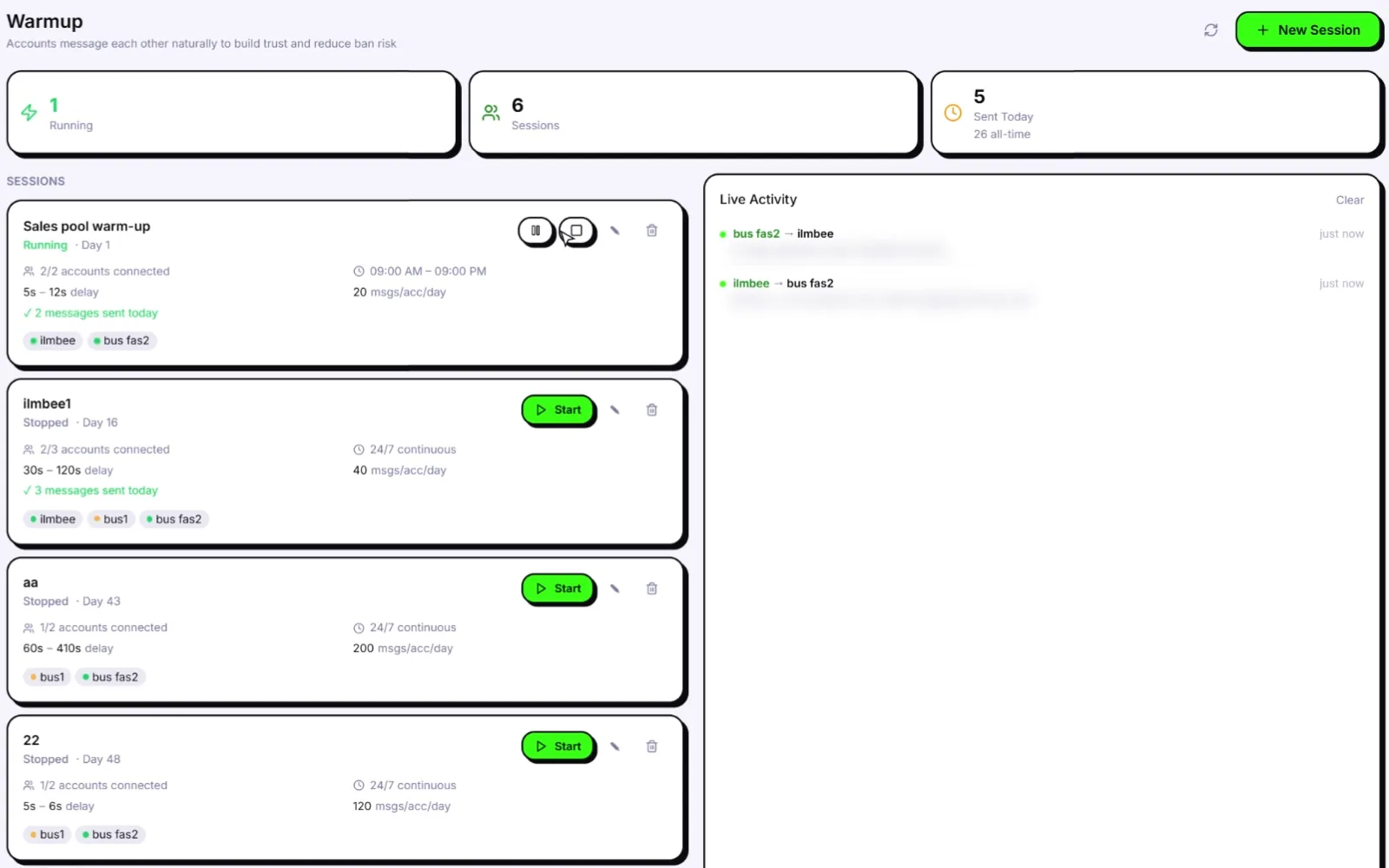
It won't turn a Page audience into opted-in WhatsApp contacts, and no tool removes ban risk. The app is free to download; warming and sending need a licence, currently $397 one-time for lifetime access.
Reach leads by phone number, not just through your Page inbox
Warm WhatsApp numbers, see a safe daily limit for each one and run follow-ups that stop on reply, from one Windows app.
Free account. Windows 10 and 11. Warming and sending need an active licence.
Frequently asked questions
Is Messenger or WhatsApp better for business?
WhatsApp is the better default in most countries: it has more than 3 billion monthly users, tops Similarweb's ranking in 70 of 100 countries and lets you message people by phone number. Messenger is the better choice when your customers are Facebook-heavy, as in much of the US, when they already message your Facebook Page, or when Facebook ads drive your conversations. Many businesses run both.
How many people use Facebook Messenger in 2026?
Nobody outside Meta knows exactly. Meta's last official Messenger figure is 1.3 billion monthly active users, from September 2017, and it now reports only combined daily users across all its apps: 3.60 billion in June 2026. Independent data points to decline in some markets. Ofcom found Messenger's UK reach at 58% of online adults in May 2025, with visitors down 7% in a year.
What is the 24-hour rule on Facebook Messenger?
It is the standard messaging window in Meta's Messenger Platform policy. After a person messages your Page or takes a similar action, you can send them any message, including promotions, for 24 hours. The window can last up to 7 days after a click-to-Messenger ad. Outside it, you can only use message tags for important personal updates, the Human Agent tag or paid Marketing Messages.
Are Sponsored Messages still available on Facebook?
No. Meta ended creation of the Sponsored Messages ad type in Marketing API v20.0, and in every API version from 19 August 2024; its Marketing Messages FAQ dates the deprecation to 31 July 2024. The replacement is Marketing Messages on Messenger, which only reach people who subscribed, are capped at one a day per Page and are available to businesses in 20 markets.
Should I run click-to-Messenger or click-to-WhatsApp ads?
Run click-to-Messenger ads where your audience lives on Facebook and you want replies to become Marketing Messages subscribers. Run click-to-WhatsApp ads where WhatsApp is the default app, or when you want the conversation and the phone number on WhatsApp. Meta doesn't publish results by app, so split a test budget and compare cost per conversation and cost per sale.
Can a Facebook Page message people who haven't messaged it?
Only in narrow, paid cases. Under Meta's Messenger Platform policy, the window opens with the person's action, such as messaging the Page, tapping a button or replying to an ad. Marketing Messages can start chats, but only with subscribers: people who replied to a click-to-Messenger ad, accepted an opt-in or were matched from your uploaded customer list. A Page has no route for messaging strangers.
Sources
- VentureBeat: Facebook Messenger passes 1.3 billion monthly active users (September 2017)
- Meta Platforms: Second quarter 2026 results, Form 8-K Exhibit 99.1 (July 2026)
- Ofcom: Online Nation 2025 (December 2025)
- Similarweb: Most Popular Messaging Apps in 2025 (March 2025, updated August 2025)
- Pew Research Center: Americans' Social Media Use 2025 (November 2025)
- TechCrunch: WhatsApp now has more than 3 billion users a month (May 2025)
- TechCrunch: Mark Zuckerberg says WhatsApp has 100M monthly active users in the US (July 2024)
- Meta for Developers: Messenger at F8 2019 (April 2019)
- Meta for Developers: Messenger Platform and IG Messaging API policy (checked October 2026)
- Meta for Developers: Marketing API v20.0 changelog (2024)
- Meta for Developers: Marketing Messages on Messenger FAQ (checked October 2026)
- Meta Platforms: Q4 2022 earnings call transcript (February 2023)
- The Motley Fool: Meta Platforms Q3 2025 earnings call transcript (October 2025)
- The Motley Fool: Meta Q4 2025 earnings call transcript (January 2026)
- WhatsApp Business: Business app features (checked October 2026)
- WhatsApp: Business Messaging Policy (September 2026)
- WhatsApp: Terms of Service (checked October 2026)
- TechCrunch: WhatsApp will curb the number of messages people and businesses can send without a response (October 2025)
Sources checked October 2026. Vendor figures are labelled as such in the text.