Instagram DM vs WhatsApp in 2026: which to use for outreach, and when to switch
Instagram DM vs WhatsApp depends on the job. For creators, e-commerce and visual brands reaching new people, Instagram wins: the profile does the convincing, and DMs drive Instagram's growth. For quotes, voice notes, follow-ups and closing a sale, WhatsApp usually wins. For cold outreach at volume, neither is easy: Instagram's official API has no cold-DM route, and WhatsApp needs warmed numbers.
- Scale: Instagram has 3 billion monthly users (September 2025) and WhatsApp more than 3 billion (April 2025), so reach is not the deciding factor.
- Cold DMs on Instagram: messages from non-followers land in Requests, Meta publishes no daily DM cap, and its API only replies inside a window the user opens.
- Instagram wins for discovery and first touch, especially when your posts and Reels are the proof.
- WhatsApp wins once someone wants a price: quotes, documents, voice notes, follow-ups and the move to a sale.
- Best setup: get found and make first contact on Instagram, then move to WhatsApp when the person asks or taps a click-to-WhatsApp link.
Instagram DM vs WhatsApp: the short verdict
Use Instagram to get found and to make the first touch, and use WhatsApp once the person wants a price, a quote or a real conversation. The table covers the common cases; sources for each point are in the sections below.
| If you need... | Choose | Why |
|---|---|---|
| To be found by people who don't know you yet | Reels and recommendations reach non-followers; WhatsApp is built around people who already have your number | |
| Proof before the first reply (portfolio, products, comments) | The profile does the convincing before anyone accepts your message | |
| Automated replies to comments and DMs people start | Instagram (official API) | Private replies to comments and the 24-hour window are designed for this |
| To send a quote, a PDF or a voice note and follow up | The chat sits in the main chat list, and ordinary accounts have no 24-hour window | |
| Buyers in markets where WhatsApp is the default | It is the top messaging app in 70 of the 100 countries Similarweb examined | |
| Reaching US adults on one app | Pew counts 50% of US adults on Instagram against 32% on WhatsApp | |
| Many conversations from several numbers, without the API | WhatsApp (with a warmer such as Wassuply) | Each number has its own session and daily limit; Instagram has no official cold-DM route |
Neither channel offers a clean, official route for cold messages at volume. That is the honest starting point for any cold DM Instagram vs WhatsApp comparison, and the sections below show why.
How many people use Instagram and WhatsApp in 2026?
Both apps are at the same scale: Instagram has 3 billion monthly users and WhatsApp more than 3 billion. Instagram reached 3 billion monthly active users in September 2025, as announced by Mark Zuckerberg and Instagram head Adam Mosseri (TechCrunch, September 2025). WhatsApp passed 3 billion monthly users in April 2025 (TechCrunch, May 2025).
The inbox matters more than the headline number. Announcing the milestone, Mosseri said "almost all of our growth has been driven by DMs, Reels, and recommendations", and that Instagram would reorient the app around those three. For a business, that means DMs are where Instagram is putting its weight.
Where you sell changes the picture. In the US, Pew found that 50% of adults use Instagram and 32% use WhatsApp (Pew Research Center, November 2025). Worldwide, Similarweb's Android data puts WhatsApp as the top messaging app in 70 of the 100 countries it examined (Similarweb, 2025). Instagram isn't part of that messaging ranking.
Business messaging is big on both, but Meta doesn't split it by app. It says about a billion people message a business each week across its messaging apps (Meta, September 2023). The widely repeated "150 million people message a business on Instagram every month" has no Meta source we could find, so we don't use it.
Instagram DMs vs WhatsApp: full comparison table
Here is how the two channels compare on the points that decide outreach, as of October 2026.
| Factor | Instagram DMs | |
|---|---|---|
| Monthly users | 3 billion (September 2025) | More than 3 billion (April 2025) |
| US adults who use it (Pew, 2025) | 50% | 32% |
| What you need to message someone | Their handle | Their phone number |
| Where a first message from a stranger lands | Message requests, not marked as Seen until accepted | The main chat list |
| Proof the recipient sees | Your profile, posts, Reels and comments | A name, a photo and, on the Business app, a business profile and catalogue |
| Official API for business-started chats | None found; replies only inside a window the user opens | Business Platform, with opt-in required by WhatsApp's policy |
| Published daily message limit | None for the app; API rate limits only | None published; a cap on unanswered messages is in testing |
| Rich formats | Photos, videos, Reels, voice messages, links | Voice notes, documents, photos, catalogue links |
| Paid route to a conversation | Click-to-Instagram Direct ads | Click-to-WhatsApp ads |
| Main account risk | Spam enforcement under Meta's Community Standards | Bans and temporary restrictions under WhatsApp's terms |
| Best for | Discovery, creators, e-commerce, visual brands | Quotes, follow-ups, closing, WhatsApp-first markets |
Where do cold Instagram DMs land, and is there a daily limit?
DMs from non-followers land in Requests rather than the main inbox, and Meta publishes no daily DM cap for the Instagram app.
Message requests
Meta's developer documentation describes the rule from the receiving account's side: messages from people who are not followers of an account sit in the Requests folder and aren't marked as Seen until the request is accepted. Requests that stay inactive for 30 days stop showing up in the API (Meta for Developers, checked October 2026).
In practice, a cold DM waits until the person decides to open it, and they can check who you are before they do. That is why Instagram outreach works best for businesses whose grid, Reels and comments already answer "who is this, and are they any good?"
Daily DM limits
Meta publishes no daily DM limit for the Instagram app. What it does publish are rate limits for its messaging API, counted per professional account: 300 Send API calls a second for text, 10 a second for audio and video, and 750 private replies to post and Reel comments an hour. It also warns that sending too many messages to a single thread can trigger rate limiting.
The "safe limits" on automation-tool blogs, such as 20 to 50 DMs a day for a new account, are vendor estimates with no Meta document behind them. Meta's spam policy targets posting, engaging and account creation "at very high frequencies", whether manual or automated, without giving a number.
WhatsApp is no clearer. It publishes no daily limit for ordinary accounts and is testing a monthly cap on messages to people who haven't replied, without saying what the cap is (TechCrunch, October 2025). Every limit you see, including the safe daily limits in Wassuply's own Health & Risk panel, is an estimate. Our guide to WhatsApp sending limits covers what is and isn't known.
Can you send cold DMs through the Instagram API?
As we read Meta's documentation, no: the official Instagram Messaging API only lets a business message people who acted first, inside a window they open.
Meta's Messenger Platform and IG Messaging API policy defines a standard messaging window: the period, usually 24 hours, in which a business can send any message after a person's own action. The actions it lists include messaging the account, tapping a call-to-action button, opening an ig.me link on an existing thread and reacting to a message. If the person's first message follows a click-to-Direct ad, the window can last up to 7 days. Messages inside the window may be promotional.
Outside the window, the options are narrow. A Human Agent tag lets a person, not a bot, reply by hand for up to 7 days, and other tags are reserved for "important and personally relevant updates", with restrictions for misuse. The API can also send a private reply to someone who commented on your content, which is why comment-to-DM automations fit the rules: the comment comes first.
We found nothing in Meta's documentation that lets a business send the first message to someone who hasn't interacted with it. That is our reading of the docs, not a statement from Meta, but the practical result is clear: cold Instagram DMs are sent by hand from the app, or by unofficial tools that Meta's spam rules can catch.
WhatsApp has its own version of this rule. Its Business Messaging Policy says businesses may only contact people who gave them their number and opted in, and its Terms of Service list "bulk messaging, auto-messaging, auto-dialing, and the like" as impermissible. Cold WhatsApp outreach carries real ban risk, and privacy laws apply to every number on your list. We compare the official and unofficial WhatsApp routes in Wassuply vs the WhatsApp API.
Instagram or WhatsApp for business: which suits you?
Instagram suits businesses whose work sells on sight; WhatsApp suits conversations that need to go further than a first reply.
Instagram wins when the profile is the proof
- Creators and personal brands. Your Reels and posts are the pitch, so a DM from a profile people recognise reads as a follow-on, not a cold approach.
- E-commerce and product brands. Product shots, try-ons and customer comments sit one tap away from the message.
- Visual services. Designers, photographers, salons, interior and wedding businesses: anyone whose before-and-after does the selling.
- Reaching strangers. Recommendations and Reels put you in front of non-followers. WhatsApp is built around people who already have your number.
WhatsApp wins when the conversation needs to go further
- Quotes and documents. A price, a PDF proposal or a catalogue link sits in a thread the buyer checks next to their friends and family.
- Voice notes. WhatsApp users sent 7 billion voice messages a day on average, WhatsApp said in March 2022, its latest figure. Voice isn't for everyone: in YouGov's 17-market survey, 66% preferred sending text and 7% audio (YouGov, February 2024), so offer a voice note rather than lead with one. Our guide to voice notes in outreach covers when they help.
- Follow-ups. Ordinary WhatsApp accounts have no 24-hour window, so a follow-up next week is possible. Keep it to one or two, and stop the moment someone replies.
- The move to a sale. A phone number is a lasting contact. Delivery questions, payment details and after-sales stay in one thread.
- WhatsApp-first markets. Where WhatsApp is the default, buyers often expect to finish the conversation there. More in why WhatsApp works for sales.
The honest split for instagram dm outreach vs WhatsApp: Instagram is better at starting conversations with strangers, and WhatsApp is better at finishing them. That is why the two work best together.
What do people on Reddit report about Instagram DMs vs WhatsApp?
Reddit reports on cold Instagram DMs are mixed. They are individual anecdotes, not data:
- r/agency, 2024: one commenter said they closed three web-development clients in two months from Instagram, but that it takes at least 50 to 60 DMs a day. Another aims for 100 DMs a day to accounts with under 10,000 followers and a website. (thread)
- r/LeadGeneration, 2025: a 3D artist got no replies to personalised cold emails, while a friend who cold-DMs brands on Instagram gets a good response. The top reply argued that email feels like work, while "getting a DM feels like being discovered". (thread)
- r/SocialMediaMarketing, 2025: an agency's DMs to brand accounts went unseen, probably stuck in hidden message requests. Repliers suggested commenting and following first, and one said they learned the hard way that "the limit is low, like 10 a day". (thread)
- r/coldemail, 2025: a freelancer sending cold DMs from six aged Instagram accounts with real content was getting replies, until all six were disabled one by one with no warning or appeal. The top reply, from someone who says they work at an outreach company, called Instagram DMs the wrong channel for B2B services. (thread)
- r/agency, 2024: about 400 cold messages in a week through Messenger and Instagram, offering businesses a free website redesign, got no replies. OP said the same approach gets about 20 to 25% response rates on LinkedIn. (thread)
How to combine them: find people on Instagram, talk on WhatsApp
The flow that fits both platforms' rules is Instagram for discovery and the first touch, then WhatsApp once the person asks for more or taps a click-to-WhatsApp link.
- 1Get found with posts and ReelsContent does the prospecting. People who see your work come to your profile, and the profile answers the first questions before any message.
- 2Make the first touch on InstagramReply to comments and story replies first, since the person has already acted. If you DM someone cold, keep it short and specific: one observation, one question, no link.
- 3Offer WhatsApp when they askA question about price, availability or details is the moment to switch. The WhatsApp Business app lists short links and QR codes among its free entry points, with click-to-WhatsApp ads as the paid option; put the short link in your bio.
- 4Run the conversation on WhatsAppSend the quote, add a voice note if it suits the person, follow up once if they go quiet, then stop.
An illustrative first WhatsApp message after someone asked on Instagram:
The paid version of this flow is the click-to-message ad, and Meta is pushing it. Zuckerberg said click-to-message ads across Messenger, Instagram Direct and WhatsApp had reached a $10 billion revenue run rate (Meta Q4 2022 earnings call, February 2023). On the Q3 2025 call, CFO Susan Li said click-to-WhatsApp ad revenue grew 60% year over year (October 2025).
If Facebook is a bigger part of your audience than Instagram, read our Messenger vs WhatsApp for business comparison. For email next to WhatsApp, see WhatsApp vs email cold outreach.
How to start WhatsApp outreach safely
Start with one warmed number and people who expect to hear from you, then add volume slowly.
- 1Create a free account and install the appCreate a free Wassuply account, download the Windows app and connect the WhatsApp number you will move Instagram conversations to.
- 2Warm the number for at least 15 daysA brand-new number needs at least 15 days of warm-up before its first campaign, and 30 is better. See how the WhatsApp warmer works.
- 3Message people who asked firstStart with people who messaged you on Instagram, tapped your WhatsApp link or replied to an ad. Stay under the number's safe daily limit and turn on Smart Send.
- 4Stop on reply and honour opt-outsLet follow-ups stop when someone replies, answer opt-outs straight away and move interested people to a quote or a call. Our guide to avoiding WhatsApp bans has the rest.
Where Wassuply fits next to Instagram
Wassuply is a Windows desktop app for warming up WhatsApp numbers and running cold WhatsApp outreach from unlimited numbers, sold as a one-time $397 lifetime licence during early access. It handles the WhatsApp half of the flow above; it does not send Instagram DMs.
It runs ordinary WhatsApp and WhatsApp Business numbers through WhatsApp Web sessions, so there is no Business API, no Meta verification and no template approval. Each number gets its own isolated session, browser fingerprint and optional proxy.
Before a number messages anyone, it warms up by chatting with your other numbers using lines from built-in chat packs, on random 30-120 second gaps inside the hours you set. Health & Risk then gives it a safe daily limit of 30 to 250 messages depending on its age, plus a live 0-100 risk score.
For the conversation itself, import the people who asked as a CSV with phone, name, custom1 and custom2 columns, without saving them as contacts. Write the message with merge fields and spintax, or add a voice note; AI voice notes use your own ElevenLabs key. Follow-ups stop the moment someone replies, and replies land on a Pipeline CRM board.
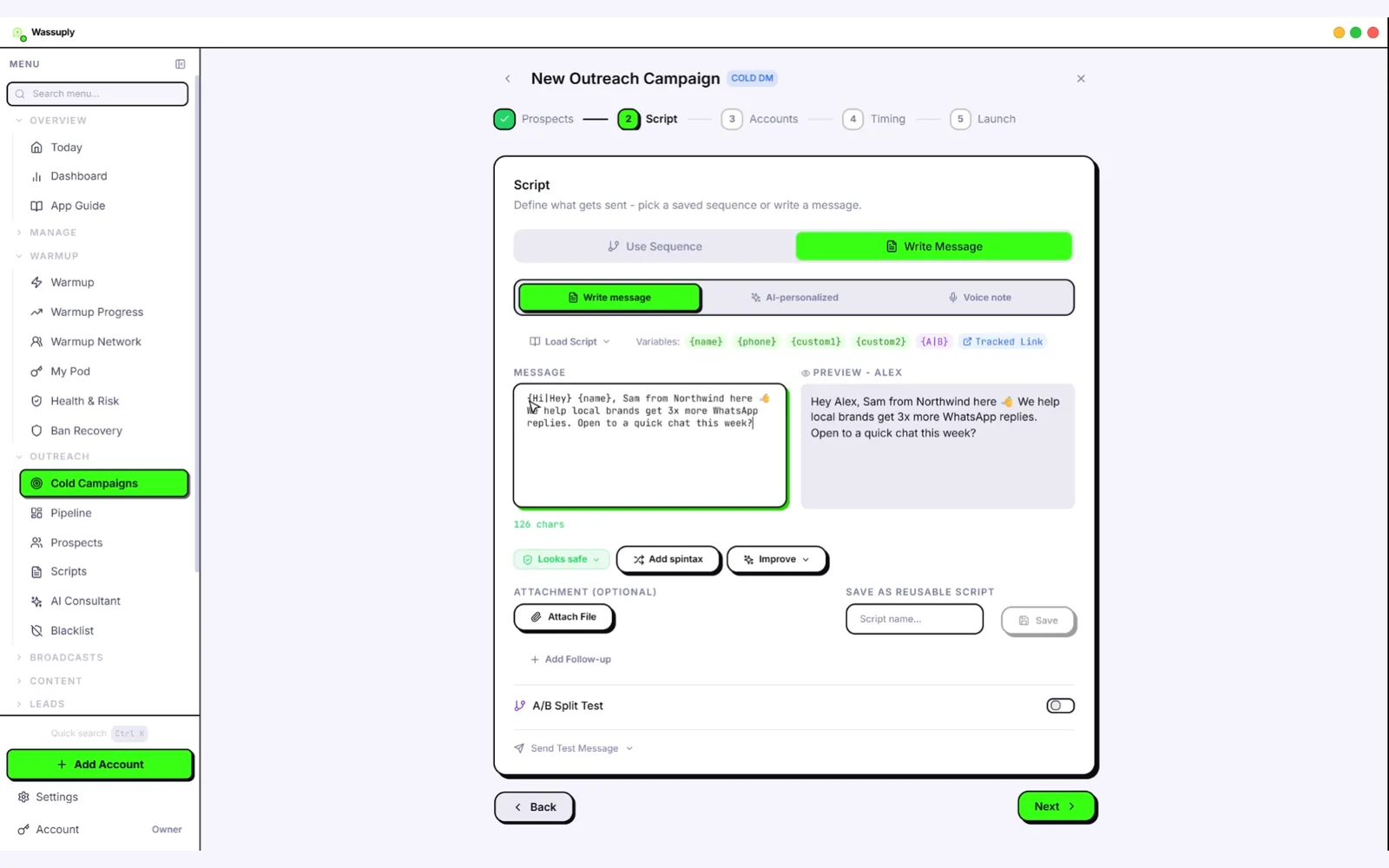
It won't make a cold list warm, and no tool removes ban risk. The app is free to download; warming and sending need a licence, currently $397 one-time for lifetime access.
Turn Instagram interest into WhatsApp conversations
Warm a WhatsApp number, keep it inside a safe daily limit and run follow-ups that stop when someone replies, from one Windows app.
Free account. Windows 10 and 11. Warming and sending need an active licence.
Frequently asked questions
Is it better to use Instagram or WhatsApp for business?
Use both, for different stages. Instagram is better for being discovered and making first contact, because your posts and Reels show people who you are before they reply. WhatsApp is better once someone is interested: sending a quote, a document or a voice note, following up and closing. Where WhatsApp is the default messaging app, many buyers will expect to finish the conversation there.
Is there a daily limit on Instagram DMs?
Meta publishes no daily DM limit for the Instagram app. It only publishes API rate limits, such as 300 Send API calls a second for text and 750 private replies to comments an hour per professional account. The 20 to 50 DMs a day that automation vendors call safe are their own estimates, not Meta figures. Meta's spam rules target activity at very high frequencies without giving a number.
Why do my Instagram DMs go to message requests?
Instagram files messages from people outside someone's network as message requests rather than in the main inbox. Meta's developer documentation says messages from people who are not followers of an account sit in the Requests folder and aren't marked as Seen until the request is accepted. A cold DM therefore waits until the person chooses to open it, which is why a convincing profile matters.
Can you send cold DMs with the Instagram API?
Not as we read Meta's documentation. The Instagram Messaging API works inside a 24-hour standard messaging window that opens only when the person acts first, for example by messaging you, tapping a button or replying to a click-to-Direct ad. It can also send private replies to people who commented on your posts. We found no official route for a business to message someone who has not interacted with it.
How do I move a conversation from Instagram to WhatsApp?
Wait until the person asks for something that needs more room, such as a price, availability or details, then offer WhatsApp in one line and share your WhatsApp short link. The WhatsApp Business app generates a short link and QR code you can put in your Instagram bio. Click-to-WhatsApp ads do the same job with paid reach. Confirm in the first WhatsApp message what they asked for.
Can you get banned for cold DMs on Instagram or WhatsApp?
Yes, on both. Meta's spam rules cover high-frequency activity on Instagram, and WhatsApp's Terms of Service list bulk messaging and auto-messaging as impermissible, with bans and temporary restrictions as enforcement. Lower the risk by messaging people who expect to hear from you, keeping volumes small, warming new WhatsApp numbers for at least 15 days and stopping as soon as someone asks you to.
Sources
- TechCrunch: Instagram now has 3 billion monthly active users (September 2025)
- TechCrunch: WhatsApp now has more than 3 billion users a month (May 2025)
- Pew Research Center: Americans' Social Media Use 2025 (November 2025)
- Similarweb: Most Popular Messaging Apps in 2025 (March 2025, updated August 2025)
- Meta: Hosting the Second Edition of Conversations in India (September 2023)
- Meta for Developers: Instagram Messaging overview (checked October 2026)
- Meta for Developers: Messenger Platform and IG Messaging API policy (checked October 2026)
- Meta for Developers: Messenger Platform and Instagram API rate limits (checked October 2026)
- Meta Transparency Center: Spam (Community Standards, checked October 2026)
- Meta Platforms: Q4 2022 earnings call transcript (February 2023)
- The Motley Fool: Meta Platforms Q3 2025 earnings call transcript (October 2025)
- WhatsApp Blog: Making Voice Messages Better (March 2022)
- YouGov: Do consumers prefer sending and receiving messages in audio or text form? (February 2024)
- WhatsApp Business: Business app features (checked October 2026)
- WhatsApp: Business Messaging Policy (September 2026)
- WhatsApp: Terms of Service (checked October 2026)
- TechCrunch: WhatsApp will curb the number of messages people and businesses can send without a response (October 2025)
Sources checked October 2026. Vendor figures are labelled as such in the text.