Telegram vs WhatsApp for business: which wins for outreach, broadcast and sales in 2026
Telegram vs WhatsApp for business comes down to audience and format. Telegram wins for broadcast channels, crypto and tech communities, and buyers in markets such as Russia, Kazakhstan and Uzbekistan. WhatsApp wins for one-to-one sales conversations almost everywhere else: it has more than 3 billion monthly users to Telegram's 1 billion (both 2025 figures) and reaches 90% of UK online adults to Telegram's 9% (Ofcom, 2025).
- Choose WhatsApp for one-to-one sales conversations in most countries. It is the default messenger for far more of your prospects.
- Choose Telegram for broadcast channels, large public groups, bots, crypto and tech audiences, and CIS markets such as Russia, Belarus and Kazakhstan.
- Cold outreach on Telegram is fragile: bots can't start chats, a reported account can only message people who saved its number, and since March 2025 users can charge Stars to receive messages from non-contacts.
- WhatsApp has rules too: its Terms ban bulk messaging and auto-messaging, so new numbers need warming and slow, personal sending.
- Many teams use both: a Telegram channel to build the audience, WhatsApp for the conversation that closes the deal.
Telegram vs WhatsApp for business: the short verdict
For most businesses that sell one to one, WhatsApp is the better choice. Telegram is better when you are building an audience, running a community or selling into the markets where it is the default messenger. The table sorts the common cases.
| If you need... | Choose | Why |
|---|---|---|
| One-to-one sales conversations in most countries | It was the top messaging app in 70 of the 100 countries Similarweb examined (Android data, 2025) | |
| Buyers in Russia, Belarus, Kazakhstan, Uzbekistan or Moldova | Telegram | The same Similarweb study ranks Telegram first in those markets, among others |
| A broadcast channel for news, offers or alerts | Telegram | Telegram says a channel can have an unlimited number of subscribers (as of October 2026) |
| A crypto, Web3 or developer community with bots | Telegram | Groups hold up to 200,000 members, and the Bot API is free |
| First messages to people who don't know you yet | WhatsApp, warmed and paced | Telegram limits reported accounts to saved contacts; WhatsApp restricts spam too, so warm up and send slowly |
| Many conversations from several numbers, without the API | WhatsApp (with a warmer such as Wassuply) | Each number warms up and sends inside its own daily limit, from one Windows PC |
| UK customers | 90% of UK online adults used it in May 2025, against 9% for Telegram (Ofcom, 2025) |
In the US, neither app is the default. Pew found that 32% of US adults use WhatsApp (2025) and did not ask about Telegram, so compare texting as well in SMS vs WhatsApp for outreach. Our cold outreach channel scorecard puts all the channels side by side.
How many people use Telegram vs WhatsApp in 2026?
WhatsApp has about three times Telegram's audience: more than 3 billion monthly users against 1 billion, the latest figure each company has published. Both are company figures, not independent audits.
Telegram says it passed 1 billion monthly active users in 2025. Pavel Durov announced it on 19 March 2025, up from 950 million in July 2024, according to TechCrunch (March 2025). The "500 million daily users" figure on some stats sites has no Telegram source, so we leave it out.
Mark Zuckerberg said on Meta's Q1 2025 earnings call that more than 3 billion people use WhatsApp every month (TechCrunch, May 2025). Monthly active users count anyone who opened the app at least once in a month, which tells you who you could reach, not who reads business messages.
Where each app leads
Reach depends on country. Similarweb's 2025 study of Android usage put WhatsApp top in 70 of the 100 countries it examined, and Telegram top in Belarus, Kazakhstan, Moldova, Russia and Uzbekistan, among others.
The UK shows how lopsided it can be elsewhere. Ofcom's Online Nation 2025 report found that WhatsApp reached 90% of UK online adults (44.2 million) in May 2025, while Telegram reached 9% (4.3 million), up 26% on the year before. Telegram's UK audience also skews: 67% of its adult visitors were men, and 40% were aged 18 to 34 (Ofcom, 2025).
Where does Telegram beat WhatsApp for business?
Telegram beats WhatsApp at one-to-many: public channels, very large groups and bots, plus a home advantage in several CIS markets. If your plan is to build an audience rather than start conversations, start there.
Broadcast channels and big groups
A Telegram channel is a one-way feed that anyone can follow, and Telegram says a channel can have an unlimited number of subscribers, while groups can hold up to 200,000 members (Telegram FAQ, checked October 2026). WhatsApp added its own one-way Channels in June 2023, and its groups hold up to 1,024 users (WhatsApp, November 2022).
The bigger difference is intent. WhatsApp's 2019 white paper said about 90% of messages on the service are one-to-one and stated plainly: "Our service is not a broadcast platform." Telegram, by contrast, treats broadcasting as a core use.
Bots and automation
A Telegram bot is an automated account built on Telegram's free Bot API, and Telegram says the platform hosts more than 10 million bots. Free bots can send about 30 messages a second for bulk notifications. Paid broadcasts go up to 1,000 a second at 0.1 Stars per message above the free rate, but only for bots with at least 100,000 monthly active users and a balance of 100,000 Stars (Telegram Bots FAQ, as of October 2026).
On WhatsApp, third-party automation belongs on the official Business Platform (the API), and the Terms of Service list "bulk messaging, auto-messaging, auto-dialing, and the like" as impermissible on ordinary accounts.
Crypto, tech and CIS audiences
Crypto, Web3 and developer communities often gather in public Telegram groups and channels, helped by the open bot platform and Telegram Stars, the in-app currency. If those are your buyers, or they live in the CIS markets above, they already expect to find you on Telegram.
Telegram vs WhatsApp business features: full comparison
Side by side, Telegram is the stronger broadcast and automation platform, and WhatsApp is the bigger and more personal one-to-one network. Rules and limits change, so this reflects each company's pages as of October 2026.
| Factor | Telegram | |
|---|---|---|
| Monthly users | 1 billion+ (Telegram, 2025) | 3 billion+ (Meta, 2025) |
| Where it leads | Belarus, Kazakhstan, Moldova, Russia, Uzbekistan, among others (Similarweb, 2025) | Top messenger in 70 of 100 countries studied (Similarweb, 2025) |
| UK reach | 9% of online adults (Ofcom, May 2025) | 90% of online adults (Ofcom, May 2025) |
| Business account | Telegram Business, since 31 March 2024, included with paid Telegram Premium | WhatsApp Business app, free since January 2018; Meta Verified from $14 a month |
| Business tools | Opening hours, location, quick replies, greeting and away messages, start page, chatbots | Business profile, catalogue, labels, quick replies, greeting and away messages, short links |
| How people reach you | A public username, no phone number needed | Your phone number, a QR code or a short link |
| Groups | Up to 200,000 members | Up to 1,024 users |
| Broadcast | Channels with unlimited subscribers | One-way Channels since 2023; broadcast caps tested in 2025 |
| Bots and automation | Free Bot API; bots can't start chats | Third-party automation through the paid Business Platform (API) only |
| Cold first messages | Reported accounts limited to saved contacts; recipients may charge Stars | Terms ban bulk messaging; a cap on messages to non-repliers is in testing |
| Published daily sending limit | None | None for ordinary accounts |
| Spam enforcement | Temporary limits; appeal through @SpamBot | Restrictions or bans; review request in the app |
| Best for | Channels, communities, bots, CIS markets, crypto and tech | One-to-one sales and support in most markets |
What is Telegram Business, and how does it compare with WhatsApp Business?
Telegram Business is a set of business tools that Telegram added to ordinary accounts on 31 March 2024, included with Telegram Premium, its paid subscription. It covers the same basics as the WhatsApp Business app, with more room for bots.
Telegram's launch post lists opening hours, location, quick replies, automated greeting and away messages, a custom start page and chatbot support. On 30 April 2025 Telegram went further and let Business users connect third-party chatbots, including AI bots, to run their account's chats.
The WhatsApp Business app is older and free. WhatsApp launched it in January 2018 for small businesses, and Meta's features page lists a business profile, a catalogue, labels, quick replies, greeting and away messages, and short links. Meta's last published figure is 200 million monthly Business app users (June 2023), and Meta Verified costs from $14 a month (TechCrunch, June 2024).
Automation is the real split. Telegram lets a third-party bot answer for your business account; on WhatsApp, the Business app's automation is Meta's own, and third-party bots need the Business Platform. Our guide to WhatsApp Business vs personal WhatsApp covers the app in detail, and Wassuply vs the WhatsApp API covers the Platform.
Can you do cold outreach on Telegram?
You can message strangers on Telegram, but it is a fragile channel for cold outreach. Bots can't start conversations, reports quickly limit an account, and some recipients charge you to get through.
- Bots can't open a chat. Telegram's developer docs say it plainly: "Bots can't start conversations with users." A person has to message the bot first or add it to a group.
- Reports limit your account. Telegram's spam FAQ says that when people report your messages and moderators agree, your account is limited. A limited account can only message people who have saved its number as a contact, though it can still reply to anyone who writes first.
- Limits get longer. A first offence usually brings a limit of "a few days or so", and repeat offences longer blocks. Some virtual and VoIP numbers can trigger a harsher response. Appeals go through @SpamBot.
- No published limit. Telegram publishes no daily message limit for new accounts, so any figure you read online is a guess.
- Recipients can charge you. Since 7 March 2025, users can set a fee for incoming messages from people outside their contacts, paid in Telegram Stars. For some recipients, a cold message now costs money.
- The Terms forbid spam. Telegram's Terms of Service rule out using the service to "send spam or scam users".
Telegram outreach works better as pull than push: post useful content in a channel, take part in relevant groups, and let a bot or your Business account handle the people who write in.
What do people on Reddit report about Telegram vs WhatsApp outreach?
We found no Reddit thread reporting results from Telegram cold outreach. What turns up are accounts hitting the limits above. These are individual anecdotes, not data:
- r/Telegram, 2024: a user found they couldn't message more than 3 people who weren't mutual contacts, and the only reply suggested checking @SpamBot in case the account had been limited. (thread)
- r/Telegram, 2025: another user could only message mutual contacts even though @SpamBot reported no restrictions: "it won't let me send messages to people not in mutual contacts". (thread)
- r/Telegram, 2025: a brand-new account on a TextNow virtual number was banned within 3 hours. Replies blamed the virtual number and suggested a staged start: nothing for 24 hours, then joining groups without posting, then posting, then adding friends. (thread)
- r/b2bmarketing, 2025: on the WhatsApp side, asked whether WhatsApp could replace the email newsletter for B2B, the top-voted reply said they would be annoyed and block it, writing "Whatsapp is for people I want to talk to." Others asked how you would even find a prospect's number. (thread)
Is WhatsApp better than Telegram for sales conversations?
Yes, in most markets. Sales happen in one-to-one chats, which is what WhatsApp is built around, and it is where most of your prospects already spend their messaging time.
That closeness cuts both ways: a relevant, personal message gets noticed, and an irrelevant one feels intrusive. The best measured read-rate data we know of, Chatarmin's 2026 benchmark of 382 brands' opt-in campaigns, found a 72% median open rate; we found no comparable Telegram benchmark. Cold messages will do worse than opt-in campaigns, as our post on why WhatsApp works for sales explains.
WhatsApp has rules of its own. In 2019 it said it removed over two million accounts a month for bulk or automated behaviour. In October 2025 it announced a test of a monthly cap on messages to people who haven't replied, without saying what the cap is, after testing a limit on broadcast messages in March 2025. Our guide to avoiding WhatsApp bans covers how to stay inside those lines.
Telegram or WhatsApp for marketing: using both
You don't have to pick one. A Telegram channel can build the audience while WhatsApp carries one-to-one conversations with the people who show interest.
How to start WhatsApp outreach safely
If WhatsApp is the right channel for your conversations, start slowly and with numbers you can afford to lose.
- 1Create a free accountSign up and download Wassuply on Windows 10 or 11. The account and download are free; connecting numbers, warming and sending need an active licence.
- 2Use dedicated outreach numbersKeep your main business number out of outreach, and decide whether each new number runs on the Business app or personal WhatsApp before you warm it.
- 3Warm each new number for at least 15 daysThirty days is better. Our WhatsApp warm-up timeline shows what each week looks like.
- 4Start small and personalSend a short, relevant first message to a small list, stay inside each number's daily limit and honour every opt-out. Check the privacy rules in our guide to cold WhatsApp and GDPR.
Where Wassuply fits
Wassuply is a Windows desktop app for warming up WhatsApp numbers and running cold WhatsApp outreach from unlimited numbers, sold as a one-time $397 lifetime licence during early access. It works with WhatsApp only, not Telegram, so it covers the one-to-one half of the split above.
- Many numbers, kept apart. Each number runs in its own isolated WhatsApp Web session with its own browser fingerprint and an optional proxy, so many numbers can run side by side on one PC.
- Warm-up first. Your numbers chat with each other using lines from 10 built-in chat packs, with random 30-120 second gaps inside the hours you set.
- Limits per number. Health & Risk suggests a safe daily limit of 30 to 250 messages by number age, next to a live 0-100 risk score.
- Paced campaigns. Import a CSV, write with merge fields and spintax, and send with random 30-90 second gaps. Follow-ups stop the moment someone replies.
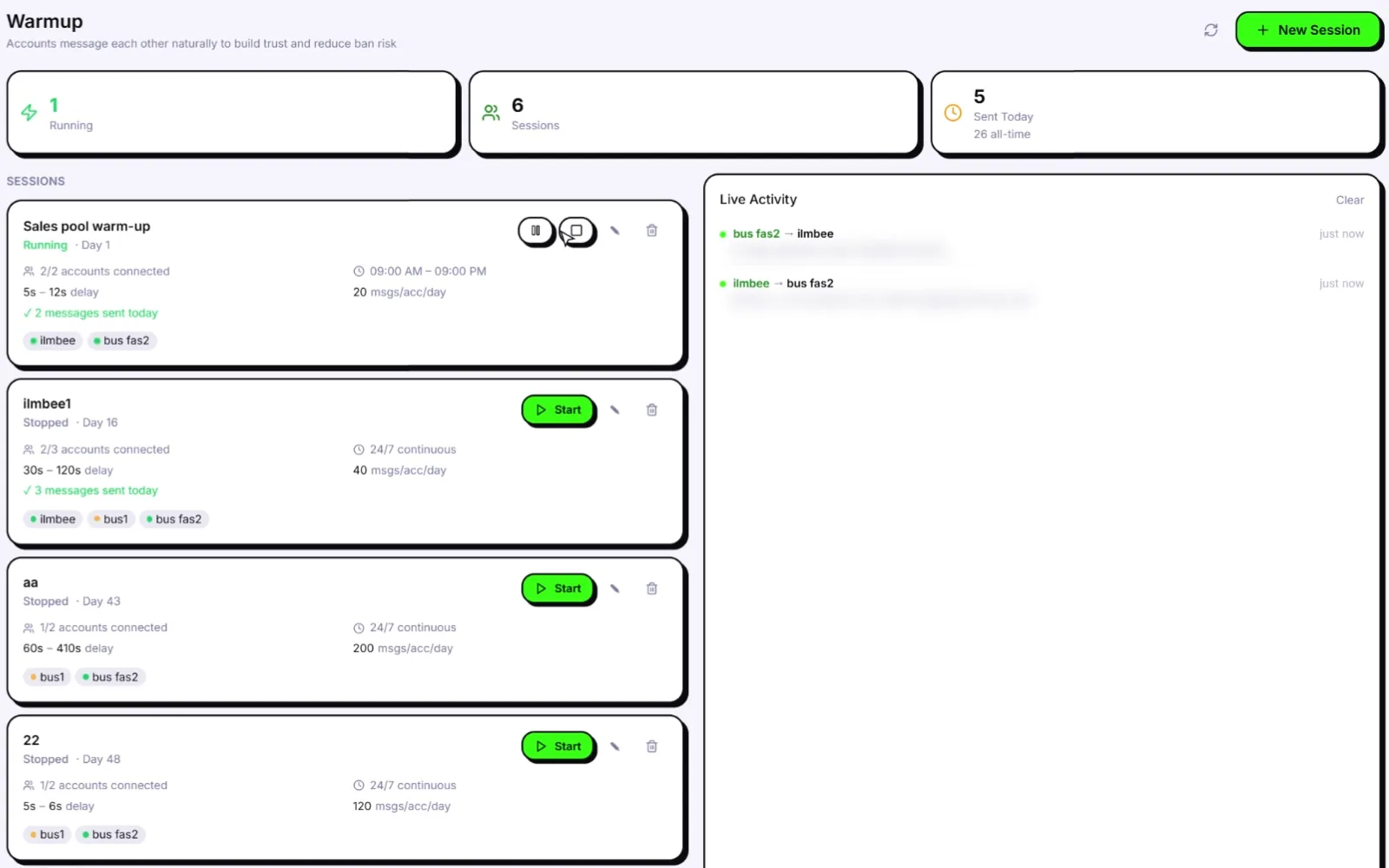
It won't build you a Telegram community, and it can't remove ban risk. If you have decided WhatsApp should carry your sales conversations, it gives each number a steadier start.
Keep the community on Telegram, close the deal on WhatsApp
Wassuply warms and paces the WhatsApp numbers that carry your one-to-one sales conversations, all from one Windows app.
Free account. Windows 10 and 11. Warming and sending need an active licence.
Frequently asked questions
Is Telegram better than WhatsApp for business?
Only for some businesses. Telegram is better for broadcast channels, large public communities, bots, and buyers in markets where it leads, such as Russia, Belarus, Kazakhstan, Uzbekistan and Moldova. WhatsApp is better for one-to-one sales and support in most other countries, because far more of your customers use it: more than 3 billion monthly users against Telegram's 1 billion, both 2025 figures from the companies themselves.
Can I send cold messages on Telegram?
You can, but it rarely lasts. Telegram's spam FAQ says that if people report your messages, your account is limited and can only message people who have saved your number, for a few days on a first offence and longer after that. Bots can't start conversations at all, and since March 2025 users can charge Stars for messages from non-contacts.
Does Telegram have a business account like WhatsApp Business?
Yes. Telegram Business launched on 31 March 2024 and turns an ordinary account into a business account with opening hours, location, quick replies, greeting and away messages, a custom start page and chatbot support. It comes with Telegram Premium, the paid subscription. The WhatsApp Business app is free to download, with some paid extras such as Meta Verified.
What are Telegram Star Messages?
Star Messages, launched in March 2025, let Telegram users set a fee in Telegram Stars, the app's in-app currency, for every message they receive from people outside their contacts. For outreach, it means some recipients will charge you to reach their inbox, so a cold Telegram message can cost money. Someone who sets a fee is also telling you they don't want unsolicited messages.
Which countries use Telegram more than WhatsApp?
Similarweb's 2025 study of Android usage ranks Telegram as the top messaging app in Belarus, Kazakhstan, Moldova, Russia and Uzbekistan, among others, while WhatsApp leads in 70 of the 100 countries studied. In the UK, Ofcom found that 9% of online adults used Telegram in May 2025, against 90% for WhatsApp. Where your buyers live matters more than any feature.
Is WhatsApp or Telegram safer for business outreach?
Neither is safe for careless outreach. Telegram limits reported accounts to messaging saved contacts, and WhatsApp's Terms list bulk messaging and auto-messaging as impermissible and allow suspension. On WhatsApp, warming a new number for at least 15 days, sending slowly and writing personal first messages lowers the risk without removing it. On both apps, honour every opt-out and follow privacy law.
Sources
- Telegram: Press Info (2025)
- TechCrunch: Telegram founder Pavel Durov says app now has 1B users (March 2025)
- TechCrunch: WhatsApp now has more than 3 billion users a month (May 2025)
- Similarweb: Most Popular Messaging Apps In 2025 (2025)
- Ofcom: Online Nation 2025 (December 2025)
- Pew Research Center: Americans' Social Media Use 2025 (November 2025)
- Telegram: Frequently Asked Questions (checked October 2026)
- Telegram: Introducing Telegram Business (March 2024)
- Telegram: Extra-Secure Group Calls, Automated Accounts, and More (April 2025)
- Telegram: Bots, an introduction for developers (checked October 2026)
- Telegram: Bots FAQ (checked October 2026)
- Telegram: Spam FAQ (checked October 2026)
- Telegram: Star Messages, Pinned Gifts, Verification Platform 2.0, and More (March 2025)
- Telegram: Terms of Service (checked October 2026)
- WhatsApp Blog: Introducing WhatsApp Channels (June 2023)
- WhatsApp Blog: Communities now available (November 2022)
- WhatsApp Business: WhatsApp Business App Features (checked October 2026)
- WhatsApp Blog: Introducing the WhatsApp Business App (January 2018)
- TechCrunch: WhatsApp Business crosses 200M MAUs (June 2023)
- TechCrunch: Meta Verified for WhatsApp businesses, plans from $14 a month (June 2024)
- WhatsApp: Terms of Service (effective January 2021)
- WhatsApp: Stopping Abuse, How WhatsApp Fights Bulk Messaging and Automated Behavior (February 2019)
- TechCrunch: WhatsApp will curb the number of messages people and businesses can send without a response (October 2025)
- TechCrunch: WhatsApp will soon limit number of broadcast messages users and businesses can send (March 2025)
- Chatarmin: WhatsApp Open Rate Benchmark 2026 (September 2026)
Sources checked October 2026. Vendor figures are labelled as such in the text.